
Most email programmes segment by recency, frequency, and monetary value, send the same campaign to each bucket with a different discount, and call it personalisation. It isn't — it's the same email at four price points.
"A segment that only changes the discount isn't segmentation. It's a pricing decision you've dressed up as relevance."
— Nitesh Kasma, Co-Founder — Brand Strategy & Client Growth
What is RFM good for, and where does it stop?
RFM is a value model. It's genuinely useful for deciding how much you're willing to spend to keep someone, which lists deserve a win-back budget, and where your revenue concentration risk sits. Keep it for those jobs.
What it can't tell you is why someone bought, what problem they were solving, or what they'd plausibly buy next. A first-time buyer of a gift set and a first-time buyer of a refill pack land in the same RFM cell and need completely different emails — one needs a reason to buy for themselves, the other needs a replenishment reminder timed to run-out.
Which segments actually change the message?
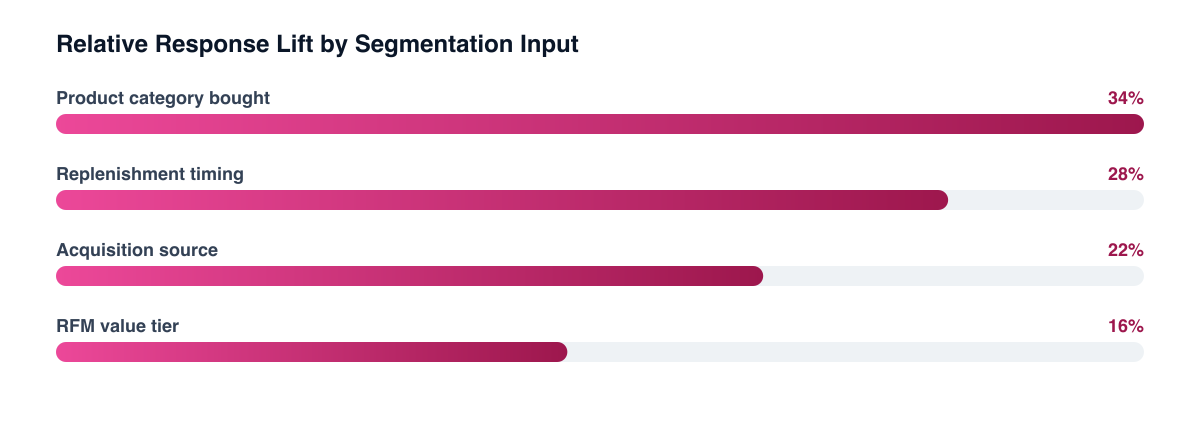
Four, in rough order of how much they earn their build cost:
- First product purchased. The strongest predictor of the next relevant product you have. It should drive the entire post-purchase sequence, not just the receipt.
- Replenishment position. Where the customer is in their consumption cycle for a consumable. A reminder that arrives at day 45 of a 60-day product is a nudge; the same email at day 20 is noise, and at day 90 it's a win-back.
- Acquisition source and offer. Someone who came in on a heavy first-order discount behaves differently from someone who came in at full price from organic search. Sending both the same repeat-purchase offer trains the wrong half of your list.
- Engagement without purchase. Subscribers who open and click and never buy are either a pricing objection or a product-fit problem. They deserve a different email than the one that assumes intent.
Each of these changes what the email says, not just who receives it — which is the test for whether a segment is worth maintaining.
Build the segment only if it changes the copy If two segments would receive the same message with a different subject line, they're one segment. Every additional segment is a maintenance cost paid every campaign.
How much segmentation is too much?
There's a real ceiling, and it arrives sooner than most teams expect. Every segment splits your volume, and small segments produce unstable results — a 400-person cell will show a wild open rate difference that means nothing. If a segment can't produce a readable result, you can't optimise it, and it becomes a rule nobody revisits.
There's also a deliverability angle. Heavier segmentation usually means more sends per subscriber across overlapping campaigns, and send volume against a partly-disengaged list is exactly the pattern that erodes sending reputation. Segment to send better, not to find more excuses to send.
What does this look like in practice?
Start from the flows, not the campaigns. Post-purchase, replenishment, and browse-abandon flows carry most of the revenue in a mature programme and are where the segment actually determines the content — the structural point behind any good Klaviyo flow build. Rebuild those three by first product and replenishment cycle before touching the campaign calendar.
Then measure per-segment on revenue per recipient rather than open rate, and hold the segments against a control that gets the generic version. Some will fail to beat it. That's a result worth having: it tells you the segment describes a difference that doesn't matter to the customer, and you can retire it. Pair the read with cohort analysis so you can see whether a segment's lift persists beyond the first repeat order.
Related guides
- Email and Retention for D2C: The Complete Guide
- Klaviyo Flow Strategy: The Sequences That Carry the Revenue
- Email Marketing for D2C: Turning a List Into Revenue
- D2C Customer Segmentation That Actually Drives Decisions
Segmentation earns its keep when the message changes, and costs you when it doesn't. Rebuild the flows around what someone bought and when they'll need it again before adding another value tier — it's usually the highest-return week of work available in a CRM and retention programme.
PART OF OUR SERVICE
CRM & Retention
PROOF FROM A CLIENT
+45% repeat purchase rate
from 22% to 32% of customers purchasing again within 90 days · Beauty & Personal Care
How a Beauty D2C Brand Lifted Repeat Purchase Rate by 45% with a Loyalty Program Rebuild→Want a free marketing audit?
We'll review your tracking, ad accounts, and funnel — and show you exactly where the gaps are.
Get Your Free Audit →