

Deliverability failures are quiet. Nothing bounces, nothing errors, the send report looks normal — the messages just stop arriving where anyone reads them.
"Mailbox providers don't tell you they've started routing you to spam. Your engagement metrics tell you, and only if you know which ones to watch."
— Nitesh Kasma, Co-Founder — Brand Strategy & Client Growth
What actually determines whether you land in the inbox?
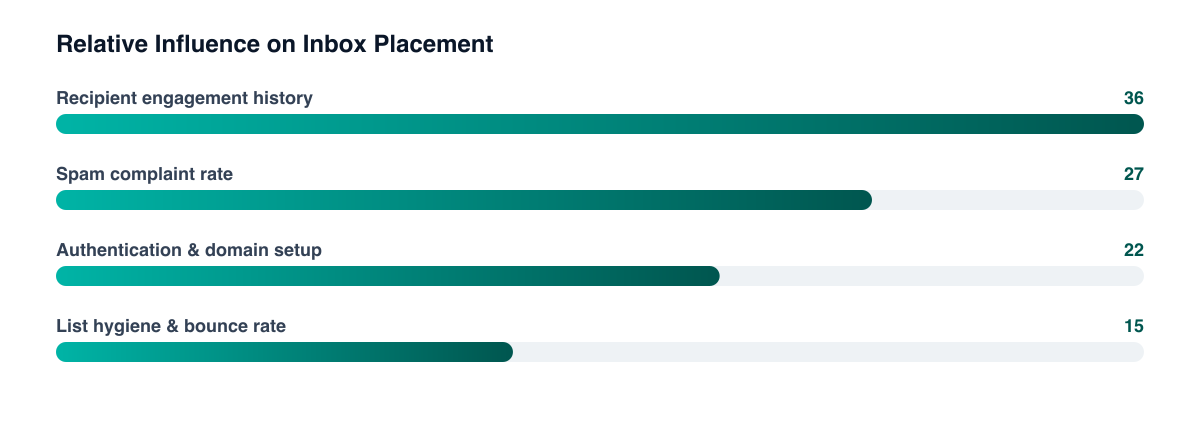
Authentication gets you permission to be judged; engagement decides the verdict. SPF, DKIM, and DMARC records prove the mail genuinely came from your domain — Google and Yahoo now require them for bulk senders, and without them delivery problems are guaranteed rather than likely. But authentication alone doesn't earn the inbox. Once you're authenticated, mailbox providers weigh how recipients behave: opens, replies, deletions without opening, and above all spam complaints.
That's why a technically flawless setup can still degrade. The sending domain's reputation is built from recipient behaviour over time, and a few large sends to disengaged addresses can undo months of good signal.
Which practices quietly cause the damage?
- Mailing the full list on every campaign. Sending to addresses that haven't opened in a year tells providers your mail is unwanted, and that judgement gets applied to your engaged subscribers too.
- Making unsubscribe hard. Every hidden or multi-step unsubscribe converts a would-be unsubscribe into a spam complaint, which is far more damaging.
- Buying or importing lists, including from an acquisition or a partner co-registration. These addresses never consented to you specifically, and complaint rates reflect it.
- Sending marketing from your transactional domain, which puts order confirmations and password resets at risk of the same reputation hit.
- Ramping volume too fast on a new sending domain, before any positive engagement history exists to offset it.
Complaint rate is the metric to alert on Mailbox providers publish thresholds around a small fraction of a percent, and crossing them has abrupt consequences. Most email platforms surface complaint rate per send — it deserves a threshold alert far more than open rate does.
How do you repair a damaged reputation?
Slowly, and by sending less. Cut the list to the segment that has genuinely engaged recently — opened or clicked in the last 30 to 60 days — and send only to them for several weeks. Volume drops, and so does total revenue in the short term, but consistent positive engagement is the only input that rebuilds reputation. Once placement recovers, reintroduce broader segments gradually rather than resuming the old full-list cadence.
Run a sunset flow permanently after that: subscribers who haven't engaged in a defined window get a final re-permission message, then get suppressed. The list shrinks, and revenue per send usually goes up — because the messages are now reaching people who see them.
Doesn't a smaller list mean less revenue?
Only if list size were the thing generating revenue, which it isn't. A disengaged address contributes nothing except a reputation drag on every other address you send to. The metric worth optimising is revenue per delivered email, not list size — and that number typically improves after a hygiene pass, which is the clearest evidence that the removed contacts were costing more than they returned. It's the same logic that makes segmentation beat batch-and-blast on every measure that touches the P&L.
Related guides
- Klaviyo Email Flow Strategy: The Flows That Actually Earn
- Email Marketing for D2C Revenue
- D2C Customer Segmentation That Drives Revenue
- The D2C Email and Retention Guide
Deliverability isn't a one-time setup task that a checklist closes out. It's an ongoing consequence of list practices, and it's the foundation every other retention program is built on — because a flow that doesn't arrive doesn't convert regardless of how well it's written.
PART OF OUR SERVICE
CRM & Retention
PROOF FROM A CLIENT
+45% repeat purchase rate
from 22% to 32% of customers purchasing again within 90 days · Beauty & Personal Care
How a Beauty D2C Brand Lifted Repeat Purchase Rate by 45% with a Loyalty Program Rebuild→Want a free marketing audit?
We'll review your tracking, ad accounts, and funnel — and show you exactly where the gaps are.
Get Your Free Audit →