How a Beauty D2C Brand Lifted Repeat Purchase Rate by 45% with a Loyalty Program Rebuild
KEY RESULT
+45% repeat purchase rate
from 22% to 32% of customers purchasing again within 90 days
90-Day Repeat Purchase Rate
32%
from 22%
Email/SMS Attributed Revenue
27%
from 14%
Loyalty Program Enrollment
38%
from 0%
12-Month Customer Lifetime Value
$134
from $86
The Challenge
This beauty brand had solid first-purchase conversion and healthy new customer volume, but 90-day repeat purchase rate had been flat at 22% for over a year. Post-purchase marketing consisted of a generic "thanks for your order" email and a monthly promotional blast to the full list — no segmentation, no loyalty mechanic, no lifecycle logic.
Leadership had already tried the default fix: more discounting. Bigger promo codes to bring lapsed customers back. It moved a short-term spike in orders each time but never changed the underlying repeat rate, and margin was eroding with every campaign.
There was no cohort visibility either — nobody could say whether newer customers were retaining better or worse than older ones, or whether any acquisition channel was producing more loyal buyers than another. Retention was being managed by instinct, one campaign at a time.
What We Did
1. Cohort and Segmentation Audit
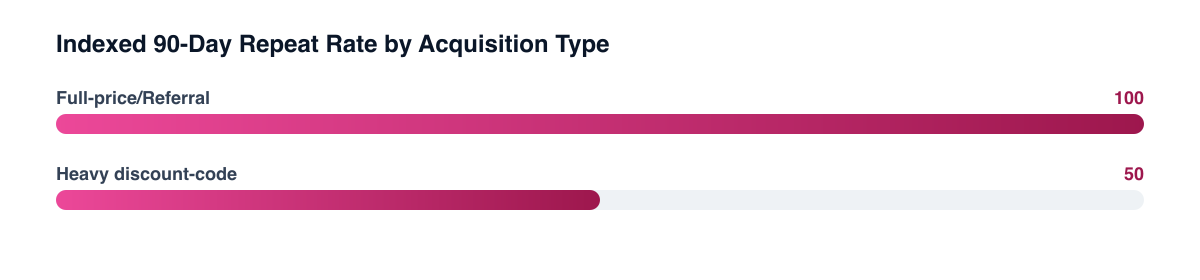
We rebuilt a cohort view from 18 months of order history, segmented by acquisition month and channel. This surfaced two things immediately: customers acquired through heavy first-order discount codes retained at roughly half the rate of full-price and referral customers, and the steepest drop-off for every cohort happened between order 1 and order 2 — not later.
That pinpointed exactly where to intervene: the window between a customer's first and second purchase was the highest-leverage moment in the entire lifecycle, and nothing was currently happening there.
2. Tiered Loyalty Program Design
We designed a three-tier program (Glow, Glow+, Glow VIP) using the brand's own order data to set thresholds, not a generic template. Entry tier gave an immediate, tangible perk at signup — free shipping plus early access to new launches — rather than a slow-accruing points balance. Points still accrued in the background, but the reward threshold was set so a customer's second purchase alone could unlock their first redemption, addressing the "unreachable reward" problem directly.
The top tier was designed around access rather than discounts: early product previews and a direct restock alert line, reserved for the top 15% of spenders by 12-month value.
3. Lifecycle Flow Integration
The loyalty program was woven directly into existing email and SMS flows rather than living solely on an account page. The post-purchase flow now confirmed points earned and showed the exact balance needed for the next reward. A dedicated "second purchase" flow — informed by the cohort audit — used tier perks and a personalized product recommendation instead of a blanket discount. Tier-upgrade emails were added as a standalone trigger, which became one of the highest open-rate flows in the account within the first month.
The Results
Within four months, enrolled customers were repeat-purchasing at a meaningfully higher rate than non-enrolled customers, pulling the blended 90-day repeat purchase rate from 22% to 32% — a 45% relative lift. Email and SMS-attributed revenue nearly doubled as a share of total revenue, driven by the new second-purchase and tier-upgrade flows rather than by sending more promotional volume.
The compounding effect showed up in 12-month customer lifetime value, which rose from $86 to $134. Critically, this came without an increase in average discount depth — the program replaced blanket promotions with a structure that gave the brand's best customers a reason to stay that didn't require training the entire list to wait for the next sale.
“We assumed retention was an email frequency problem — just send more, discount more. It wasn't. Once we had an actual program with tiers people cared about, repeat purchases moved without us discounting harder.”
— Founder, Beauty D2C Brand
+ DEEPER READING
The tactics behind these results
D2C Retention Marketing: Email, SMS, and Owned Channels That Drive Repeat Revenue
The complete guide to D2C retention marketing in 2026 — building email flows that generate 30-40% of revenue, SMS and WhatsApp programs that outperform every paid channel, subscription models that hold, and affiliate programs that pay for themselves.
Read guide →
CRM & RETENTIONHow to Build Klaviyo Email Flows That Actually Convert
Most Klaviyo flows are set up once and forgotten. Here's how to build a retention engine with welcome series, abandoned cart, post-purchase, and win-back flows that drive real revenue.
Read guide →
CRM & RETENTIOND2C Retention: How to Turn One-Time Buyers into Loyal Customers
Acquiring a new customer costs 5-7x more than retaining one. Yet most D2C brands spend 90% of their budget on acquisition. Here's how to flip that equation.
Read guide →
EMAIL & RETENTIONPush Notifications for D2C: The Retention Channel Most Brands Set Up Wrong
Push notifications have the highest open rates of any owned channel — and the worst implementation rates. Here's how to build a push strategy that retains customers instead of annoying them.
Read guide →