

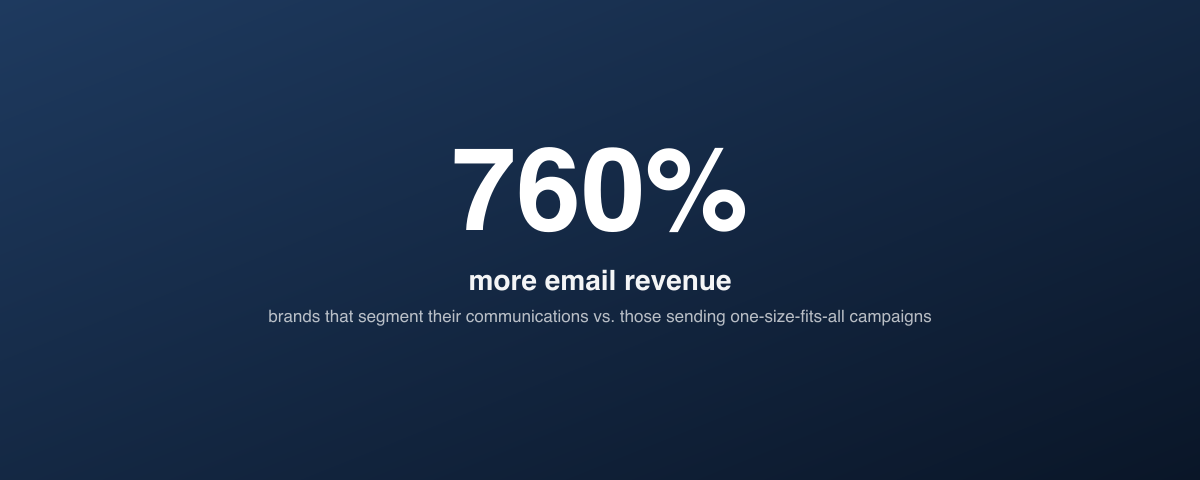
Brands that segment their communications earn 760% more revenue from email than those that don't. That number isn't a typo — it's what happens when you stop treating a first-time buyer the same as a VIP customer who has spent $2,000 with you over three years. The segment-level performance figures later in this post come from lists we've audited and resegmented ourselves.
One-size-fits-all messaging doesn't just underperform. It actively destroys the metrics that matter: unsubscribes climb, conversion rates drop, and your best customers start tuning out because your content isn't relevant to them. LTV stalls because you're using the same re-engagement discount with a loyal monthly buyer who was never going to churn anyway.
The fix is structured segmentation — building meaningful customer cohorts and then communicating with each one in a way that matches where they are in their relationship with your brand.
Why does broad messaging tank retention?
When every customer gets the same email, you're making a series of costly mistakes simultaneously. You're offering promotions to customers who would have bought at full price. You're sending product re-order reminders to people who just purchased two days ago. You're running win-back campaigns on customers who lapsed six months ago with the same message you'd send someone who lapsed six weeks ago.
The downstream effects compound. Spam complaints rise as irrelevance accumulates. Deliverability suffers. And on the paid side, you're spending retargeting budget on audiences that have no business being in the same ad group — wasting impressions and inflating CPAs.
Good segmentation is fundamentally a data & analytics problem. The brands that do it well treat their customer database as a live asset, not a static list.
What are the foundational dimensions: RFM plus three more?
RFM — Recency, Frequency, Monetary — is the starting point for most segmentation frameworks, and it works because it captures the three signals that best predict future purchase behaviour.
- Recency: How recently did the customer last purchase? Someone who bought 10 days ago is in a fundamentally different state than someone who bought 14 months ago.
- Frequency: How many orders have they placed? A 5-order customer has established a pattern. A 1-order customer hasn't yet.
- Monetary: How much have they spent in total? This is your proxy for LTV trajectory.
Score each dimension on a 1–5 scale and combine them. A customer scoring 5-5-5 is your best buyer. A customer scoring 1-1-1 is likely churned or nearly worthless to reactivate.
But RFM alone leaves gaps. Layer in three additional dimensions to build more precise segments:
Category preference. What product types does each customer gravitate toward? A skincare brand customer who only buys serums shouldn't get the same messaging as a customer who primarily buys SPF. Personalised product recommendations based on category affinity consistently outperform generic cross-sells by 30–50% on click-through rate.
Acquisition source. Paid social customers behave differently from organic search customers. Customers who came in through an influencer campaign have different brand expectations than those who came through Google Shopping. Knowing the source lets you tailor onboarding and early-lifecycle messaging accordingly.
Lifecycle stage. New, active, at-risk, lapsed, and churned are distinct stages that need distinct playbooks. Lumping at-risk and lapsed together into a single "win-back" segment is a common mistake that leads to underinvestment in at-risk customers (who are cheaper to save) and overinvestment in churned customers (who are expensive to reactivate).
How do you build RFM segments in Klaviyo or a CDP?
In Klaviyo, RFM segmentation is built through the segment builder using order count, last order date, and total lifetime value as conditions. A practical starting point for most D2C brands:
Five core segments:
- Champions — purchased in last 30 days, 4+ orders, high LTV
- Loyal — purchased in last 60 days, 3+ orders
- Promising — 1–2 orders, purchased in last 45 days
- At-risk — last purchase 60–120 days ago, previously active
- Lapsed — no purchase in 120+ days
If you're working with a CDP like Segment or Amplitude, you can build these same cohorts with more granularity and push them to Klaviyo as dynamic lists. The advantage of a CDP is that you can incorporate behavioural signals beyond purchase data — browse history, product page views, quiz responses — which sharpens your segments significantly.
For a deeper look at how to structure your measurement infrastructure, the D2C Analytics and Attribution: The Complete Guide covers the full data stack from event tracking through to segment-level reporting.
How do you personalise recommendations vs. promotions by segment?
Segmentation changes not just who you message, but what you message.
Champions and Loyal segments don't need discounts. They're buying anyway. Sending them 20% off codes trains them to wait for promotions and erodes your margins. Instead, these segments respond to early access, new product launches, and personalised replenishment reminders based on their actual purchase cadence.
Promising customers — those 1–2 order buyers — need social proof and cross-sell logic. They've validated interest but haven't yet established a habit. Product recommendations based on their initial purchase category, combined with reviews from customers like them, typically lift second-purchase rate by 15–25%.
At-risk customers need urgency without desperation. A well-timed "we noticed you haven't been back" message with a relevant product recommendation often outperforms a blanket discount. If the recommendation doesn't convert, then a modest incentive (free shipping, 10% off) as a secondary trigger makes sense.
Lapsed customers are the segment where discount pressure is actually warranted — they've already disengaged, so you need a reason to re-enter the relationship. But size your win-back investment based on their historical LTV. A customer who spent $80 lifetime doesn't justify the same win-back spend as one who spent $800.
Understanding which segments drive sustainable margin comes back to Customer Lifetime Value: The Metric That Should Drive Every Marketing Decision.
VIP tier segmentation: why does your top 20% deserve different treatment?
In most D2C businesses, 20% of customers generate 60–80% of revenue. These customers are not just high-value — they're your best advocates, your most forgiving testers, and your most cost-efficient retention targets.
VIP segmentation means identifying this cohort explicitly and giving them a materially different experience:
- Dedicated flows: VIPs get their own email and SMS sequences, not the standard automations.
- Early access: New product drops, limited editions, and sale previews land in VIP inboxes first.
- Surprise and delight: Unexpected upgrades, handwritten notes, or loyalty rewards tied to milestone spend thresholds.
- Feedback loops: Involve VIPs in product development. A survey to your top 500 customers is both a retention tactic and a valuable product research channel.
The threshold for VIP classification varies by brand, but a practical rule: if the segment contains more than 5% of your customer base, it's probably too broad. VIP treatment only feels special if it's genuinely exclusive.
How do you mirror email segments in paid retargeting?
Segmentation that stops at email is leaving money on the table. Your Klaviyo segments should map directly to custom audiences in Meta and Google.
Champions and Loyal customers in a lookalike seed audience will dramatically outperform a cold lookalike built off all customers. The signal is cleaner because you're telling the algorithm to find people who look like your best buyers, not your average ones.
At-risk segments in paid retargeting justify a different creative angle than your prospecting ads — they already know your brand, so you can skip the awareness layer and go straight to conversion messaging with specific product references.
Lapsed segments warrant frequency-capped retargeting with a clear incentive, but suppress them from prospecting campaigns. Spending to reacquire someone who already knows you in a prospecting ad unit is inefficient.
Audience hygiene rule: Suppress any email segment from paid retargeting where the conversion intent doesn't justify the CPM. Active buyers don't need retargeting spend — they're already in your email flows.
What's the measurement framework: revenue per recipient by segment?
The metric that ties all of this together is revenue per recipient (RPR) measured at the segment level, not the campaign level.
Campaign-level RPR masks the variance between segments. A campaign might average $0.18 RPR overall, but Champions might be generating $0.72 while Lapsed customers drag it down to $0.04. Without segment-level visibility, you can't optimise.
Track RPR monthly by segment, alongside:
- Segment migration rate: Are Promising customers moving to Loyal? Are At-risk customers slipping to Lapsed?
- Unsubscribe rate by segment: If VIPs are unsubscribing at above-average rates, your VIP content isn't differentiated enough.
- Incremental revenue from segmentation: Compare RPR for segmented campaigns against historical blast campaigns. This is your segmentation lift — the number that justifies the operational investment in maintaining clean segments.
A segmentation framework that's working should show Champions generating 4–8x the RPR of your average list, with Lapsed and at-risk segments progressively lower. If Champion RPR is only 1.5x your overall average, your Champion content isn't differentiated enough to justify the classification.
The bottom line
Segmentation isn't a one-time project — it's an operating discipline.
"Segmentation isn't a one-time project — it's an operating discipline."
— Aashish Kasma, Co-Founder — Data & Analytics
Build your RFM foundation, layer in category preference and lifecycle stage, then match your messaging and paid audiences to each cohort. Measure RPR at the segment level, watch migration rates monthly, and the compounding effect on LTV becomes visible within a single quarter.
Related guides
- D2C Analytics and Attribution: The Complete Guide to Measuring What Actually Works
- Customer Lifetime Value: The Metric That Should Drive Every Marketing Decision
- First-Party Data Strategy for D2C: Building the Asset That Survives Every Privacy Update
- How to Build Klaviyo Email Flows That Actually Convert
PART OF OUR SERVICE
CRM & Retention
PROOF FROM A CLIENT
+45% repeat purchase rate
from 22% to 32% of customers purchasing again within 90 days · Beauty & Personal Care
How a Beauty D2C Brand Lifted Repeat Purchase Rate by 45% with a Loyalty Program Rebuild→Want a free marketing audit?
We'll review your tracking, ad accounts, and funnel — and show you exactly where the gaps are.
Get Your Free Audit →