

Almost every email programme discovers the same thing when it increases send frequency: total revenue rises. That result is real, and it's also the reason most brands sail past their ceiling without noticing.
"Unsubscribes are the bill for last quarter's send frequency, and they arrive after you've already spent the list."
— Nitesh Kasma, Co-Founder — Brand Strategy & Client Growth
Why does more sending look like it works?
Because the cost is deferred and the benefit is immediate. An extra campaign this week produces revenue this week. The subscriber who stopped opening because of it produces nothing measurable — they don't unsubscribe, they don't complain, they just quietly stop being part of your audience.
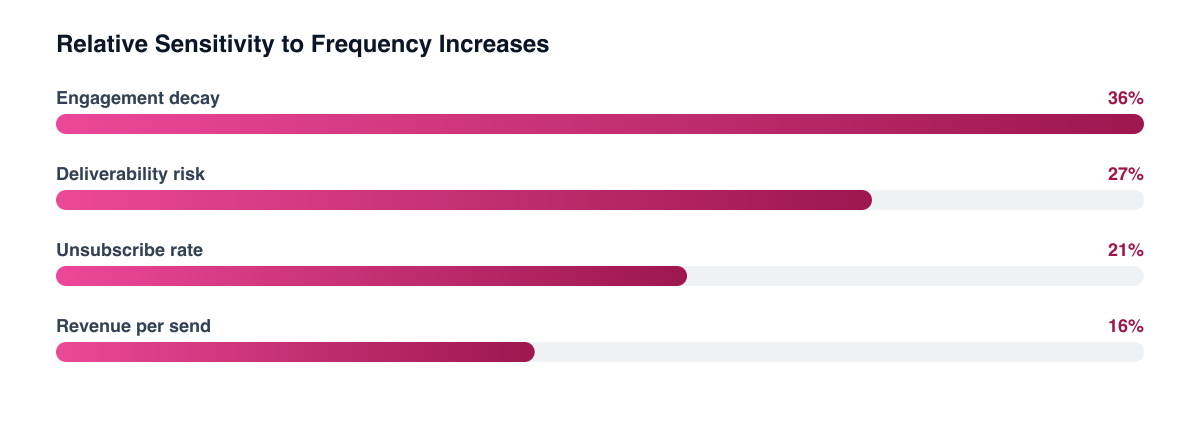
That asymmetry means revenue-per-campaign will keep looking acceptable long after the programme has started eroding. The metric that catches it earlier is revenue per subscriber per month, held against list size and engagement rate over a rolling window. If sends went up 40% and revenue per subscriber went up 5%, you have your answer.
What actually sets a brand's ceiling?
Purchase cycle and content supply, mostly, and neither is about email.
A consumable with a 30-day replenishment cycle supports a genuinely higher cadence than a durable bought once every two years, because there's always a relevant thing to say. A brand with a real editorial capability supports more than one that can only produce promotions — and a list that only ever receives discounts trains itself to wait for the next one, which is a margin problem disguised as a frequency question.
The other input is what else you're sending. Email frequency can't be set in isolation from SMS and WhatsApp and push, because the subscriber experiences one total volume from your brand, not three channel budgets.
How do you find it without damaging the list?
Test on a holdout, and run it long enough for the decay to show:
- Split the engaged portion of your list into a current-cadence group and a higher-cadence group. Leave the disengaged segment out of the test entirely — it will only add noise and deliverability risk.
- Run for at least two purchase cycles. A two-week test measures the immediate lift and none of the cost, which is precisely the error you're trying to avoid.
- Read revenue per subscriber, not per send, plus engagement rate and unsubscribe rate as guardrails.
- Watch inbox placement, not just opens. A frequency increase against a partly disengaged list is one of the reliable routes to deliverability trouble, and opens will look fine right up until they don't.
Set a frequency by segment, not by list Your most engaged subscribers can absorb several times the cadence your least engaged can. One global frequency is always wrong for both ends of the list.
What do you do once you've found the ceiling?
Stop pushing against it and change the mix instead. The next increment of revenue comes from making the sends you already have more relevant — which is a segmentation problem — or from moving volume into flows, which are triggered by behaviour and therefore land when they're wanted.
It's also worth building a preference centre that offers frequency options rather than a binary unsubscribe. A subscriber who downgrades to monthly is retained; the same subscriber facing only an unsubscribe button is gone, and re-acquiring them costs what acquisition costs.
Related guides
- Email and Retention for D2C: The Complete Guide
- Email Deliverability for D2C: Why Your Flows Stopped Landing
- Email Marketing for D2C: Turning a List Into Revenue
- Win-Back Campaigns That Actually Bring Customers Back
Frequency is the easiest lever in email to pull and the easiest to over-pull, because the damage is invisible for a quarter. Measure it per subscriber, set it per segment, and revisit it whenever the CRM and retention mix changes.
PART OF OUR SERVICE
CRM & Retention
PROOF FROM A CLIENT
+45% repeat purchase rate
from 22% to 32% of customers purchasing again within 90 days · Beauty & Personal Care
How a Beauty D2C Brand Lifted Repeat Purchase Rate by 45% with a Loyalty Program Rebuild→Want a free marketing audit?
We'll review your tracking, ad accounts, and funnel — and show you exactly where the gaps are.
Get Your Free Audit →