
A lapsed customer is not a lost customer — but the default win-back playbook, an escalating discount that gets deeper with every unopened email, teaches exactly the wrong lesson.
"A lapsed customer is not a lost customer — but the default win-back playbook, an escalating discount that gets deeper with every unopened email, teaches exactly the wrong lesson."
— Nitesh Kasma, Co-Founder — Brand Strategy & Client Growth
It reactivates the purchase, but it also reactivates a customer who now expects a discount every time they've gone quiet.
Why does the discount ladder backfire?
An email sequence that opens at 10% off and escalates to 25% off by the third message optimizes for one reactivation, at the cost of training the segment to disengage on purpose. Customers learn the pattern fast: go quiet, wait for the biggest offer, buy only on the deepest discount. The next lapse cycle starts from a worse position, because the customer now has a specific number in mind before they'll return.
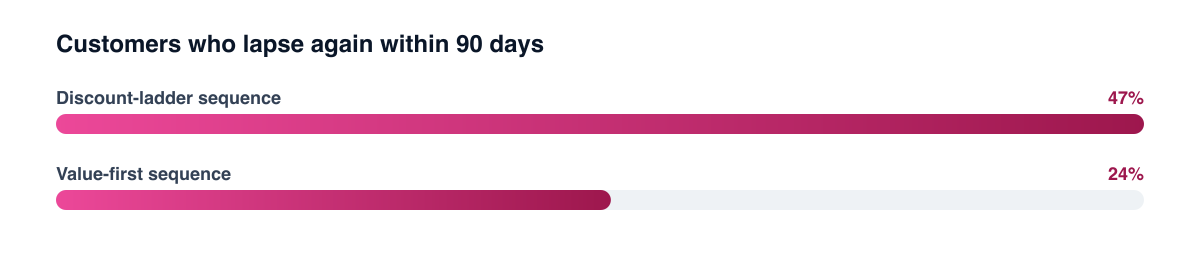
The tell your data will show Segment customers reactivated by a win-back discount and track their behavior on the next order. If a large share buys again only during another discount-driven touch, the sequence reactivated the transaction without rebuilding the relationship.
What should you lead with instead?
The goal of a win-back sequence isn't just one more order — it's re-establishing a reason to buy at full price again. That means the first touch should never be a discount:
- Lead with a reason, not an offer. A message about a new product, a restock of something they viewed, or content relevant to their past purchase re-engages interest without training a discount expectation.
- Segment by lapse reason, not just lapse duration. Someone who churned after a bad shipping experience needs a different message than someone who simply hasn't needed to reorder yet — segmenting by reason changes what the first touch should say.
- Save the discount for the final touch, and make it a real one. If a value-first message doesn't reactivate, a single well-timed offer as a last resort performs better than a discount that was visible from message one.
- Route reactivated customers into a normal lifecycle flow, not back into general marketing — a customer who just came back is still a flight risk and deserves a different cadence than the rest of the list.
The exception Price-sensitive categories (commodity consumables, categories with heavy promotional norms) are the one case where leading with a modest offer performs better than a value-first message — know your category's baseline promotional expectation before defaulting to a value-first sequence.
How do you time the sequence to lapse behavior?
Win-back timing should be based on each customer's own purchase cadence, not a fixed 60- or 90-day rule applied to everyone:
- Calculate expected reorder windows per product category using historical repeat purchase data, then trigger the first win-back touch shortly after a customer misses their expected window.
- Give the value-first touch time to work before escalating — at least one full send cycle before introducing any offer.
- Cap the sequence at three to four touches. Beyond that, continuing to email a genuinely disengaged customer damages sender reputation more than it drives reactivation.
Related guides
- Email Should Be One of Your Biggest Revenue Channels
- D2C Customer Segmentation: How to Divide Your List to Multiply Revenue
- Loyalty Programs for D2C Brands: How to Build One That Actually Drives Repeat Purchases
- Cohort Analysis for D2C Brands: The Retention Metric Hiding in Your Revenue Dashboard
A win-back sequence built entirely on discounts will always show a reactivation number in a dashboard — the cost just doesn't show up until the same customers lapse again, expecting a bigger offer than the last one. Building the sequence around a reason to return rather than a discount is the harder CRM and retention problem, and the only version that compounds.
PART OF OUR SERVICE
CRM & Retention
PROOF FROM A CLIENT
+45% repeat purchase rate
from 22% to 32% of customers purchasing again within 90 days · Beauty & Personal Care
How a Beauty D2C Brand Lifted Repeat Purchase Rate by 45% with a Loyalty Program Rebuild→Want a free marketing audit?
We'll review your tracking, ad accounts, and funnel — and show you exactly where the gaps are.
Get Your Free Audit →