
Brands pay creators for a video, post it from the brand handle as an ad, and are then surprised it performs like every other brand ad. The thing that made it work was the creator's face and account attached to it, and that is what the paid-creator formats exist to preserve.
"Creator content as an ad is only half the asset. The other half is the permission to run it, the length of that permission, and a structure that lets you scale what works."
— Dhruvit Shah, Co-Founder — Performance Marketing & Growth Strategy
What is whitelisting, and what are the platforms' actual names for it?
"Whitelisting" is industry shorthand, not a platform setting. The mechanism is that a creator grants you permission to run ads using their identity. On Meta these are partnership ads, which need permission from the partner whose handle the ad will run from, and which the partner can revoke. On TikTok the equivalent is Spark Ads, where the creator authorizes a specific post for you to promote.
In both cases the ad carries the creator's name rather than yours, and the creator keeps control of whether it can keep running.
How do the two permission models differ?
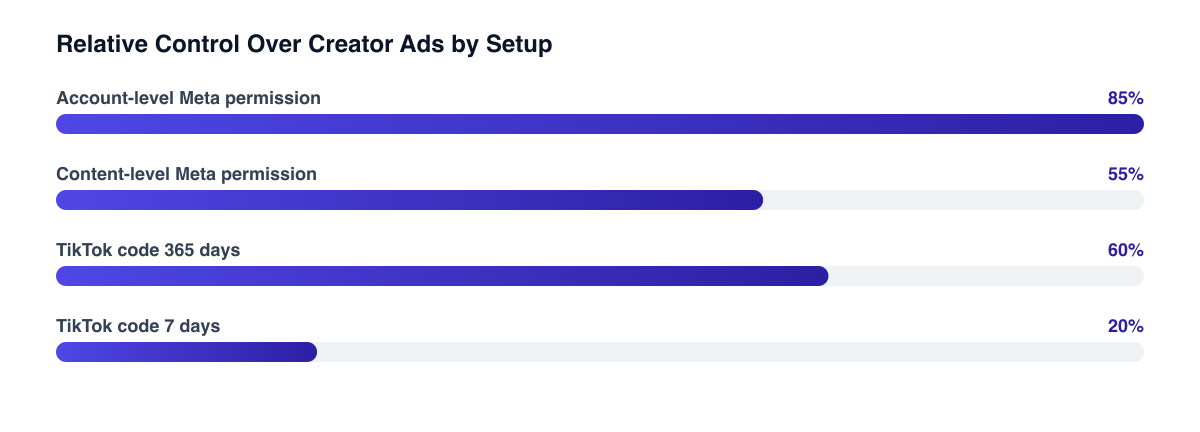
Meta separates permission into two levels. Content-level permission covers one post, story or reel the creator has already published, typically shared through a partnership ad code or the brand-partner boost option. Account-level permission is ongoing: once the creator accepts, you can create partnership ads from their handle without a pre-existing post, or from existing posts that tag your brand. The creator can revoke either level.
TikTok works per post: the creator generates an authorization code for a video and chooses a period. Creators commonly choose from options such as 7, 30, 60 or 365 days (confirm the current options in Ads Manager), and when the authorization lapses the ad stops and you need a fresh code from the creator. A running ad is only as durable as the period on its code.
The chart below puts Meta and TikTok on one scale for comparison, but the two platforms control permission differently and the figures are illustrative, so read it as a rough contrast rather than a like-for-like measurement.
Where do usage rights come in?
Platform permission is not a licence. It lets the ad run; it doesn't say how long you can use the footage elsewhere, whether you can edit it, or whether you can run it on other channels. Those terms belong in the creator agreement, and they should match the authorization you request. A contract that grants 90 days of paid use paired with a 7-day code is a mismatch that shows up mid-campaign.
What to settle before the shoot:
- Paid usage window, and whether it can be extended at a set rate.
- Platforms covered, since permission on one doesn't carry to another.
- Editing rights for cut-downs and captions.
- Exclusivity, if you need it, and what it costs.
For the briefing side, see our guide to briefing influencers and the ROI framing for creator spend.
How should you structure the campaigns?
Keep creator ads in their own testing lane rather than mixing them into existing ad sets, so you can see whether the creator format earns its fee. A workable pattern is a testing campaign where each piece of creator content competes against others, and a scaling campaign where the winners move once they've proven themselves. This mirrors the approach in our creative testing framework.
- Request the longest authorization you've contracted for at the start, so a winner isn't switched off while it's scaling.
- Test hooks before creators — the first seconds matter more than whose face it is (see paid social hooks).
- Log expiry dates per asset and ask for renewals ahead of time.
- Refresh the pool, because creator content fatigues like any other (creative fatigue).
Match the permission period to the contract, then calendar the expiry Ask for the longest authorization you've paid for, record the end date next to each asset, and renew before the winner needs it.
Does it beat running the same video from the brand account?
Often, but not always, and the honest answer depends on the account. In our experience a creator's handle can read more like a recommendation than an advertisement, which is the reason to do it, though that is a judgement rather than a measured rule. Against that: a creator with an unusual audience can drag in the wrong buyers, you depend on their goodwill to renew, and the production is only as good as their process. Compare against your own brand-handle version in a controlled test rather than assuming.
Related guides
- TikTok Ads for D2C Brands in 2026
- Influencer Marketing ROI in 2026
- UGC vs. Studio Creative
- Creative Fatigue: How to Spot It, Diagnose It, and Fix It
Creator ads work when the permissions, contracts and test structure are set up before the content is shot. That operating layer is what we handle in our paid social engagements.
Want a free marketing audit?
We'll review your tracking, ad accounts, and funnel — and show you exactly where the gaps are.
Get Your Free Audit →