
Most creator briefs fail before the creator ever opens them. They're either a three-paragraph mood board with no context, or a 12-page document so prescriptive that the creator has zero room to sound like themselves. Both produce the same result: content that looks polished, feels hollow, and doesn't convert.
A performance brief is different. It gives creators enough context to understand who they're talking to and why the product matters — and enough freedom to deliver it in a way that actually lands. That's the job.
Why do most creator briefs kill performance?
The most common brief mistake is treating creators like production houses. You hand them a script, a shot list, and a list of must-say phrases, and expect them to bring authenticity to something that's been stripped of all spontaneity.
The second most common mistake is the opposite: "Here's the product, here's our website, be creative." No context on the audience. No core message. No direction on what the ad needs to do. The creator makes something they're proud of that hits zero of your conversion goals.
Both problems stem from not understanding what information a creator actually needs to make content that works as a paid ad.
The brief's job is to transfer context, not control. Creators know how to talk to their audience — your job is to tell them what to say, not how to say it.
What does a performance brief actually include?
A brief built for ad performance has six components:
1. ICP description. Not demographics — psychographics. "25–34 female" is useless. "A woman who's tried three skincare routines in the past year and is skeptical of anything that promises overnight results" is actionable. The creator needs to know who they're talking to so they can choose the right register, reference points, and tone.
2. Core message (one sentence). What is the single thing the viewer should walk away believing? "This supplement actually gives you energy without the crash" or "This app saves freelancers 3 hours a week on invoicing." One message. If you can't define it, the creator can't deliver it.
3. Hook options. Provide 2–3 hook directions, not a required script. Something like: "Option A: Lead with a relatable problem. Option B: Lead with a surprising result. Option C: Address a common objection head-on." This preserves the creator's voice while steering toward hooks that creative & branding data consistently shows outperform brand-led openings.
4. Platform specs and format requirements. Aspect ratio, length range, safe zones for captions, whether it's for Stories vs. Feed vs. TikTok. Don't make the creator guess or submit something that requires a reshoot.
5. CTA. Be explicit. "End with a direct CTA to visit the link in bio" vs. "Soft close with a recommendation" are different outputs. For whitelisted ads especially, the CTA needs to be said clearly — not implied.
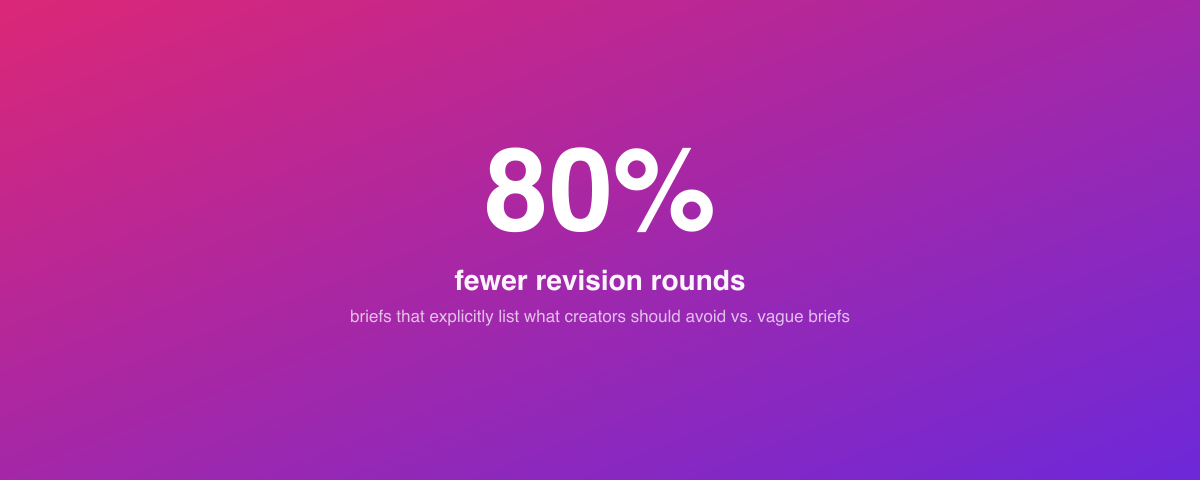
6. What NOT to do. This section prevents 80% of revision rounds. List specific things: don't mention competitor X by name, don't say "cheap," don't use before/after framing for compliance reasons. If there are legal constraints or brand sensitivities, put them here explicitly.
How do you brief for different creative formats?
The brief structure stays the same — what changes is the emphasis.
UGC testimonial: The core message should be anchored in a real-feeling personal experience. Brief the creator on the specific transformation or outcome you want them to narrate. Don't write their testimonial for them — give them the result to hit ("you should feel like you're hearing from someone who genuinely found the solution they'd been looking for"), not the words to say. For more on when UGC outperforms produced content, see UGC vs. Studio Creative.
Product demo: Here you can be more directive about what the product needs to show on screen. But the frame matters — are they demoing because it's impressive, or because the viewer's been skeptical it actually works? That changes the entire tone of the demo.
Educational content: Give the creator the key insight or data point you want the viewer to retain. For educational formats, the brief should specify whether you want the brand to feel primary (this is an ad) or secondary (this is useful content that happens to feature a product). Both work — they just need different briefs.
How do you brief for whitelisted ads vs. organic posts?
These require materially different briefs. An organic post brief prioritizes the creator's audience relationship above everything else — the brand is secondary to making good content. A whitelist brief is an ad that happens to come from the creator's handle. The performance expectations are higher, the CTA should be more direct, and you have more control over how it's deployed.
For whitelisted creative, tell the creator upfront that the content will run as paid media. Brief them on the targeting context if relevant ("this will serve to cold audiences who don't know the brand yet"). That changes how much setup and context they'll need to include in the video itself.
Organic brief: creator-first, brand-second. Whitelist brief: treat it like a paid creative asset that needs to earn clicks.
How do you review output without killing authenticity?
When you get deliverables back, review against the brief — not against your personal taste. The question isn't "would I have said it that way?" It's: does this deliver the core message? Is the hook strong? Does it end with a clear CTA?
Flag genuine performance risks (misleading claims, missing CTA, wrong format specs). Don't flag stylistic choices that are the creator's voice doing its job. If a creator's natural cadence includes pauses and you want a slick 30-second cut, you hired the wrong creator — revising that out won't fix the underlying mismatch.
Limit revision rounds to two. If the brief was clear and the output still misses the core message, have a 15-minute call before sending another written note. Most revision cycles are a communication problem, not a creative problem.
How do you iterate briefs based on performance data?
Briefs shouldn't be static. After 4–6 weeks of running creator content, pull your performance data and work backward into the brief.
Which hooks drove the highest 3-second view-through rate? Which CTAs drove the lowest CPL? Was educational format outperforming testimonials on cold audiences? Those answers should feed directly into your next round of briefs.
Specifically: update your hook options based on what's working, adjust the "what NOT to do" list based on what failed, and refine the ICP description if you're seeing specific audience segments convert at 2x+ the average. This is how brands compound their creator programs into a real performance channel rather than a series of one-off experiments.
For a broader look at whether creator programs are worth the investment at your stage, see Influencer Marketing in 2026: Real ROI or Expensive Vanity? — particularly the section on cost-per-acquisition benchmarks by channel.
The bottom line
A creator brief that performs is one that transfers context, not control — it tells the creator who the audience is, what the core message is, and what to avoid, then gets out of the way.
"A creator brief that performs is one that transfers context, not control — it tells the creator who the audience is, what the core message is, and what to avoid, then gets out of the way."
— Nitesh Kasma, Co-Founder — Brand Strategy & Client Growth
Brief for the outcome you need, review against the brief not your taste, and let performance data reshape your next brief. That cycle is how creator content stops being a brand play and starts being a growth channel.
Related guides
PART OF OUR SERVICE
Creative & Branding
Want a free marketing audit?
We'll review your tracking, ad accounts, and funnel — and show you exactly where the gaps are.
Get Your Free Audit →