
TikTok's ad platform looked like a gamble two years ago. Brands that stuck with it have been rewarded. The platform has matured — better attribution, a more robust Shop integration, and, in the accounts we manage, CPMs that are usually lower than Meta on comparable audiences. For D2C brands willing to adapt their creative approach, TikTok is one of the highest-opportunity paid channels heading into 2026.
Here's what's working right now, based on campaigns we run across beauty, apparel, wellness, and home goods categories.
TikTok ad formats: which ones should you prioritize?
Spark Ads Promote organic posts (yours or a creator's) directly as ads. The content keeps its native appearance — comments, likes, and the creator's handle all stay visible. This is the most important format for D2C brands right now.
Why it works: social proof is baked in. A post with 50K likes running as a Spark Ad converts better than the same video in a standard in-feed placement because the engagement signals are visible and trusted.
TopView Full-screen, sound-on video that appears when a user first opens TikTok. Separate from TopFeed (the first in-feed placement after a swipe). Premium placement with premium pricing.
Why it works: brand awareness plays at scale. Best suited for product launches, seasonal campaigns, or brands with established creative that needs reach. Not a starter format.
TikTok Shopping Ads Video Shopping Ads, Catalog Listing Ads, and LIVE Shopping Ads. Lets you tag products directly in video so viewers can purchase without leaving the app.
Why it works: friction removal. The path from discovery to checkout is now a single flow. For impulse-purchase categories (beauty, accessories, home decor), this format can dramatically lift conversion rates.
Standard In-Feed Ads Your baseline format. Appears in the For You Page between organic content. Good for testing creative before deciding whether to invest in Spark Ads or Shopping Ads.
Why it works: cost-efficient testing ground. Run new creative here first. If it performs, promote it via Spark Ads for social proof amplification.
What's the 3-second hook rule for creative best practices?
TikTok is a ruthless scroll environment. You have a few seconds, at most, to stop the thumb before the user swipes past. Treat that as a hard constraint that shapes every creative decision.
Native over polished Overproduced ads look like ads. TikTok users have calibrated pattern recognition for branded content. UGC-style video — handheld, natural lighting, authentic voice — consistently outperforms studio-produced assets on this platform.
Lead with the problem or the payoff Open with the thing that matters most: the before/after, the surprising result, the problem you solve. Do not open with your brand name or logo. Those belong at the end.
Sound-on creative A large share of TikTok viewers watch with sound on. Use trending audio strategically, but don't rely on it — original voice-over with a clear script often outperforms trendy music.
Text overlays that reinforce the hook Many users read before they commit to watching. Put the key claim or question in text on-screen within the first 2 seconds.
Keep it under 30 seconds for conversion campaigns Longer formats work for organic and brand awareness, but for direct-response, 15–30 seconds is the sweet spot. Get to the CTA before attention drops.
How do you use creator partnerships for performance?
The most consistent creative winners on TikTok in 2026 come from creator partnerships — not brand-produced content. The key shift is treating creators as performance marketing assets, not just brand awareness plays.
Brief for conversion, not just awareness
Give creators a specific outcome to drive: add to cart, use discount code, visit landing page. Share your top-performing hooks and let them adapt in their voice.
Work with micro-creators (10K–100K followers)
Bigger isn't better for performance. Micro-creators have higher engagement rates and their audiences trust them more. Source through TikTok Creator Marketplace.
Get whitelisting rights
Negotiate to run the creator's content as a Spark Ad from their handle. This preserves the native feel and social proof while giving you full targeting and budget control.
Test volume over individual bets
Commission 8–12 creators per product launch. Expect 2–3 winners. The cost of the non-performers is built into the model — don't optimize for perfection, optimize for volume and iteration.
What have we learned about audience targeting vs. broad?
TikTok's recommendation algorithm is powerful enough that broad targeting (minimal audience restrictions) outperforms interest-based targeting for most D2C brands once you have sufficient conversion data. Here's the practical framework:
| Spend level | Approach |
|---|---|
| $0–$50/day | Use interest-based targeting to seed the algorithm. Give it a starting point while conversion data is thin. |
| $50–$200/day | Begin testing broad audiences in parallel campaigns. Compare CPL and ROAS over 7-day windows. |
| $200+/day | If broad matches or beats interest-based, shift budget allocation toward broad. Use Custom Audiences (website visitors, customer lists) for retargeting layers. |
Why is TikTok Shop the biggest opportunity most D2C brands are sleeping on?
TikTok Shop has crossed into mainstream e-commerce. The integration of shoppable video, affiliate creator content, and native checkout into one surface is unlike anything Meta or Google offers. For D2C brands selling physical products, here's how to approach it:
- Set up your TikTok Shop catalog and connect it to your Shopify store via the official integration
- Enable the TikTok Shop Affiliate program — creators can tag your products in organic content and earn commission on sales
- Run Video Shopping Ads against your best-performing organic product videos
- Use LIVE Shopping for product launches or limited-time offers — in our experience live conversion can run well above standard video
How do TikTok and Meta CPMs honestly compare in 2026?
In the D2C accounts we run, TikTok CPMs are typically below comparable Meta placements, though the gap varies by category and season. But raw CPM comparison misses the point — what matters is cost per purchase and ROAS.
| Metric (ranges we typically see, not industry averages) | TikTok | Meta |
|---|---|---|
| CPM | $8–$16 avg (In-Feed) | $12–$22 avg (Feed + Reels) |
| Avg CTR | 1.0–2.5% | 0.9–1.8% |
| Creative half-life | 3–7 days (fast fatigue) | 7–14 days |
| ROAS (mature campaigns) | 1.8–3.5x (category dependent) | 2.5–5x (category dependent) |
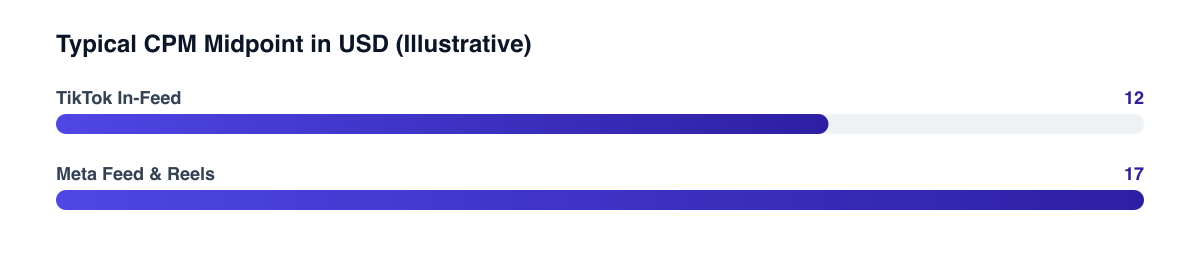
TikTok's lower CPMs are offset by faster creative fatigue and generally lower purchase intent at the top of funnel. The sweet spot: use TikTok to build awareness and TOFU volume cheaply, and retarget those audiences on Meta where purchase conversion rates are higher.
Where do you start if you're new to TikTok ads?
Install the TikTok Pixel and set up Events API
Tracking is the foundation. Use Events API alongside the browser pixel to maximize signal match rate for algorithm optimization.
Start with $50–$100/day on In-Feed ads
Test 3–5 creative variations with different hooks. Let each run for 5–7 days before drawing conclusions. Optimize for Add to Cart or Initiate Checkout initially.
Identify 2–3 micro-creators in your niche
Source via TikTok Creator Marketplace. Give a simple brief. Get first creator content live within 2 weeks.
Set up TikTok Shop
Even if you're not ready to invest in LIVE, the affiliate network starts working for you passively once your catalog is connected.
Promote your best organic or creator content as Spark Ads
Once you identify what resonates organically, amplify it with budget. This is the most efficient path to TikTok ROAS.
The bottom line
TikTok in 2026 rewards brands that create natively, partner with creators strategically, and use the platform's own tools (Shop, Spark Ads, broad targeting) rather than fighting against the grain with polished brand content. The CPM advantage is real, but it only matters if your creative earns the attention.
Related guides
- Meta Ads for D2C Brands: The Complete 2026 Playbook
- UGC vs. Studio Creative: Which Actually Performs Better on Meta and TikTok
- The Creative Testing Framework That Scales What Works
- YouTube Ads for D2C Brands in 2026
Brands that treat TikTok as a cheaper Meta will be disappointed.
"Brands that treat TikTok as a cheaper Meta will be disappointed."
— Dhruvit Shah, Co-Founder — Performance Marketing & Growth Strategy
Brands that treat it as a discovery-native commerce platform will find one of the best acquisition channels available right now.
PART OF OUR SERVICE
Performance Marketing
PROOF FROM A CLIENT
5x revenue growth
monthly revenue, driven by performance marketing, creative briefing and CRM · Men's Grooming
How Hivado Grew Revenue 5x in 6 Months with Performance Marketing→Want a free marketing audit?
We'll review your tracking, ad accounts, and funnel — and show you exactly where the gaps are.
Get Your Free Audit →