

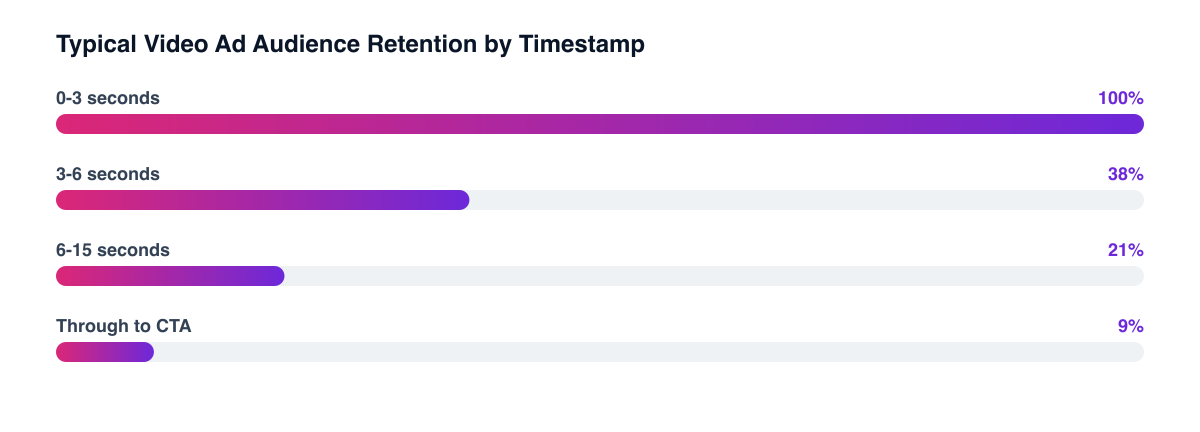
A video ad that loses most of its audience in three seconds isn't being judged on its argument. It's being judged on its opening frame, by someone whose thumb is already moving.
"The hook isn't the start of the ad — it's a separate ad whose only job is to buy the next five seconds."
— Palash Shukla, Creative Designer
Why treat the hook as its own asset?
Because it fails independently of everything else. A creative with a strong offer, clean production, and a genuinely good demo can post terrible results purely because the first frame looks like an ad. Meanwhile a modest phone-shot clip with a sharp opening line carries the same offer to a much better result. When those two get compared as whole creatives, the wrong conclusion gets drawn — "UGC beats studio," or "this offer doesn't work" — when the only variable that actually moved was the opening.
Separating the hook from the body makes it testable. Same body, four different openings, and the three-second retention rate tells you which opening earned attention before any of the downstream metrics get involved.
What kinds of hooks actually work?
Fewer than the internet suggests, and they cluster into a handful of shapes:
- The specific problem, stated plainly — naming the exact frustration in the viewer's own words, not a marketing paraphrase of it. Specificity is what signals "this is about me."
- The contradiction — a claim that runs against what the viewer assumes is true, which buys attention through the desire to see it resolved.
- The visual demonstration with no setup — the product doing the interesting thing in frame one, before any words. Strongest for products with a visible transformation.
- The mid-conversation open — starting as though the viewer joined a sentence already in progress, which reads as content rather than as an ad.
What consistently doesn't work: a logo, a slow establishing shot, a question so broad it applies to everyone, and any opening that requires context the viewer doesn't have yet.
Write the hook last, but test it first The clearest hooks usually come from the body of the ad — the sharpest line in the script, moved to the front. Write the argument, find the sentence that would make a stranger stop, and open with that.
How many hooks should one creative get?
Three to five, minimum, before deciding the creative itself doesn't work. Editing a new opening onto an existing body is cheap — no reshoot, no new concept — which makes it the highest-leverage iteration available to a small team. This is also the fastest way to extend the life of a creative that's fatiguing: the same body with a genuinely new opening frequently reads as a new ad to both the audience and the algorithm.
Does the same thinking apply to static ads?
Yes, with the roles shifted. In static, the hook is the image and the first four or five words of overlay text — everything else is body copy that only gets read if those land. The same test structure applies: hold the offer and layout constant, vary only the headline and hero image, and judge on click-through before judging on conversion. It's the same testing framework, just with a shorter unit of attention.
Related guides
- Creative Testing Framework: How to Test Without Wasting Spend
- Creative Fatigue in D2C: Spotting It Before Performance Drops
- UGC vs. Studio Creative: Which Actually Performs
- Video Ad Production for D2C Brands
Most brands iterate on offers and audiences long before they iterate on openings, which is backwards — the opening decides how many people ever reach the offer. Fixing it is usually the cheapest creative work available.
PART OF OUR SERVICE
Creative & Branding
Want a free marketing audit?
We'll review your tracking, ad accounts, and funnel — and show you exactly where the gaps are.
Get Your Free Audit →