
Your best-performing ad just became your worst. ROAS is down 30%, CPCs are climbing, and your media buyer is scratching their head because nothing changed in targeting or bidding. Something did change — your audience saw that ad 12 times and stopped caring. The decay curves and thresholds below come from ad accounts we've audited, which is why they're ranges rather than a single number.
Creative fatigue is the most common performance killer in scaling D2C accounts, and it's almost always diagnosed too late.
"Creative fatigue is the most common performance killer in scaling D2C accounts, and it's almost always diagnosed too late."
— Nitesh Kasma, Co-Founder — Brand Strategy & Client Growth
The symptoms show up in your ROAS report weeks after the decay actually started. If you're waiting for ROAS to drop before refreshing creative, you're perpetually reacting instead of managing.
Here's how to get ahead of it.
What is creative fatigue, actually?
Creative fatigue happens when the same creative is shown too many times to the same audience, causing engagement to decay. The algorithm keeps spending, but the humans on the other end have mentally checked out. CTR falls, conversion rate drops, and CPM often rises as the platform's relevance signals weaken.
But there's a distinction that most brands miss: frequency fatigue vs. concept fatigue.
Frequency fatigue is mechanical — your audience has literally seen the same ad too many times. This is fixable with creative rotation. Swap in a fresh variation of the same angle (new hook, new thumbnail, new first three seconds) and performance often recovers.
Concept fatigue is deeper. It means the underlying message — the angle, the offer framing, the creative concept — is exhausted with your audience. Even a fresh execution of the same concept won't move the needle. You need to retire the concept entirely and test new ones.
Misdiagnosing concept fatigue as frequency fatigue is an expensive mistake. Brands produce five new variations of a dead angle and wonder why nothing works.
What are the early warning signals?
By the time ROAS visibly tanks, you're 2–3 weeks into the decay curve. The real indicators show up earlier in the funnel:
Watch these in order — they fire before ROAS moves:
- CPM rising 15%+ week-over-week on the same placements
- CTR falling 20%+ from the creative's peak (not from launch)
- CPC rising while impressions hold steady
- Hook rate (3-second video views / impressions) falling below 25% on video
- Landing page CVR holding but fewer clicks reaching it
Stable impressions with declining clicks is the classic fingerprint. The algorithm is still buying the impression, but the creative isn't converting attention anymore.
Set these as weekly alerts in your reporting stack. A 20% week-over-week CTR drop on any creative with more than 10,000 impressions should trigger a review, not a wait-and-see.
How do you diagnose fatigue vs. other issues in platform data?
Not every performance drop is creative fatigue. Before you pull creative, rule out the other causes.
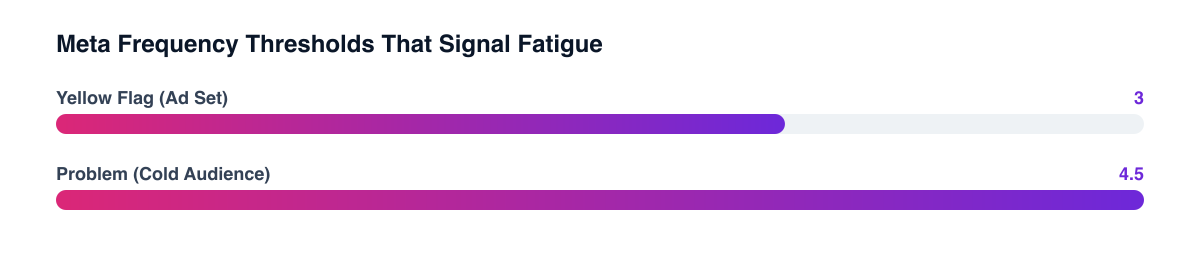
In Meta Ads Manager, go to the ad level and pull the frequency column alongside CPM, CTR, and CPC on a 7-day rolling window. A frequency above 3.0 at the ad set level is a yellow flag. Above 4.5 on a cold audience is almost always a problem. If frequency is low (under 2.0) and CTR is still falling, the issue is likely audience exhaustion or a bid/budget problem — not creative.
Cross-check by isolating the creative in a fresh ad set with a new audience segment. If CTR recovers, you had audience saturation, not creative fatigue. If it stays flat, the creative is done regardless of audience.
On TikTok Ads, the signal set is slightly different. Watch your Video Play Actions Rate and the 6-second watch rate. TikTok's algorithm is more aggressive about deprioritizing creative it deems low-engagement, so fatigue shows up faster — often within 5–7 days of a creative hitting scale. A creative that was producing a 1.5%+ CTR and drops below 0.8% over a 5-day window is in fatigue territory.
The Meta Ads for D2C Brands: The Complete 2026 Playbook has a deeper breakdown of how Meta's delivery system interacts with creative relevance scoring — worth reading before you over-rotate creative in response to normal variance.
What creative rotation strategy works?
How many variants should you run, and when do you pull them?
Minimum viable creative rotation for a scaling D2C account:
- 3–5 active creatives per ad set at any time
- No single creative should represent more than 40% of ad set spend
- Retire any creative that has dropped 30% from its peak CTR over a 7-day window
- Always have 2–3 creatives in testing (low budget, learning phase) before you need them
The mistake most brands make is waiting until a creative dies before testing the replacement. By the time the winner is fatigued, the new creative hasn't accumulated enough data to step in confidently. You end up with a performance gap.
Treat creative rotation like inventory management. You don't reorder stock when you run out — you reorder when you hit a threshold. Same principle here.
When to refresh vs. replace:
Refresh (new execution, same concept) when: frequency is high but the concept is relatively new, hook rate is low but conversion rate was strong, or the creative is under 4 weeks old and hasn't been widely distributed.
Replace concept entirely when: multiple executions of the same angle have all decayed, the core message has been in market for 6+ weeks at scale, or qualitative feedback (comments, replies) shows audience skepticism about the claim or offer framing.
The creative & branding work we do for scaling accounts is built around this distinction — production cadence is set by fatigue data, not by gut feel.
How do you build a pipeline that prevents fatigue?
Reactive creative production is the root cause of most fatigue crises. The fix is a production cadence that feeds the rotation before it empties.
The benchmark for a scaling D2C account running $50K–$200K/month in Meta + TikTok spend:
- 8–12 new creative assets per month minimum
- At least 3 distinct concepts tested per month (not just executions)
- 1 net-new creative angle introduced every 2 weeks
This sounds like a lot until you break it down: a single shoot day with one creator can produce 4–6 raw UGC assets. Two hook variations per asset gets you 8–12 pieces. With a systematic brief-to-production workflow, this is achievable without a full in-house team.
The structural piece most brands skip: link production to performance data. Every creative brief should come from a diagnosed gap — a fatigued concept that needs replacement, a new angle hypothesis from your winning ads' comment sections, or a format gap (you're running too much static, not enough video). Production without data feedback is how you end up making five versions of a dead angle.
The Creative Testing Framework That Scales What Works maps out how to structure your testing cadence so that new creative enters the rotation with intent, not just volume.
The bottom line
Creative fatigue is a predictable, manageable problem — but only if you're tracking the right leading indicators instead of waiting for ROAS to tell you it's already happened. Build your rotation around frequency and CTR decay signals, diagnose concept fatigue separately from frequency fatigue, and tie your production cadence to the data so you're never caught without fresh creative when a winner runs dry.
Related guides
PART OF OUR SERVICE
Creative & Branding
Want a free marketing audit?
We'll review your tracking, ad accounts, and funnel — and show you exactly where the gaps are.
Get Your Free Audit →