

A points-based loyalty program is a real commitment — new tech, redemption liabilities, an ongoing program to manage. VIP tiering is the version of the same idea that a brand can build this month with the segmentation tools it already has.
"VIP tiering is the version of the same idea that a brand can build this month with the segmentation tools it already has."
— Nitesh Kasma, Co-Founder — Brand Strategy & Client Growth
The goal is the same as any loyalty program — concentrate retention effort on the customers who generate the most revenue — but the mechanism is just spend-based segmentation and differentiated treatment, not a points ledger.
Why does spend concentration make tiering worth doing?
Revenue in most D2C customer bases is heavily concentrated: a small share of customers routinely account for a disproportionate share of total revenue. Cohort analysis usually reveals this exact pattern even in brands that don't think of themselves as having a "VIP problem" — most just haven't looked at spend distribution across their list.
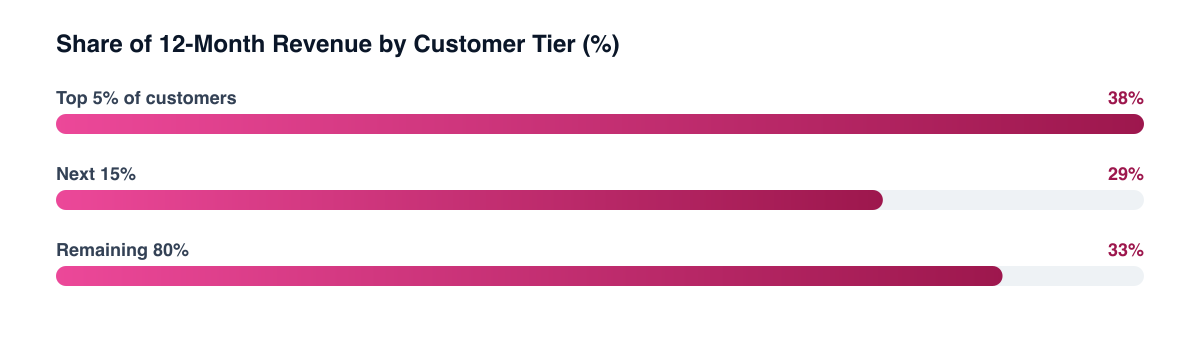
If a small tier already generates that much of the business, treating them identically to a first-time buyer in every email and support interaction is leaving retention upside on the table.
How do you define tiers without a loyalty platform?
- Use trailing 12-month spend, not lifetime spend, so a customer who bought heavily two years ago but has since gone quiet doesn't stay classified as a VIP indefinitely.
- Set three tiers, not five. More tiers sound more precise but dilute the perceived exclusivity of the top one and add operational complexity that rarely pays for itself at D2C scale.
- Build the segment directly in your ESP or CDP using order data already flowing in — this doesn't require new infrastructure, just a saved segment definition and a recalculation schedule.
- Recalculate monthly, not in real time. Tier membership shouldn't flicker after a single order; a stable monthly refresh keeps the segment meaningful and avoids treatment changing mid-relationship.
The threshold test Pull your customer list ranked by trailing-12-month spend and look for the natural break where value per customer drops off sharply. That break, not a round number like "$500," is usually the right tier boundary.
What should actually be different for a VIP tier?
Differentiated treatment matters more than the label itself:
- Early access to new products and restocks before the general list, which also gives you a read on demand before a full launch.
- A different email/SMS cadence and tone — less promotional pressure, more first-look and relationship-building content.
- Priority support routing, so a VIP customer's issue doesn't sit in the same queue as a first-time buyer's shipping question.
- A meaningful perk reserved for the tier — free shipping thresholds waived, a surprise gift on a milestone order — small enough to protect margin, exclusive enough to be noticed.
What not to do Don't make the VIP perk purely a bigger discount. That just turns your best customers into your most discount-trained customers, the same failure mode that shows up in poorly structured win-back sequences — the fix there applies here too.
Is this worth building before a full loyalty program?
For most D2C brands under a certain scale, yes — a segmentation-based tier captures most of the retention value of a full loyalty platform without the implementation cost, the points liability on the balance sheet, or the ongoing program management. It's also a reasonable first step before a full loyalty program: building the tiers first tells you which perks your best customers actually respond to before you commit to a points structure around them.
Related guides
- Loyalty Programs for D2C Brands: How to Build One That Actually Drives Repeat Purchases
- D2C Customer Segmentation: How to Divide Your List to Multiply Revenue
- Cohort Analysis for D2C Brands: The Retention Metric Hiding in Your Revenue Dashboard
- Customer Lifetime Value: The Metric That Should Drive Every Retention Decision
Most of the customer data needed for this already sits in the order history your ESP can already query. The only real decision left is where to draw the line — and what to actually do differently once you have. Drawing that line well is ordinary CRM and retention work, and it matters more than the tier names or the rewards attached to them.
PART OF OUR SERVICE
CRM & Retention
PROOF FROM A CLIENT
+45% repeat purchase rate
from 22% to 32% of customers purchasing again within 90 days · Beauty & Personal Care
How a Beauty D2C Brand Lifted Repeat Purchase Rate by 45% with a Loyalty Program Rebuild→Want a free marketing audit?
We'll review your tracking, ad accounts, and funnel — and show you exactly where the gaps are.
Get Your Free Audit →