
Most D2C brands have a loyalty program. Fewer than a third of their customers have any idea what's in it. Points accumulate silently in a corner widget, redemption rates hover in the single digits, and the program shows up as a cost center rather than a retention lever. The problem isn't that loyalty programs don't work — it's that most of them aren't designed to be used. The redemption and repeat-rate figures below come from loyalty programs we've audited, not from platform-published benchmarks.
Why do most loyalty programs fail?
The typical D2C loyalty program is a points-per-dollar tracker bolted onto checkout: earn 1 point per $1, 100 points = $5 off. It's easy to launch and does almost nothing. Three structural problems show up over and over:
The math doesn't feel real. A customer who spends $60 on average earns 60 points — worth $3. That's not a meaningful incentive to come back sooner or spend more; it's a rounding error they'll never notice.
There's no second reason to join. If the only benefit is "earn points," a customer who doesn't care about points has zero reason to enroll. Programs that convert well always stack a second, immediate benefit — early access, a birthday perk, free shipping at a lower threshold — on top of the points mechanic.
Nobody tells them it exists. Enrollment is passive, buried in the account menu, mentioned once in a post-purchase email. If loyalty isn't referenced in the channels a customer already reads — SMS, email flows, the product page — it doesn't exist to them.
The fix Points are the mechanic, not the pitch. Lead with an immediate, tangible perk at signup (a discount code, free shipping, early access to a drop) and let points accumulate in the background for customers who stick around.
Why should you structure tiers around real behavior change, not vanity spend?
Flat programs treat a $50 customer and a $500 customer identically, which wastes the biggest lever loyalty programs have: recognizing your best customers in a way that makes them spend more to stay recognized.
A tiered structure works when each tier unlocks something a customer can feel, not just a bigger point multiplier:
- Entry tier (on signup): immediate perk — 10% off, free shipping, or early access to new drops.
- Mid tier (2nd–3rd purchase): a real discount step-up plus a soft status signal — "Insider" badge, private restock alerts.
- Top tier (top 10–15% of spenders): access that can't be bought outright — early product previews, a direct line to support, surprise gifts on shipment.
Set thresholds from your own data, not a template Pull your actual order history and find the natural break points — where does spend drop off after the first purchase, and what's the average order value of your top 15% of customers? Tier thresholds set from a template (e.g., "$100/$300/$500") almost always miss where your customers actually cluster.
How do you fix the redemption threshold problem?
The single biggest killer of loyalty engagement is a point value that never feels reachable. If it takes 8 purchases to earn a meaningful reward, most customers churn before they ever redeem — and a program nobody redeems from generates zero behavior change, just a liability on your balance sheet.
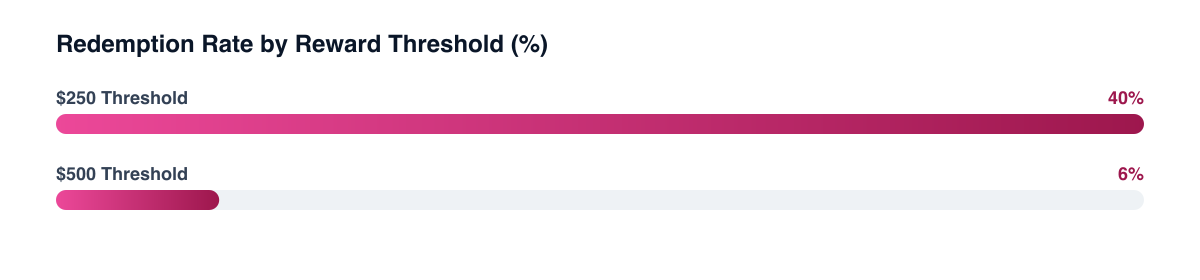
Reachability test A new customer should be able to earn their first reward within 2 purchases, not 8. If your average order value is $60 and your reward threshold requires $500 in spend, cut it down. A $250 threshold that gets redeemed by 40% of customers beats a $500 threshold that gets redeemed by 6%.
Why does loyalty only work if it lives inside your lifecycle flows?
A loyalty program that lives solely on an account page is invisible. It needs to be woven into the flows customers are already reading — particularly email and SMS, where retention marketing already happens.
Concrete integration points that consistently move repeat purchase rate — the levers behind a 22% to 32% shift in 90-day repeat rate for a beauty D2C brand:
- Post-purchase flow: confirm points earned on this order and show the balance needed for the next reward — not just a generic "thanks for your order."
- Points-about-to-expire flow: if points expire, a reminder 2 weeks out recovers redemptions that would otherwise be lost.
- Tier upgrade flow: the moment a customer crosses into a new tier, tell them immediately with what it unlocks — this is one of the highest open-rate triggered emails a loyalty program can generate.
- Win-back flow: lapsing customers get a points-boost or bonus-tier offer instead of a generic discount, which retains program value instead of training customers to wait for blanket sales.
How do you measure it the way you'd measure any acquisition channel?
Loyalty programs get evaluated loosely ("do people like it?") far more often than they get evaluated on the metrics that actually matter. Track these against a pre-launch baseline:
- Program enrollment rate — % of customers who join within 30 days of first purchase.
- 90-day repeat purchase rate, split between enrolled and non-enrolled customers — this is the number that proves or disproves the program.
- Redemption rate — % of earned points/rewards actually used. Under 15% means your thresholds or comms are broken.
- Customer lifetime value lift for enrolled vs. non-enrolled cohorts over a 12-month window.
If enrolled customers aren't repeat-purchasing at a meaningfully higher rate than non-enrolled customers within 90 days, the program isn't retention — it's decoration.
Related guides
- Email Should Be One of Your Biggest Revenue Channels
- SMS and WhatsApp Marketing for D2C
- D2C Customer Segmentation: How to Divide Your List to Multiply Revenue
- Customer Lifetime Value: The Metric That Should Drive Every Marketing Decision
A loyalty program is a retention feature, not a marketing checkbox.
"A loyalty program is a retention feature, not a marketing checkbox."
— Nitesh Kasma, Co-Founder — Brand Strategy & Client Growth
Built with real thresholds, woven into flows customers already read, and measured against a control group, it's one of the few retention levers that gets more valuable to a customer the longer they stay — which is exactly the incentive a D2C brand needs its best customers to feel. Programs that survive contact with a P&L tend to be the ones built as CRM and retention infrastructure rather than a points widget bolted onto the storefront.
PART OF OUR SERVICE
CRM & Retention
PROOF FROM A CLIENT
+45% repeat purchase rate
from 22% to 32% of customers purchasing again within 90 days · Beauty & Personal Care
How a Beauty D2C Brand Lifted Repeat Purchase Rate by 45% with a Loyalty Program Rebuild→Want a free marketing audit?
We'll review your tracking, ad accounts, and funnel — and show you exactly where the gaps are.
Get Your Free Audit →