
TikTok doesn't care how many followers you have. Post something that earns attention and the algorithm will show it to hundreds of thousands of people who've never heard of your brand. That's the opportunity — and the challenge — for D2C brands building organic social in 2026.
The brands compounding real revenue from TikTok organic aren't posting casually. They're treating it like a media operation: structured formats, deliberate hooks, consistent cadence, and a pipeline from organic content into paid. Here's how it works.
How Does TikTok's Algorithm Actually Work in 2026?
The For You Page algorithm has evolved, but the core mechanics are stable. TikTok distributes content in waves — your video first goes to a small test audience (typically 200–500 accounts). If it performs, it gets pushed to a larger pool, then wider still.
What signals drive that performance score?
The primary ranking signals: Watch time, completion rate, replays, shares, and saves. Comments and likes matter, but watch time and completion rate carry the most weight.
Completion rate is particularly punishing for D2C brands who treat TikTok like a TV commercial. A 60-second video with a 15% completion rate will underperform a 20-second video with a 70% completion rate. TikTok is optimizing for attention retention, not content length.
Shares are the multiplier that breaks content beyond your niche. When someone shares your video to their followers or sends it directly, TikTok reads that as a strong signal of genuine value. For D2C brands, shareable content usually falls into "this is so me" or "I need to send this to someone" categories — both are worth designing for deliberately.
The practical implication: every video you post is its own distribution event.
"Every video you post is its own distribution event."
— Nitesh Kasma, Co-Founder — Brand Strategy & Client Growth
Your last 10 posts don't create a compounding follower-based reach the way Instagram did in 2018. The algorithm can pick up any piece of content at any time if it earns engagement. Some brands have had 6-month-old posts go viral. Plan your content library with that in mind.
What Are the 4 Content Formats That Drive D2C Purchase Intent?
Not all TikTok content converts. Views without intent are just vanity. These four formats consistently move the needle for D2C brands — and they map to real purchase behavior, not just passive watching.
1. Problem-Solution
Open with a problem your customer has — stated bluntly, without setup. "If your [product category] looks like this, here's why." Show the problem visually, then introduce your product as the fix. This format works because TikTok's discovery model means you're reaching people who don't know your brand yet. You need to earn relevance in the first two seconds, not assume it.
2. Social Proof (UGC-Style)
Testimonials repackaged as organic content. Raw, unpolished video of a real customer talking about results performs better than polished testimonial ads because it reads as native. Text overlays with pull quotes, "I tried this for 30 days" formats, and before/after documentation all fall here. This also doubles as ad creative when you need to feed TikTok Ads for D2C: What's Actually Working in 2026 — one of the biggest leverage points in the organic-paid flywheel.
3. Founder POV
People buy from people. Founder-led content builds the kind of trust that product-only content can't manufacture. Behind-the-scenes production, "why we built this," responses to customer DMs, and opinion takes on your category all perform well here. Authenticity isn't a vibe — it's a format decision. Phone camera, natural lighting, direct-to-lens delivery.
4. Product Education
How-to content with your product embedded naturally. Not a tutorial ad — a genuinely useful piece of content where your product happens to be the tool. This format drives saves (strong algorithmic signal) and creates bookmark-style behavior where people return to the video before purchasing.
How Do You Write Hooks That Stop the Scroll?
The first 1.5 seconds decide everything. TikTok users scroll at roughly 1–2 seconds per video when nothing catches them. Your hook needs to create a reason to stop before the brain makes a conscious decision.
Hook framework: Pattern interrupt → curiosity gap → payoff promise. In 1.5 seconds.
The strongest hooks for D2C are either visually disruptive (unexpected movement, text that makes a bold claim) or verbally direct ("Stop buying [category] until you've seen this" / "We tested 47 [products] so you don't have to"). Questions work when they're specific and painful — "Why does your [product] stop working after 2 weeks?" beats "Want to know a secret?" every time.
Test your hooks ruthlessly. The same video body with three different first-1.5-second hooks can produce 10x variation in completion rate. Most brands don't test hooks at all — that's a real competitive advantage if you do.
What Posting Frequency Creates the Compounding Effect?
One to three posts per day is the cadence that consistently builds algorithmic momentum. This feels aggressive until you understand what daily posting actually does: it gives you more chances to hit a distribution wave, builds a larger content library for the algorithm to test over time, and trains your team to produce faster (which improves quality through iteration, not just volume).
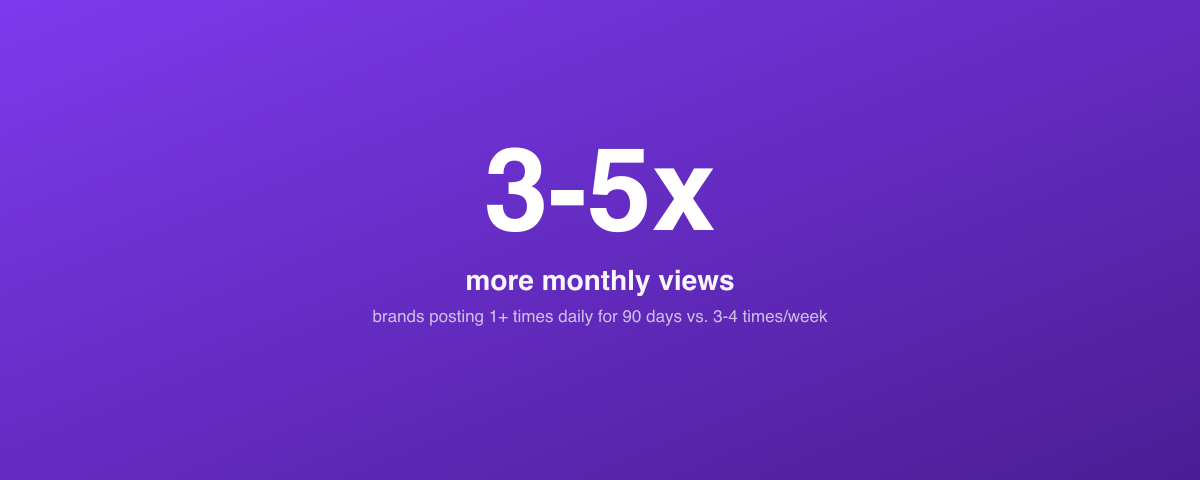
Benchmark: Brands posting 1+ times daily for 90 consecutive days see, on average, 3–5x more monthly views than brands posting 3–4 times per week, even when per-post quality is similar.
The compounding effect is real but requires consistency. Gaps in posting reset algorithmic momentum. Build a content calendar, batch-shoot once a week, and treat TikTok like an editorial operation, not a social media task.
This is also why organic social for D2C strategies that treat TikTok as an afterthought consistently underperform — the algorithm rewards sustained commitment, not sporadic effort.
How Do TikTok Shop and Product Link Integration Work?
TikTok Shop has matured into a real commerce layer. In 2026, brands with products under $60 are seeing add-to-cart rates of 4–8% on Shop-integrated content — meaningfully higher than driving traffic off-platform.
Tag products in every video where it's contextually relevant. Keep the product link prominent in your bio for higher-consideration purchases. Use the "Add to Cart" CTA overlay sparingly and only when the video is already selling — slapping a Shop link on an awareness-format video creates friction, not conversion.
Live commerce is still underutilized by most D2C brands. A 30-minute TikTok Live with a product demo and limited offer can drive more same-day revenue than a week of standard posts. The algorithm also boosts accounts that go Live regularly, creating an organic reach benefit beyond the session itself.
How Does Organic TikTok Work as a Paid Creative Pipeline?
The best-performing TikTok ads in 2026 look like organic content — because they often are. Brands running effective social media programs are systematically identifying their top organic performers and whitelisting them as paid dark posts.
The flywheel: Organic content tests creative in real conditions → high-performers get promoted as ads → ad learnings inform the next organic content batch.
This reduces paid creative production costs significantly. Instead of spending $5,000–$15,000 on a dedicated ad shoot, you're investing in an organic content operation that produces testable creative as a byproduct. Organic videos with strong completion rates and engagement already have social proof baked in when you boost them — that social proof (view counts, comments) carries over and increases paid ad credibility.
Track your organic posts' click-through rates to profile pages and link-in-bio clicks. That data tells you which content formats are generating actual purchase intent, separate from passive virality. A post with 500k views and 200 profile visits is less valuable for your business than a post with 50k views and 2,000 profile visits.
The Bottom Line
TikTok organic works for D2C brands when it's treated as a systematic content operation, not a channel you post to when you have something to say. The algorithm will distribute your content to non-followers if it earns attention — but earning that attention requires deliberate formats, tested hooks, and daily consistency over 90+ days before momentum builds.
Related guides
PART OF OUR SERVICE
Social Media
Want a free marketing audit?
We'll review your tracking, ad accounts, and funnel — and show you exactly where the gaps are.
Get Your Free Audit →