

Reels views are vanity. 10 million views with zero link clicks, zero DMs, and zero attributed purchases is just a distribution event that benefited Instagram more than your brand. The engagement and conversion figures below come from Reels accounts we've run and audited, not from platform-published averages.
"10 million views with zero link clicks, zero DMs, and zero attributed purchases is just a distribution event that benefited Instagram more than your brand."
— Nitesh Kasma, Co-Founder — Brand Strategy & Client Growth
The D2C brands actually making social media work on Reels aren't optimizing for reach — they're optimizing for a measurable downstream action, and they build every creative and posting decision around that goal.
Here's what that looks like in practice.
What does the algorithm actually reward in 2026?
Instagram's Reels algorithm has shifted its weighting over the past two years. The signals that matter most right now, roughly in order of impact:
Hook rate (percentage of viewers who watch past 3 seconds) is the gating signal. If your first 3 seconds don't hold attention, the algorithm stops distributing. Anything below 50% hook rate is a red flag. Top-performing Reels typically run 60–75%.
Watch time and replays — specifically the share of viewers who watch 75%+ and those who replay — signal to the algorithm that the content is worth pushing. A 30-second Reel where most people watch 25 seconds performs better than a 60-second Reel where most people watch 25 seconds, even though total watch time is identical.
Shares over saves. Saves indicate personal utility; shares indicate social currency. Shares have a higher algorithm weight because they extend distribution into new audiences. If your Reels aren't being shared, you're in a closed loop — your existing followers see it and the algorithm doesn't amplify it further.
Comments with substance. Emoji comments are ignored. Replies that contain multiple words, questions, or opinions signal engagement quality that the algorithm uses as a proxy for content value.
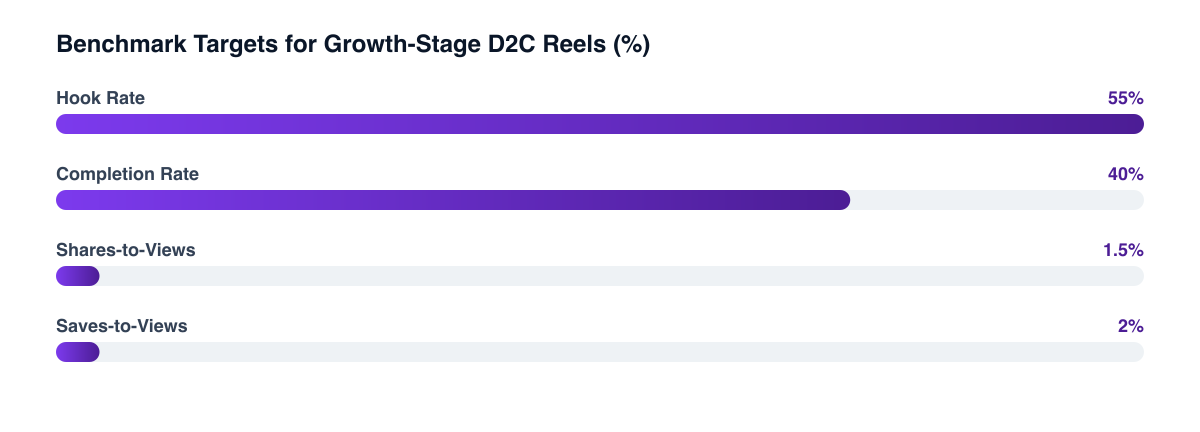
Benchmark targets for growth-stage D2C Reels: hook rate >55%, completion rate >40%, shares-to-views ratio >1.5%, saves-to-views ratio >2%.
What 3 formats drive purchase intent?
Not all Reels formats are equal for D2C. Three consistently outperform on downstream revenue metrics.
Education-first. The format: teach something specific and genuinely useful about the problem your product solves, without overtly pitching the product for the first 80% of the video. A skincare brand might produce a 45-second Reel on "the actual reason your moisturizer isn't absorbing" — and the product appears in the last 8 seconds as the solution. This format drives saves (people bookmark useful information) and comments (people have opinions and questions about the problem), which feeds the algorithm and builds intent simultaneously.
Social proof in motion. Static testimonials are dead. The format that works is stitched reaction-style Reels — a customer reviewing the product on screen, intercut with the product in use. This is different from a polished testimonial ad. The rougher the production on the customer segment, the more credible it reads. This is the format where UGC vs. Studio Creative decisions matter most: UGC wins on credibility for social proof Reels, and credibility is what drives conversion.
Product demo with a specific claim. Vague demonstrations ("look how great this product is") don't move purchase intent. Specific claim demos do. "Holds up to 48 hours — we wore it through a workout, a dinner, and slept in it" is a different video from "long-lasting formula." The specificity creates a mental anchor the viewer carries into the purchase decision. Lead with the result, show the proof, keep it under 45 seconds.
How do you write hooks for the first 2 seconds?
The first frame and first spoken or on-screen word determine hook rate. The playbook:
Lead with conflict or contradiction. "You're moisturizing wrong" outperforms "How to moisturize correctly." The brain responds to tension more than instruction.
On-screen text in the first frame. A large, readable text overlay — not a caption, but text burned into the video — extends hook rate because it gives the silent autoplay viewer a reason to unmute. Use it to state the claim or the conflict.
Open loops beat closed statements. "Here's what we found after testing 40 different formulas" creates a loop the viewer wants closed. "Our formula is different because..." closes before it opens.
Specific numbers add instant credibility. "3 reasons your ads aren't converting" is better than "Why your ads aren't converting." The number implies structure and commitment.
Ideal Reel length by format: education (35–50 seconds), social proof (20–35 seconds), product demo (25–45 seconds). Anything over 60 seconds needs to earn every additional second with content that directly serves the claim.
How do you repurpose Reels as paid creative?
The Reels that drive organic engagement are your best signal for paid creative. High hook rate plus high completion rate on organic tells you the format and message are resonating — running it as a paid Spark Ad removes the creative risk.
The mechanics: boost organically for 3–5 days and let it accumulate 10,000+ views before making a paid decision. A Reel that organically hits a 55%+ hook rate and 1.5%+ share rate on cold distribution (non-followers seeing it on the Explore or Reels feed) is a strong candidate for paid amplification. One that only performs well with your existing followers is less signal.
When running Reels as Spark Ads, keep the social proof intact — the existing likes, comments, and shares stay on the post and they matter. A boosted Reel showing 2,400 likes outperforms the same creative run as a dark ad with zero social proof, even with identical targeting. The social signal is part of the ad.
Pair your Reels content strategy with a structured Story cadence. Stories are where the link click happens. The funnel: Reel drives awareness and interest → Story with link sticker drives the click. Post a follow-up Story within 24 hours of each Reel that pushes viewers who engaged with the Reel to take an action. Keep Story CTAs direct — "swipe to shop" is less effective than "link in Story for the full formula breakdown."
How do you measure actual revenue contribution?
Views and engagement rates tell you what the algorithm thinks of your content. They don't tell you whether Reels is making you money. That measurement requires a different setup.
UTM parameters on every link. Every Story link, every bio link, every link in caption should carry UTM parameters with a source (instagram), medium (reels or stories), and campaign (the specific content piece or series). Most brands use generic utm_source=instagram on everything and then wonder why they can't see which content drives revenue. Granular UTMs are the minimum.
GA4 source/medium reporting. With UTMs in place, GA4 gives you sessions, purchase events, and revenue by content source. The filter that matters: compare instagram/reels versus instagram/stories versus instagram/paid across a 30-day window. You'll typically see that paid drives the most revenue, Stories drives better conversion rates on lower volume, and organic Reels drives significant assisted conversion that shows up in multi-touch paths rather than last-click.
Post-purchase survey attribution. For D2C brands on Shopify, a single post-purchase survey question ("Where did you first hear about us?") with Instagram Reels as an option routinely captures 15–25% of new customer traffic that GA4 attributes elsewhere. Dark social from Reels — someone sends a friend a Reel, the friend searches your brand and buys — shows up in direct or organic search in GA4. It originated with Reels. The survey catches it.
This is the same gap covered in detail in Organic Social for D2C: What Actually Drives Revenue vs. What Just Gets Likes — the measurement problem is structural, and fixing it changes how you allocate creative resources.
Combined measurement setup: UTM-tagged links in all active traffic channels + GA4 acquisition reporting + post-purchase survey. Together these give you 85–90% accuracy on channel attribution vs. 55–60% with last-click GA4 alone.
What posting cadence and content mix work best?
For a growth-stage D2C brand with limited production resources, the sustainable cadence that drives compounding results: 4–5 Reels per week, with a 60/30/10 content mix — 60% education/value, 30% social proof, 10% direct product/offer content.
The mistake most brands make is inverting this: they post mostly product content because that feels most on-brand, and the algorithm treats it as promotional content with low organic value. The education content builds audience and algorithmic trust; the social proof content converts warm viewers; the direct offer content closes. All three need to be present and in roughly this proportion for the system to work.
Batch-produce content in themed sprints rather than creating individual Reels ad hoc. A single production day focused on "the 5 most common objections to buying [product category]" generates 5 education Reels, 5 potential hooks for social proof followups, and 5 demo angles for product content. The interconnected content also drives watch chains — a viewer who watches one Reel gets served the next.
The bottom line
Reels drives D2C revenue when you treat it as a conversion funnel rather than a broadcast channel — hook rate and watch time earn distribution, the right formats build purchase intent, and UTM-tagged Story links plus post-purchase surveys close the measurement gap. Brands that crack this combination typically see organic Reels contributing 20–35% of new customer acquisition when properly attributed, at close to zero marginal cost.
Related guides
PART OF OUR SERVICE
Social Media
Want a free marketing audit?
We'll review your tracking, ad accounts, and funnel — and show you exactly where the gaps are.
Get Your Free Audit →