
A referral program is often pitched as acquisition on autopilot. In practice it is a discount programme with a social wrapper, and whether it makes money depends on who would have bought anyway and who is gaming the reward.
"A referral program doesn't create advocates. It gives existing advocates a reason and a rail. If nobody was going to recommend you, a coupon won't change that."
— Nitesh Kasma, Co-Founder — Brand Strategy & Client Growth
When does a referral program actually work?
When the product is already something people talk about. Categories with a visible result, a shareable gift moment, or a problem friends are likely to share (skincare, food, home, kids' products, personal care) tend to fit better than low-interest, rarely discussed purchases. A leading indicator is behaviour you already have: repeat purchasers, strong reviews, and customers who send friends your link unprompted.
If second-purchase rates are weak, fix that first. Referral amplifies satisfaction; it can't manufacture it, and a brand with a shaky second-purchase rate will mostly refer people into the same disappointment. This is also not loyalty: loyalty rewards your customer for their own repeat behaviour, referral pays them to bring someone new.
How should the incentive be structured?
Decide who gets rewarded, when, and in what currency. A few choices carry most of the weight:
- Two-sided or one-sided. A reward for both parties gives the referrer something to say to a friend ("you get X, I get Y") and gives the friend a reason to act. One-sided is cheaper but weaker as a message.
- Store credit over cash. Credit pulls the referrer back to buy again, and it costs you margin rather than cash if it is used. In our experience, cash payouts tend to attract more abuse.
- Pay on a qualifying order, not a sign-up. Our usual practice is to reward after the friend's purchase clears the return window, not when they enter an email.
- Set a floor and a cap. A minimum order value protects margin; a cap per referrer limits exposure.
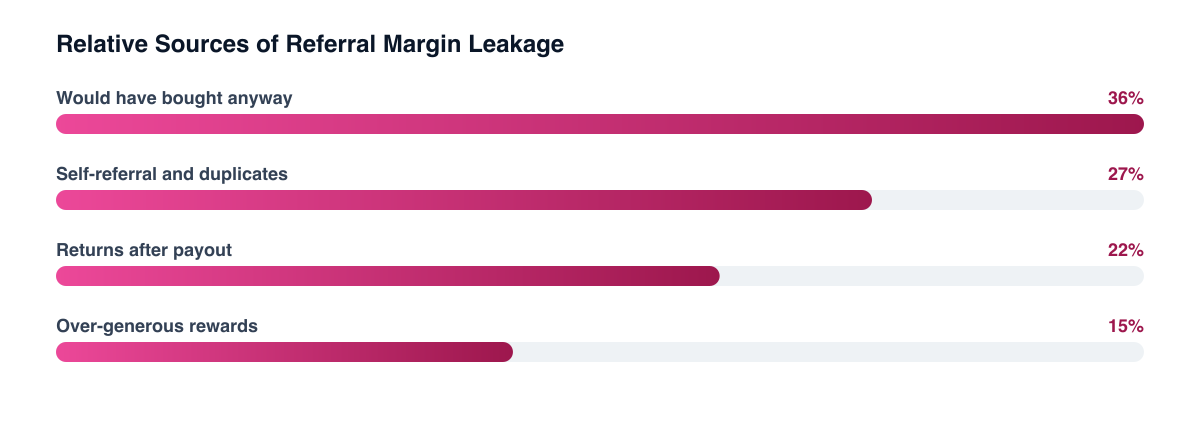
The chart is illustrative of where the leaks usually sit; your split will depend on your reward design and controls.
What about gifting programs?
Gifting is a close cousin with a different mechanism: the customer buys for someone else, or sends a free sample or gift to a friend. The recipient's first experience is a present, not a promotion, which usually feels better than a discount code. It also gives you a new profile to onboard, but only if you capture their consent and details properly. Don't add gift recipients to marketing flows unless the right permission exists for their region.
How do you stop fraud and abuse?
Assume it will happen, because rewards attract it. Typical controls are:
- Match identity signals such as email, shipping address, payment method, and device, so a person can't refer themselves under a new name.
- Hold rewards until the order is delivered and past the return window.
- Block stacking with other discounts, or limit it.
- Cap rewards per referrer and flag outliers for manual review.
- Monitor coupon-site leakage, because shareable referral codes can end up on public deal pages where anyone can use them.
Disclosure matters too. A referrer who is paid is an endorser with a material connection, and the FTC's Endorsement Guides say such connections must be disclosed clearly where a significant share of consumers wouldn't expect them. Build a plain disclosure into the share message, and don't condition rewards on positive reviews. Check your local rules, too: in the UK, for example, the CMA says any incentive, including discounts and gifts, counts as payment and the post must be labelled clearly as an ad.
Measure incremental customers, not referred orders Count only new customers who wouldn't have found you otherwise, net of rewards, fraud, and returns. Anything else flatters the programme.
How do you measure whether it's incremental?
Referral attribution can overcount, because a code may be used by people who were already on their way to buy. The cleanest approach is a holdout: expose the programme to a random share of eligible customers, withhold it from the rest, and compare new-customer volume and margin. The logic is the same as a holdout incrementality test, applied to customers rather than regions. Then calculate cost per new customer, including rewards and abuse losses, and compare with your other channels in the same terms.
Also watch what referred customers do next. If they repurchase at rates similar to other channels, the programme is feeding your retention economics. If they are one-and-done coupon users, you are paying for orders, not customers.
Related guides
- Loyalty Programs for D2C Brands: How to Build One That Actually Drives Repeat Purchases
- The Second Purchase: The Retention Metric That Predicts All the Others
- VIP Tiering for D2C: Segmenting Your Best Customers Without a Loyalty Platform
- D2C Retention: How to Turn One-Time Buyers into Loyal Customers
Run referral and gifting as a controlled experiment with a clear ceiling on cost, then widen it only if the incrementality holds. Designing the incentive, the abuse controls, and the measurement as one system is the core of our CRM and retention work.
Want a free marketing audit?
We'll review your tracking, ad accounts, and funnel — and show you exactly where the gaps are.
Get Your Free Audit →