

Ask a D2C team how retention is doing and you'll get a repeat purchase rate or an LTV figure. Moving that number is the whole job — for one beauty brand it meant going from 22% to 32% of customers buying again inside 90 days. Both are lagging, both are heavily influenced by cohorts acquired a year ago, and neither tells you whether what you changed last month worked.
"The gap between one order and two is the widest in the entire customer lifecycle. Everything after it is a smaller problem."
— Nitesh Kasma, Co-Founder — Brand Strategy & Client Growth
Why is the second order the one that matters?
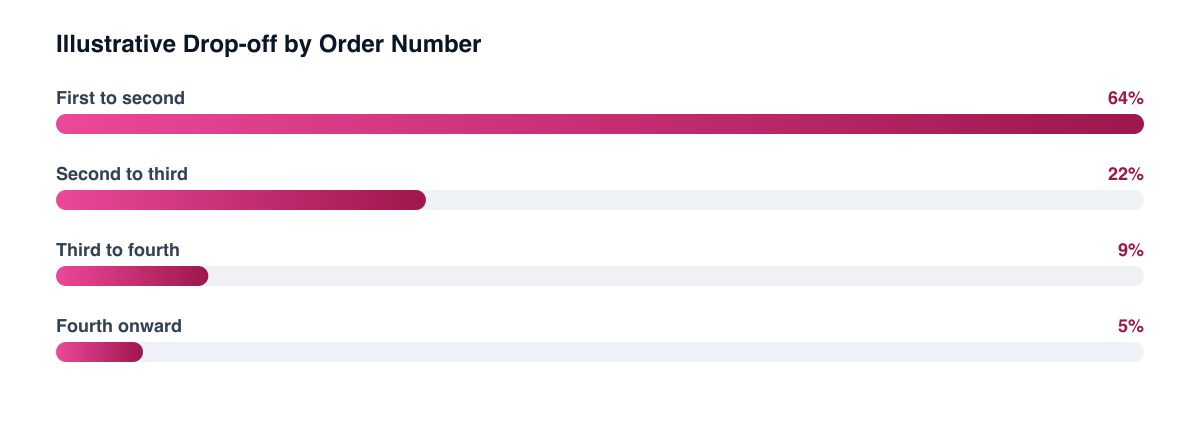
Because the probability of a third order, given a second, is dramatically higher than the probability of a second given a first. The first repeat is where the customer decides the brand is a thing they buy rather than a thing they bought — and where most of the population is lost.
That makes it the highest-leverage point in the lifecycle and, usefully, the fastest to measure. Second-purchase rate within a fixed window — 60 or 90 days depending on your category — is readable per acquisition cohort within a quarter, while LTV is still stabilising.
What actually moves it?
Four things, and only one of them is an email:
- The product experience of the first order, including delivery time and packaging. A late or damaged first delivery costs more repeat revenue than any flow recovers — which is why the returns and delivery experience belongs in the retention budget rather than in operations alone.
- What they bought first. Some entry products predict repeat purchase and some don't. Discovering which is a segmentation exercise most brands haven't run, and it should reshape what your ads promote.
- Timing relative to consumption. For consumables, the reorder prompt has to land near run-out. Too early it's ignored, too late the customer has already bought elsewhere.
- How they were acquired. Cohorts acquired on a deep first-order discount repeat at a materially lower rate. This is the single most common reason a rising acquisition volume is followed by a falling retention rate a quarter later.
Report second-purchase rate by acquisition cohort and offer A blended number hides the trade-off you're actually making. Splitting it by acquisition channel and first-order discount level usually settles an argument the team has been having for months.
What does a programme built around it look like?
The post-purchase window becomes the priority, not the campaign calendar. That means a flow structure where the sequence between order one and order two carries the most attention, the best offers, and the most testing — and where the content is determined by what the customer bought, not by where they sit in a value tier.
It also changes what a loyalty programme is for. Points schemes designed to reward high-frequency customers are rewarding people who were going to repeat anyway. A programme that pays out meaningfully at the second order is aimed at the population that actually needs converting, which is a different design — see loyalty programme structure for the trade-offs.
What does it not tell you?
Margin. A second-purchase rate bought with a heavy discount looks identical in the metric to one earned by product satisfaction, and they have completely different futures. Pair it with contribution margin per cohort, or you'll optimise your way into a busy, unprofitable repeat base.
It also won't tell you about long-cycle categories. If your product is bought once every eighteen months, second-purchase rate at 90 days measures noise, and cohort analysis over a longer horizon is the right instrument instead.
Related guides
- D2C Retention Strategy: The Complete Guide
- Cohort Analysis for D2C: Reading Retention Properly
- Customer Lifetime Value: A Practical Guide
- Loyalty Programs for D2C: What Actually Drives Repeat Purchase
Pick one metric for the retention team to move this quarter and make it second-purchase rate by cohort. It reads faster than LTV, it points at fixable causes, and it's the number most worth building a CRM and retention programme around.
PART OF OUR SERVICE
CRM & Retention
PROOF FROM A CLIENT
+45% repeat purchase rate
from 22% to 32% of customers purchasing again within 90 days · Beauty & Personal Care
How a Beauty D2C Brand Lifted Repeat Purchase Rate by 45% with a Loyalty Program Rebuild→Want a free marketing audit?
We'll review your tracking, ad accounts, and funnel — and show you exactly where the gaps are.
Get Your Free Audit →