

In Q4 a large share of your visitors in the US, UK and Australia aren't shopping for themselves, and a catalogue organised by product type makes them do the translating. "Gifts for a coworker under $50" isn't a category on most stores, so those visitors leave or search.
"A gift shopper arrives with a person and a budget, not a product name. If your navigation only knows product names, you're asking them to do your merchandising."
— Aashish Kasma, Co-Founder — Data & Analytics
How are gift shoppers different from your regular customers?
They know less about your range, have a fixed budget and a fixed deadline, and often can't judge fit or taste. A repeat buyer searches for the thing they love; a gift buyer needs reassurance that the item suits someone else, will arrive in time, and can be returned if it doesn't. That changes what a page has to do: narrow choices fast, show price clearly, and answer delivery questions without a click. Check your own data before assuming this: segment last year's November and December sessions by landing page and search terms to see which "gift" queries appeared in your site search reports.
Which gift collections are worth building?
Three cuts cover most stores, and you don't need all of them for every catalogue:
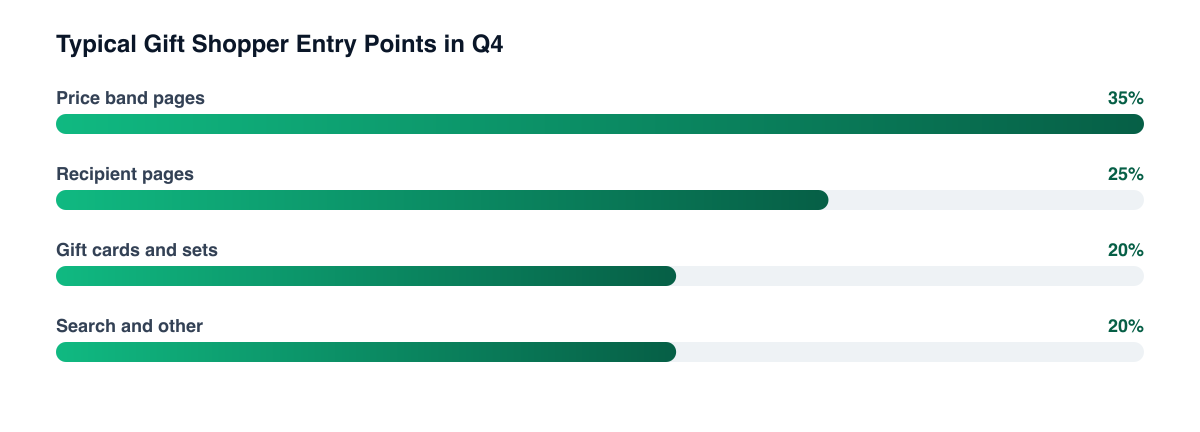
- Price band. "Gifts under $25 / $50 / $100" (adjust for £ or A$, and use your own price points, not these). This is usually the highest-value cut because budget is the first filter a gift buyer applies.
- Recipient. "For her", "for him", "for kids", "for the host", "for the person who has everything". Only use recipients your products can credibly serve; a forced recipient page full of mismatched items hurts trust.
- Gift-ready. Items that ship in gift packaging, bundles, sets and gift cards. This is the cut that carries your delivery and presentation promise.
Shopify's rule-based collections can populate these automatically from product conditions, which keeps them current as stock changes; Shopify's automated collections documentation covers the limits. In practice, a consistent product tagging scheme (for example gift-under-50 or gift-for-host) is easier to maintain than conditions rebuilt each season. That tagging approach is practitioner habit, not a Shopify requirement.
Should these be collections or landing pages?
Both can work, and the question is already covered in landing pages vs collection pages. The seasonal angle is simple: use collections for permanent-feeling, filterable browsing that your navigation and site search can point to, and a landing page when a paid campaign needs a tighter story, such as a single headline, a hand-picked set of products, a delivery cutoff and one call to action. Keep the product sets consistent, or your price-band collection and your ad landing page will disagree about what "under $50" means.
Where do they belong in the navigation?
Where a gift shopper's eye already is. Put "Gifts" as a top-level item from mid-October, with the price and recipient cuts as its sub-items. On mobile, where most of this traffic is, treat the menu as a conversion surface rather than a sitemap, as covered in our mobile navigation guide. Add the gift link to your announcement bar and homepage hero as well, and keep it live into December rather than switching it off right after Cyber Monday (Nov 30 this year); gift demand doesn't stop on that date.
Don't remove your regular navigation to make room. Returning customers still need the usual route to their products, and a navigation rebuild just before BFCM is exactly the sort of change that deserves a test, not a hunch.
How do you carry the delivery promise into gift pages?
This is where a gift page differs from an ordinary collection. Each page should state the order-by date for Christmas delivery, show whether gift wrap or a gift message is available, and link to your returns terms for gifts. The date has to come from the carrier's current holiday schedule, set conservatively; see how to build a delivery promise you can keep. A gift page that promises a date you can't meet is worse than no page.
A few supporting elements worth adding:
- A gift card option as the last-minute fallback after your physical cutoff passes.
- Short product benefit lines that answer "will they like it?", such as who it suits, not a spec list.
- Reviews that mention gifting, where you have them. A short quiz is a different route for shoppers who want help choosing.
Build the budget cut first If you only have time for one gift collection before Black Friday, make it a price-band page with the delivery cutoff shown above the products. Then check whether it shows up in your site search and analytics before adding more.
Related guides
- Landing Pages vs. Collection Pages: Where Paid Traffic Should Actually Land
- Mobile Navigation Is a Conversion Surface, Not a Sitemap
- Shopify Site Search: The Conversion Lever Hiding in Your Analytics
- Bundles vs. Discounts: How to Frame Offers for D2C
Gift-led collections are a merchandising job more than a design one: pick the cuts your shoppers actually use, tag the catalogue to match, and be honest about delivery. If you'd like help structuring and testing them before Black Friday, our Shopify CRO team can build and measure the set with you.
Want a free marketing audit?
We'll review your tracking, ad accounts, and funnel — and show you exactly where the gaps are.
Get Your Free Audit →