

Most D2C stores in the US, UK and Australia either hide their Christmas delivery dates until December or promise the carrier's best case and hope. Both cost money: the first loses gift buyers who need certainty, the second turns a late parcel into a refund, a chargeback and a one-star review.
"A delivery promise is a conversion lever until the first missed date. After that it's a refund policy."
— Dhruvit Shah, Co-Founder — Performance Marketing & Growth Strategy
Why does a visible cutoff date lift conversion in Q4?
Gift buyers have a hard deadline, and a product page that doesn't answer "will it arrive by the 24th?" pushes them to a competitor that does. The cutoff turns an open question into a decision. It also does something less obvious: it creates honest urgency. "Order by Thursday for Christmas delivery" is a fact, not a countdown timer, and it holds up better with returning customers than manufactured scarcity.
I can't give you a reliable lift figure for this, and I'd distrust anyone who does without your data. Test it: show the cutoff on product pages, in the cart and at checkout for one segment, and compare conversion and support tickets about delivery.
Where should carrier schedules come from?
From the carrier's own published holiday page, not from a roundup blog or last year's spreadsheet. Dates shift with how Christmas falls in the week, and carriers revise them. Check each carrier's current holiday schedule when you set your dates, and again in mid-November:
- US: the USPS holiday shipping page publishes recommended mailing dates by service; UPS and FedEx publish their own holiday schedules and service cutoffs on ups.com and fedex.com.
- UK: Royal Mail publishes last-posting dates on its Christmas page.
- Australia: Australia Post lists domestic and international cut-offs at auspost.com.au/christmas, and recommends sending parcels as early as possible and by those dates.
Note what these are: recommendations for service levels, usually measured from the carrier's induction point, not from the moment a customer clicks buy. International and remote-area deadlines are earlier than domestic ones, so a store selling cross-border needs a separate date per destination.
How conservative should your promise date be?
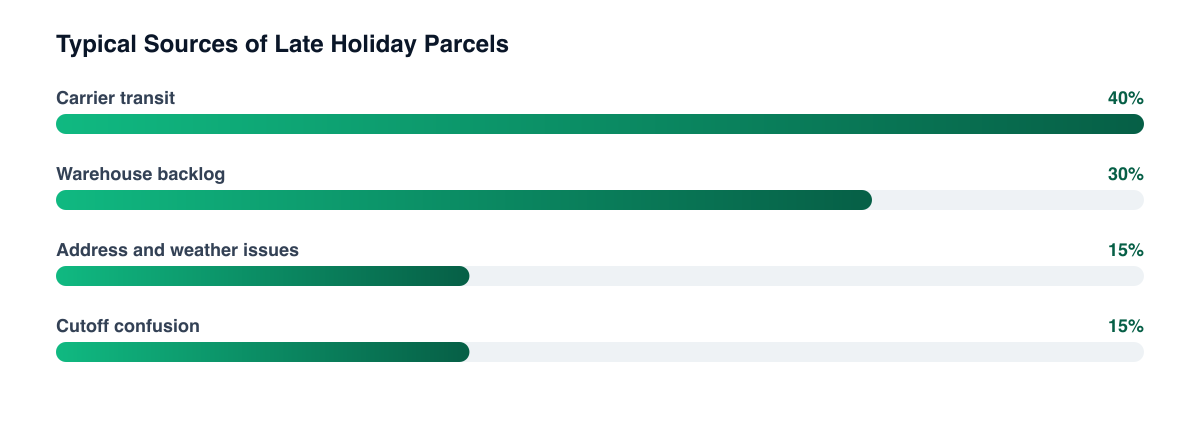
More than the carrier's date, and by an amount you can defend. The carrier's cutoff covers transit. Your promise has to cover everything before the parcel is handed over: payment review, pick and pack, a warehouse backlog after a Black Friday weekend (Nov 27 to Nov 30 this year), and the pickup schedule. The mechanism is simple arithmetic: your order cutoff equals the carrier's recommended date minus your handling time minus a buffer.
Practical rules, drawn from practitioner experience rather than a published standard:
- Set your own cutoff earlier than the carrier's, by at least a full working day, and a few more for the post-BFCM pile-up.
- Use one date per region, not a single national one, if you ship to remote areas. Australia Post's own page differentiates by location.
- Close the guaranteed window before the carrier does. After your cutoff, change the message to "ships after Christmas" or offer a gift-card option rather than leave the badge up.
- Promise a date, not a speed. "Arrives by Dec 22" is checkable; "fast delivery" isn't.
What do you do when carriers add surcharges or slip?
First, check whether the cost is yours or the customer's. UPS, FedEx and USPS each publish seasonal demand or peak-related surcharges on their own rate pages, and the amounts and dates change year to year, so read the current notices rather than a summary. Then model it against your margin: a surcharge on every residential parcel quietly eats a promotional discount. If your free shipping threshold was set in the spring, it probably needs revisiting before BFCM.
When a carrier slips, communicate before the customer asks. Send a proactive email with the real tracking status, and decide in advance what you'll offer: reship, refund or a credit. A pre-agreed rule is faster than a case-by-case argument in December. Late deliveries also feed returns and retention, so how you handle them matters beyond the single order.
Publish a cutoff you can defend, not the carrier's best case Take the carrier's current recommended date, subtract your own handling time and a buffer, and show that date on product pages and in the cart. Re-check it in mid-November.
What should the shipping messaging look like on the site?
Keep it consistent across the place where doubts appear:
- Product page: a short line under the add-to-cart button, such as "Order by [date] for Christmas delivery."
- Cart and checkout: the same date, by shipping method, so the customer isn't surprised at the last step. This ties into checkout optimisation.
- Policy pages and FAQ: the full table, plus returns terms for gifts.
- Email and ads: the same cutoff, so your media plan doesn't keep driving traffic to a promise you've closed.
Update every surface at once. A banner that says "order by the 18th" next to a checkout that says the 16th is worse than saying nothing.
Related guides
- BFCM Media Planning: What to Lock in October, and What to Leave Flexible
- Checkout Optimisation on Shopify
- Reducing Cart Abandonment
- Building a High-Converting Product Page
A clear, conservative delivery promise is one of the cheaper conversion wins available in Q4, because it's mostly a matter of reading carrier pages and doing the sums. If you'd like help testing cutoff messaging across your product, cart and checkout, our Shopify CRO team can set up and measure it before the rush.
Want a free marketing audit?
We'll review your tracking, ad accounts, and funnel — and show you exactly where the gaps are.
Get Your Free Audit →