
Most ad scripts start in a brand deck and end in a headline nobody would say out loud. Meanwhile the better copy is already sitting in your review section, written for free by people who bought the product.
"A customer describing why they bought will always out-write us describing why they should. Our job is to find the sentence, not invent one."
— Palash Shukla, Creative Designer
Why do customer words beat our own copy?
Because they carry two things a brief can't: the vocabulary people actually use, and the order they care about things in. A brand says "clinically formulated hydration"; a customer says "my skin stopped feeling tight by lunchtime." The second is a hook, a benefit, and a proof point in one line.
There's a caution that cuts the other way. Reviews are a self-selected sample, not a representative one, so they tell you how customers talk and what they worry about, not how large each group is. Treat them as a source of hypotheses, then let a structured creative test decide which ones deserve spend.
What should you actually pull, and from where?
Don't limit yourself to five-star reviews on the product page. The most useful raw material is spread across several places:
- Three- and four-star reviews — the "it's great, but" sentences are where real objections live.
- One-star reviews and returns notes — the expectation gap, in the customer's own words.
- Support tickets and pre-purchase chat questions — what people needed answered before they'd buy.
- Post-purchase survey answers — especially an open "what almost stopped you?" question.
- Competitor reviews (public ones) — the frustrations your product might solve.
Read a few hundred entries by hand before touching any tool. Summaries from software flatten the phrasing, and the phrasing is the point.
How do you turn raw reviews into hooks and objections?
Code each entry into a small set of buckets, then count roughly. A simple pass:
- Copy the exact phrase that does the work, not a paraphrase.
- Tag it: problem before purchase, objection, surprise benefit, comparison, or outcome.
- Group near-duplicates into themes and note which appear again and again.
- Pair each theme with a format: a problem phrase suits a first-three-seconds hook, an objection suits a direct-answer ad, an outcome suits a testimonial.
- Write one brief per theme, quoting the source phrase so the designer and editor hear the customer, not a summary.
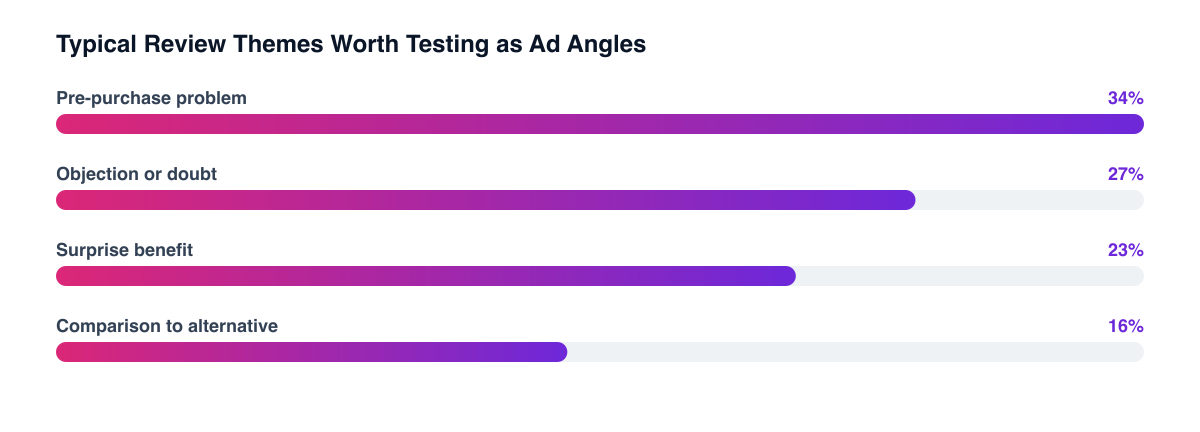
The chart is illustrative: the mix differs by category, and your own coding will tell you yours.
Where does this go wrong?
The first failure is quoting too literally. A review that works as a sentence on a page can fall flat when read aloud in a video, so rewrite for the medium but keep the words that carry the meaning.
The second is legal. A review used in an ad is an endorsement, and the FTC's Endorsement Guides say it must reflect the endorser's honest opinion, and that ads should make clear what results are generally expected when a quoted result is exceptional. Don't polish a quote into a claim you couldn't make yourself, and don't invent or edit reviews: the FTC's final rule on fake reviews and testimonials targets reviews by people who don't exist or never used the product, and incentives tied to a particular sentiment. Get permission before using a customer's name or image, and check any quote against the claims your category restricts.
The third is stopping at ads. The same objection that makes a good ad also belongs on the page, which is why strong reviews and social proof on the product page and strong creative should draw from one shared phrase bank.
Keep a living phrase bank, not a one-off audit Add new review language to a shared document monthly, tagged by theme. It becomes the first place your team looks when creative fatigue sets in and new angles are needed.
How do you know it worked?
Judge the angle, not the individual ad. Run each theme as its own concept with a few executions, compare on the metric tied to your goal, and keep the themes that win across more than one format. A theme that wins only in a single execution is a good ad; one that wins across formats is a finding about your customer.
Related guides
- D2C Creative Strategy: The Complete Guide to a High-Converting Creative Engine
- The Creative Testing Framework That Scales What Works
- UGC vs. Studio Creative: Which Actually Performs Better on Meta and TikTok in 2026
- The First Three Seconds: Writing Hooks That Stop the Scroll
The people who bought from you have already told you what mattered, in words you could never script. Turning that into briefs, hooks, and a repeatable testing habit is the day-to-day work of a creative and branding team that listens before it designs.
Want a free marketing audit?
We'll review your tracking, ad accounts, and funnel — and show you exactly where the gaps are.
Get Your Free Audit →