
Targeting is no longer a moat. With broad targeting, Advantage+, and Performance Max doing most of the heavy lifting, the era of sophisticated audience segmentation as a competitive edge is largely over. What remains — and what has compounded in importance — is creative. The brands consistently driving efficient growth on paid social in 2026 are winning because their creative is better, more systematically tested, and produced faster than competitors. Everything else is table stakes.
This guide covers the full creative strategy lifecycle for D2C brands: how to think about creative as a performance lever, how to build the infrastructure to generate and test it, and how to keep the pipeline producing winners at scale.
Why is creative now the primary performance lever?
Meta's algorithm has been remarkably candid about this shift. Broad targeting works because the platform uses creative signals — who engages, who clicks, who buys — to find the right audience. The ad itself is the targeting parameter. Run weak creative and you're not just getting low engagement; you're training the algorithm to find low-intent users because those are the only people responding to what you're showing.
This has a direct implication for budget allocation. Brands spending 80% of their attention optimizing bidding strategies and 20% on creative have it exactly backwards. The creative itself is doing the audience targeting work now.
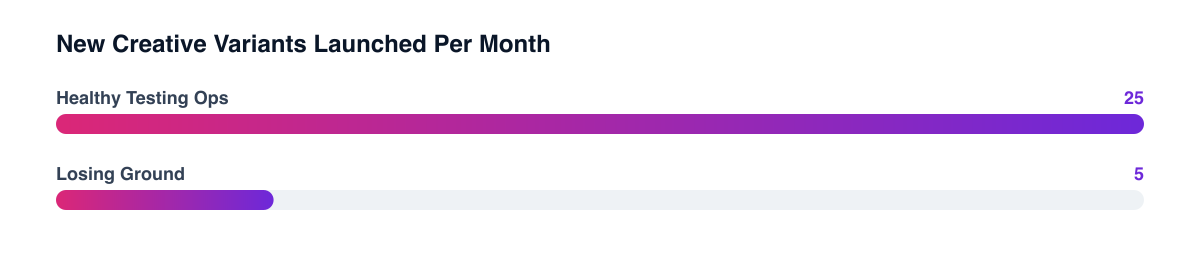
The practical benchmark: brands with a healthy creative testing operation launch 15–25 new creative variants per month. Brands losing ground are typically launching 3–5 and declaring winners based on insufficient data.
The second reason creative matters more is ad fatigue. On Meta alone, an effective frequency above 3–4 in a 7-day window reliably degrades performance. With iOS signal loss making frequency tracking less precise, the only hedge is creative volume — keep rotating fresh assets before the algorithm signals saturation.
How do you build a creative testing framework that generates real learnings?
Most brands test creative the wrong way. They run two ads, one wins, they scale it, then wonder why performance collapses three weeks later. That's not a testing framework — it's guessing with extra steps.
A real creative testing framework is designed to produce reusable knowledge, not just winners. Every test should be answering a specific question: Does emotional storytelling outperform direct product demo for this product category? Does a 3-second text hook outperform a visual-only open on Reels? Does social proof in the first 5 seconds beat offering in the first 5 seconds?
The structure that works:
Variable isolation. Change one element at a time. If you test a new hook, keep the body and CTA identical. If you test a new format, keep the offer identical. Brands that change three things at once never know what moved the needle.
Minimum viable spend per test. A reasonable threshold is 1,000 impressions or $50 spent — whichever comes first — before drawing any directional signal. For conversion-based tests, budget for at least 50 purchase events per variant. That figure isn't arbitrary: Meta's own guidance on the learning phase sets roughly 50 optimisation events per ad set in a rolling seven-day window as the point at which its delivery system has enough data to optimise reliably. Below that threshold, Meta itself treats the results as too noisy to act on — and so should you. This means most purchase-level tests require meaningful budgets. Many brands test at the click or landing page level first, then validate conversion impact on promising variants only.
Systematic tagging and documentation. Every asset that goes into testing needs a naming convention that captures: format (UGC, studio, motion graphic), hook type (question, stat, problem/agitation), offer type (discount, free shipping, social proof), and product focus. Without this, your creative library becomes a black box and you can't extract learnings across campaigns.
Framework: test hooks first (highest leverage), then format, then offer, then CTA. Across the creative tests we've run, hook quality alone explains roughly 40–60% of performance variance — which is why it goes first.
The goal of a testing framework isn't to find one great ad. It's to build a documented map of what message types, formats, and hooks resonate with your audience — so every new creative brief starts from accumulated knowledge rather than a blank slate.
Which creative formats matter in 2026?
The format landscape has shifted substantially. Understanding what works — and why — saves budget and production time.
UGC and creator-led content remains the dominant format on Meta and TikTok for most D2C categories. The core reason isn't authenticity theater — it's that UGC-style content matches the native feed environment, which reduces the subconscious ad-recognition friction that degrades engagement. One operational caveat that catches brands out at scale: once you pay a creator or provide free product, the FTC's Endorsement Guides require the material connection to be disclosed clearly in the asset itself — and that obligation follows the content when you licence it into paid media, where the disclosure is your responsibility rather than the creator's. For a detailed comparison of when UGC actually outperforms studio and when it doesn't, the data is more nuanced than the consensus suggests — read the full UGC vs. studio creative breakdown.
Studio and brand-direct content still wins in specific contexts: luxury and premium-positioned brands where production quality signals brand value, products requiring complex demonstration, and retargeting audiences who already know the brand. The mistake is treating studio as default and UGC as a supplement — for most D2C brands at growth stage, it should be the reverse.
AI-generated and AI-assisted creative has become a real production category, not an experiment. Lifestyle image variants, background swaps, multilingual video dubs, and hook-swap iterations can now be produced at a fraction of the cost and time of traditional production. The constraint isn't the technology — it's having a creative strategy clear enough to tell the AI tools what to produce. Full breakdown of what's working in AI creative production for D2C.
Hybrid creative — combining AI-generated environments with real talent, or mixing studio footage with UGC-style hooks — is increasingly where the high performers are operating. These formats get the production efficiency of AI with the authenticity signals of human presence.
Static ads are underrated. On Meta especially, a high-quality single image with a strong headline and clear product shot routinely outperforms video in direct response testing, particularly for simpler products and retargeting. Don't abandon static because video is the prevailing trend.
How do you brief creators and agencies for performance?
Bad briefs are the most common and expensive creative bottleneck in D2C marketing. When a brand hands a creator a two-line brief that says "make something authentic about our product," they're essentially asking for brand content and hoping it works as a performance ad. It usually doesn't.
Performance-oriented briefs specify: the one problem the ad is solving for the viewer, the specific hook concept (not just "be engaging" but "open with the specific complaint our customer has before they found us"), the proof points that close skepticism, and the exact call to action. The creator's job is to deliver those elements in their authentic voice — not to invent the strategy.
The brief should also specify format constraints: video length, aspect ratio, whether the brand logo or product needs to appear within the first 3 seconds, whether there's a specific offer to include. These aren't creative constraints — they're performance requirements.
Briefing creators and influencers for maximum ad performance covers the exact brief structure that consistently produces usable performance assets rather than content that needs to be scrapped.
When working with agencies, the brief structure is different but the discipline is the same. Agencies need to understand not just the creative direction but the hypothesis being tested, the audience context, and what a winning result looks like in terms of specific metrics — ROAS threshold, CTR benchmark, video completion rate target.
Why is brand identity a performance multiplier?
Brand identity and performance creative are often treated as separate workstreams by separate teams. This is a mistake. Brands with strong, consistent visual and verbal identity get more out of every performance dollar they spend.
The mechanism is simple: brand recognition reduces purchase friction. When a user who has seen your ads 10 times encounters your ad for the 11th time, the subconscious familiarity accelerates the path to conversion. The effect compounds over time — brands that maintain consistent identity across paid, organic, and email see lower CAC as they scale, not higher. The audience gradually requires less persuasion because recognition has built trust.
The practical implication is that performance creative should operate within brand guardrails, not outside them. Your UGC creator should be using your product with your packaging in your brand's world — not creating an ad that looks like it could be for any DTC brand. A strong brand identity for D2C does the heavy lifting of memorability, differentiation, and trust that no targeting optimization can replicate.
Key principle: brand consistency isn't about restricting creative — it's about making sure the audience knows who they're buying from. Distinctive assets (colors, typography, product presentation style, verbal tone) should be recognizable across every variant you test.
How do you produce video for performance?
Video is the highest-leverage format and the most common source of wasted production budget. The disconnect is usually that brands produce videos for brand objectives — storytelling, emotional resonance, brand world-building — and then run them as direct response ads where the first 3 seconds determine everything.
The most important thing to understand about D2C video ad production is that the creative hierarchy in performance video is: hook, hook, hook — then everything else. The first 3 seconds need to capture attention and communicate enough context to make the viewer want to keep watching. The middle 15–45 seconds do the job of establishing credibility, demonstrating the product, and addressing objections. The final 5–10 seconds deliver the offer and the CTA.
Practically, this means producing video with the performance structure in mind from the brief stage, not trying to retrofit a brand film into a performance ad in post. It also means producing multiple hook variations for every piece of body content — a common efficient structure is one set of body footage with 5–8 different opening hooks, which multiplies your testable variants without proportionally multiplying production cost.
Aspect ratio and format matter more than most brands account for. A video produced for a 16:9 YouTube pre-roll does not work as a 9:16 TikTok or Reels asset. If 60%+ of your paid spend is going to vertical mobile placements, your production should be native vertical, not cropped horizontal.
How do AI tools fit into the creative workflow?
AI's role in creative production has matured beyond experimentation. The brands getting real value from it have integrated it into specific parts of the workflow rather than treating it as a replacement for creative thinking.
Where AI delivers consistent lift: image variation and background generation, script first-drafting and hook ideation, video repurposing and reformatting, translation and localization, and creative performance analytics. What it cannot replace: the creative strategy that determines what to make, the brand judgment that determines what's on-brand, and the human presence that makes UGC-style content feel real.
The production math changes meaningfully with AI in the stack. Brands that previously produced 8–10 testable variants from a single shoot can now produce 30–40 through AI-generated variants, background swaps, and copy iterations. This is the volume needed to run a real testing operation.
The risk to manage is output homogeneity. When every brand uses the same AI tools on similar briefs, the creative output starts to look similar. The competitive advantage shifts back to the quality of the brief and creative strategy — AI executes the strategy, but the strategy has to be distinctive.
How do you build a creative pipeline that never runs dry?
The most common creative failure isn't bad creative — it's no creative. Brands running on 2–3 active variants with no production in flight are one winning-ad-fatigue event away from a performance cliff. Building a pipeline means treating creative production as a continuous operation, not a project.
A sustainable pipeline structure for a growth-stage D2C brand typically looks like:
Monthly creative sprints. A defined cadence — usually 2-week cycles — where briefs are issued, assets are produced, and tests are launched. This prevents the ad-hoc, reactive production mode that creates gaps.
A tiered content mix. Not everything requires a full production shoot. A healthy mix might be: 20% high-production hero content (quarterly), 40% creator/UGC content (monthly), 40% AI-generated variants and iterations (continuous). The high-production work provides the foundational assets that the other tiers remix and extend.
A creative bank. Every produced asset — including unused footage, B-roll, still images, creator content — lives in an organized library that's accessible for new variants. The most common wasted production expense is paying for a studio shoot and only using 10% of what was captured.
Feedback loops from paid performance back into creative briefs. The testing framework you run on paid creates the intelligence that informs next month's brief. This closes the loop and means your creative operation gets smarter over time rather than just producing more volume.
Influencer and creator relationships managed for asset output, not just reach. If you're working with influencers, the economics of the relationship should account for the licensing and usage rights for paid amplification. A creator with 50K followers whose content converts as a paid ad is worth more than a creator with 500K followers whose content only works as organic. Influencer marketing ROI in 2026 unpacks this distinction in detail.
How do you measure creative performance correctly?
Creative performance measurement is broken at most brands. The default is to look at ROAS by ad, pick the winner, and move on. This misses most of the useful signal.
The metrics that actually diagnose creative performance:
Hook rate (3-second video views / impressions): tells you if the opening is capturing attention. In our accounts, below 25% on Meta suggests the hook is weak and above 40% is strong — but treat those as our starting reference points, not universal benchmarks, since hook rate varies sharply by category and placement mix. Establish your own median across 20+ assets, then judge new creative against that.
Hold rate (video completions or ThruPlays / 3-second views): tells you if the body content is retaining the audience the hook captured. A high hook rate and low hold rate means a strong hook on weak substance.
CTR (link click-through rate): reflects whether the CTA and offer are compelling. For cold audiences on Meta, we typically see 1–2% as average and above 2.5% as strong for D2C. Meta's ad diagnostics — quality, engagement rate, and conversion rate rankings — are a useful cross-check here, because they score your ad against others competing for the same audience rather than against a generic benchmark.
CPC vs. CPM: a high CPM with a high CTR often means strong creative that the algorithm is showing to high-intent users. A low CPM with a low CTR means the algorithm is finding cheap inventory — not a signal of efficient creative.
Creative fatigue indicators: frequency above 3.5 combined with declining CTR is the classic fatigue signal. Start rotating new creative before performance visibly degrades — by the time the numbers drop, you've already left money on the table.
Track these at the creative level, not the campaign level. If your reporting doesn't let you see hook rate, hold rate, and CTR by individual creative asset, fix that infrastructure before optimizing anything else.
The bottom line
Creative is the primary performance lever in paid social because targeting has been commoditized — the ad itself now does the audience targeting work.
"Creative is the primary performance lever in paid social because targeting has been commoditized — the ad itself now does the audience targeting work."
— Nitesh Kasma, Co-Founder — Brand Strategy & Client Growth
Brands that build a systematic testing operation, maintain consistent brand identity, and produce enough creative volume to keep the algorithm fed with fresh signals will compound their advantage over time. The brands losing ground are treating creative as a cost center rather than a growth infrastructure investment.
Related cluster guides
- How to Brief Creators and Influencers for Maximum Ad Performance
- Brand Identity for D2C: How to Build Recognition That Scales
- Video Ad Production for D2C: From Script to High-Converting Creative
- AI in Creative Production: How D2C Brands Are Scaling Output in 2026
- UGC vs. Studio Creative: Which Actually Performs Better on Meta and TikTok in 2026
- The Creative Testing Framework That Scales What Works
- Influencer Marketing in 2026: Real ROI or Expensive Vanity?
Work with us on this
We run full-service creative strategy and production for D2C and B2B brands globally. Start with a free audit →
PART OF OUR SERVICE
Creative & Branding
Want a free marketing audit?
We'll review your tracking, ad accounts, and funnel — and show you exactly where the gaps are.
Get Your Free Audit →