

The reason small D2C teams fall behind on social isn't a shortage of ideas. It's that every post starts from zero — new concept, new shoot, new edit — and that pace is impossible to hold.
"Repurposing fails when it's an afterthought. It works when the shoot is planned backwards from the thirty posts it's supposed to produce."
— Nitesh Kasma, Co-Founder — Brand Strategy & Client Growth
What's the difference between repurposing and reposting?
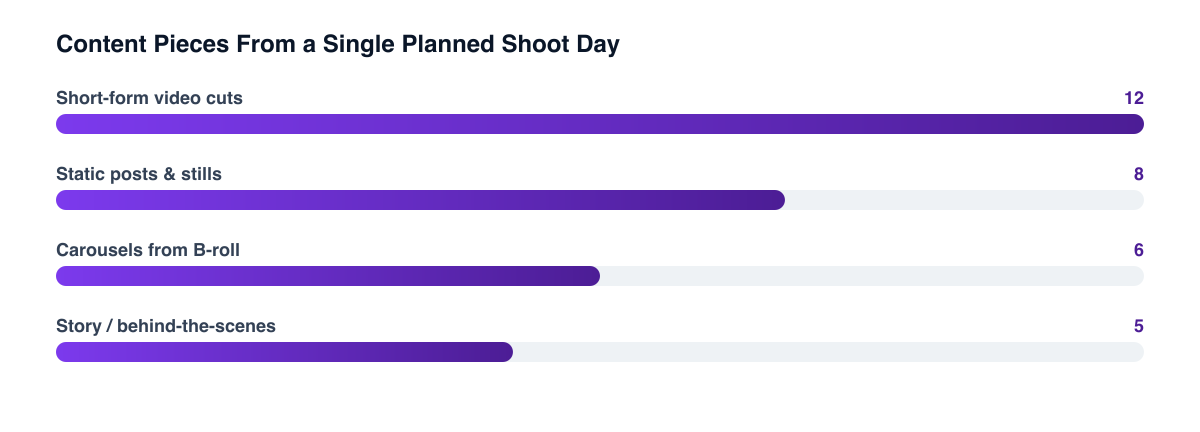
Reposting is the same asset, cross-posted, with the aspect ratio adjusted. Audiences notice, platforms deprioritise it, and it produces no incremental reach. Repurposing is extracting genuinely different pieces from the same raw material — a long-form demo becomes three short clips with different hooks, a set of stills, a carousel of the key points, and a customer-question answer that references the same product moment. Same production day, materially different pieces of content.
The unlock is planning that extraction before the shoot, not after. A shoot planned for one hero video yields one hero video. A shoot planned for thirty outputs is shot differently — more angles, more B-roll, more spoken lines captured in isolation.
How do you plan a shoot for extraction?
- Write the post list first. Decide the thirty things you want to say this month, then work out what footage each one needs. Most will share the same three or four setups.
- Capture spoken lines separately from the demo. Isolated lines recut into any number of hooks; a line spoken over a specific action only works with that action.
- Shoot generous B-roll of the product doing nothing dramatic — hands, texture, packaging, unpacking. This is the material that carries carousels and static posts, and it's the thing teams consistently under-shoot.
- Get both orientations at capture time. Reframing in the edit costs quality; framing for both costs a second take.
- Record more openings than you think you need. Hooks are the piece you'll iterate most, and they're the cheapest to capture while the setup is still lit.
The constraint isn't the camera Most repurposing systems break at the asset library, not the shoot. Footage that nobody can find gets reshot. A simple, consistently-named folder structure per shoot does more for output volume than better equipment.
Which platforms should get which cut?
Short-form video carries the widest reach and belongs everywhere, but the edit should differ: Reels reward a tight hook and a clean loop, TikTok rewards a conversational opening and native-feeling edits, and YouTube Shorts tolerates slightly longer setups. Carousels and stills do their heaviest lifting on Instagram feed, where they hold attention longer than video for detail-heavy products. Behind-the-scenes and offcuts go to stories, where the production bar is lowest and the audience is already warm.
The same library also feeds paid social, which is where the economics really land — organic content that already proved it holds attention is the cheapest source of ad creative you have.
How much of this should be repurposed versus fresh?
Roughly two-thirds repurposed, one-third reactive. The repurposed portion keeps the calendar full and consistent without weekly production pressure. The reactive third — responses to comments, trends, customer questions, timely moments — is what keeps the account from feeling scheduled, and it's usually shot on a phone in ten minutes because it doesn't need to look produced.
Related guides
- Organic Social Strategy for D2C Brands
- Instagram Reels Strategy for D2C
- TikTok Organic Strategy for D2C Brands
- Building a Brand Community Through Social Media
A month of content from one shoot day isn't a productivity hack — it's just what happens when the extraction plan exists before the camera comes out. That planning is the actual social media work; the shooting is the easy part.
PART OF OUR SERVICE
Social Media
Want a free marketing audit?
We'll review your tracking, ad accounts, and funnel — and show you exactly where the gaps are.
Get Your Free Audit →