
Most brands confuse a large follower count with a community. They're not the same thing. Followers are an audience — they watch. Community members participate, advocate, and buy again. The gap between those two things is where most D2C brands leave serious money on the table. The engagement figures below come from community programs we've run and audited, not from platform-reported averages.
A brand community isn't a vanity metric project. Done right, it's a retention engine, a product feedback loop, and an organic acquisition channel rolled into one. Brands with active communities consistently see 20–40% higher customer lifetime value and lower paid CAC as word-of-mouth fills in what ads used to carry.
What's the real difference between followers and community?
A follower hits like and scrolls on. A community member replies, shares opinions, tags friends, and defends the brand when someone posts a complaint. The behavioral difference shows up in your metrics: community members typically have 3–5x higher repeat purchase rates than your average follower.
The shift from audience to community requires a structural change. You need a space where members can talk to each other, not just consume your content. That reciprocal interaction — member to member, not just brand to member — is what builds identity. When customers start saying "we," you have a community.
What are the platform options in 2026?
The right platform depends on your audience's existing behavior. Don't try to drag people somewhere new just because you prefer it.
Instagram Broadcast Channel works best if your audience is already highly active on Instagram. It's low-friction — members opt in, you push content, they react. The limitation is it's still largely one-directional. Members can react and reply, but it's not a peer-to-peer conversation space. Use it as a top-of-funnel community gateway, not your whole strategy.
Facebook Groups have aging demographics but remain the strongest platform for deep discussion and peer support. If your product solves a lifestyle problem — fitness, parenting, home improvement — Facebook Groups still outperform every other option for sustained daily engagement. The algorithm also pushes active Groups content into members' feeds organically.
Discord is the right choice if your audience skews younger (18–34) or if your brand has a genuine culture angle — gaming, streetwear, fitness culture, music. Discord enables real-time conversation, role-based access tiers, and exclusive channel unlocks. The onboarding friction is higher, but the engagement depth among members who stay is unmatched.
TikTok LIVE is less a community home base and more a community activation tool. Regular scheduled LIVEs build a cohort of repeat viewers who start to know each other. Pair it with a Discord or Facebook Group where LIVE regulars can gather between sessions.
Pick one primary platform. A fragmented community is a dying community. You can use multiple platforms for different purposes, but your core community space should be singular.
How do you seed with your first 100?
The launch mistake most brands make is opening a community to everyone at once and wondering why it's quiet. Communities need critical mass and culture before they scale.
Start with your 100 most loyal customers. These are your highest repeat buyers, your most engaged email openers, the people who've already tagged you on social. DM them personally. Not a mass email — a real message that acknowledges their loyalty and gives them early access. That personal outreach converts at 30–50% compared to low single digits for a mass announcement.
Give them a reason to show up before the official launch: an exclusive Q&A with your founder, early access to an upcoming product, a behind-the-scenes drop. The first 100 members set the culture. If they're genuinely engaged and enthusiastic, that energy persists as you scale.
Don't open to the public until you have at least 50 active members who are already having conversations without prompting. That existing activity is what convinces the next wave of members to participate rather than lurk.
What content cadence keeps communities alive?
Even tight communities go quiet without a posting rhythm. Build a weekly cadence with variety — members who only see one type of content tune out.
A repeatable structure that works:
- Monday: Behind-the-scenes or founder/team content. Show how products are made, sourcing decisions, or a day at the warehouse. This humanizes the brand and generates genuine curiosity.
- Wednesday: Poll or prompt. Ask a product question, style question, or opinion question. Low lift for members, high signal for you. "Which colorway should we bring back?" drives both engagement and real product intel.
- Friday: Exclusive drop or early access. Even if it's small — a first look at upcoming packaging, a discount code, or access to a waitlist — this is the weekly reason-to-remain. Members who feel like insiders don't leave.
- Monthly: Live Q&A with the founder or a relevant expert. This is your highest-value community moment and should be treated as an event, not just a post.
The cadence doesn't need to be elaborate. Consistency matters more than production value. A founder posting a raw 60-second video from their phone every Friday outperforms a polished once-a-month drop.
For more on what content formats actually move the needle, the Organic Social for D2C: What Actually Drives Revenue vs. What Just Gets Likes breakdown is worth reading before you finalize your content mix.
How do community members become your cheapest acquisition channel?
Community members refer. It's not a theory — brands with active communities see referral rates 4–8x higher than their non-community customer base. When someone has an identity stake in a brand, recommending it isn't a transaction, it's self-expression.
The mechanics to accelerate this: give community members shareable assets before they're public (early product images, discount codes for friends, early launch access). Make referral natural, not forced. "Share this link for $10 off" is transactional. "You're the first to see this — forward it if you think your friends would want in" is social currency.
Track this carefully. Your social media analytics should show whether community-adjacent traffic has different conversion rates and LTV than your paid traffic. In most cases, community-referred customers have 15–30% higher average order values and 20%+ better 90-day retention.
This is how a community compounds: every retained customer who refers a new customer reduces your effective CAC without you spending an extra dollar.
How do you measure community health vs. engagement metrics?
Likes and follower counts are the wrong health indicators for a community. They measure passive consumption. Community health metrics are different:
Community health indicators:
- Active participation rate (members who post/comment weekly ÷ total members) — target 10–15%
- Member-to-member conversation ratio (replies between members vs. replies to your posts) — target >50% member-to-member
- Monthly retention rate (members who remain active month-over-month) — target >70%
- Referral conversion rate (new customers who came via community member recommendation)
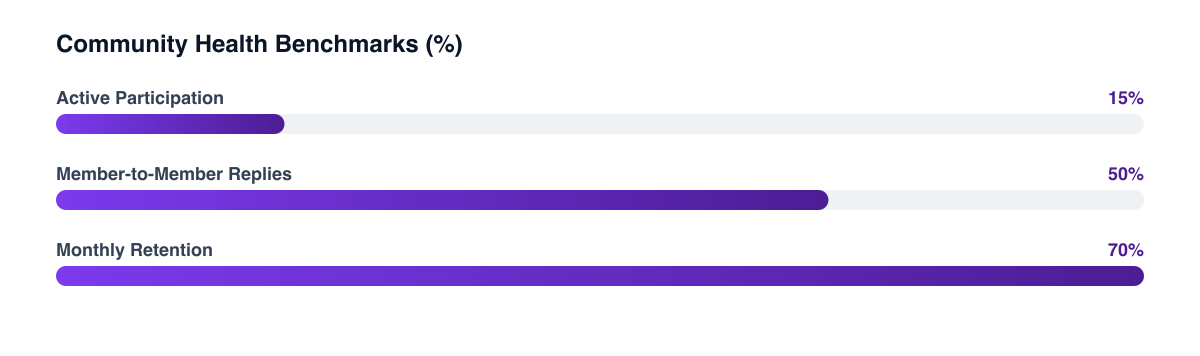
If your active participation rate is below 5%, you have an audience, not a community. The fix is usually cadence — more prompts, more live interaction, more reasons to show up.
Don't optimize for raw size. A 500-person community with 15% weekly active participation outperforms a 10,000-person group where 98% never post. The former drives revenue. The latter is just a large mailing list with extra steps.
Monitor sentiment qualitatively too. Read the threads. Community members will tell you, unprompted, what they want next, what frustrated them about their last order, and what products they're recommending to friends. That intel alone justifies the investment.
The bottom line
A brand community converts better, retains longer, and refers more than any paid channel you can buy — but only if it's built on genuine participation, not passive consumption.
"A brand community converts better, retains longer, and refers more than any paid channel you can buy — but only if it's built on genuine participation, not passive consumption."
— Nitesh Kasma, Co-Founder — Brand Strategy & Client Growth
Seed it with your most loyal 100 customers, hold a consistent content cadence, and measure health by activity rate and member-to-member conversation, not follower count. The compounding effect on CAC and LTV shows up within 90 days if you do it right.
Related guides
PART OF OUR SERVICE
Social Media
Want a free marketing audit?
We'll review your tracking, ad accounts, and funnel — and show you exactly where the gaps are.
Get Your Free Audit →