
Most B2B content is written for a single reader: the practitioner who has the problem, searches for it, and downloads the guide. They're the right person to attract and the wrong person to write the whole funnel for, because they can't sign anything.
"Your champion's hardest meeting is the one you're not invited to. The only thing in that room representing you is whatever they can remember and forward."
— Nitesh Kasma, Co-Founder — Brand Strategy & Client Growth
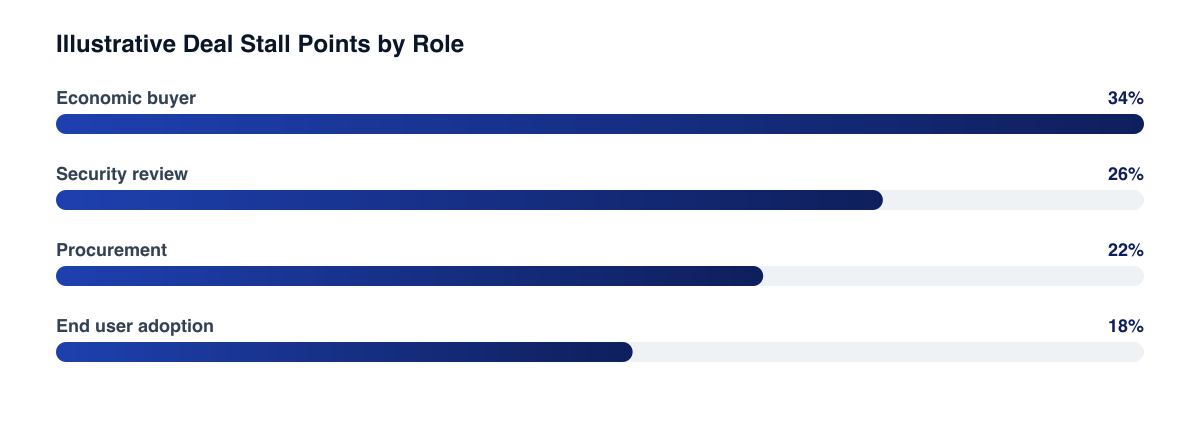
Who's actually in the room?
Five roles, sometimes held by fewer people, but the roles persist:
- The user, who cares whether it works day to day and whether learning it is painful.
- The champion, usually the user's manager, who has to justify the request and carries the reputational risk if it fails.
- The economic buyer, who cares about the business case and the alternative uses of that budget.
- The technical or security reviewer, whose default answer is no and whose objections are specific.
- The blocker, often finance or procurement, who cares about contract terms and switching cost.
Each has a different question and a different tolerance for detail. Content that addresses only the first two stalls at exactly the point where deals get expensive to lose — which is the pattern the SLA between marketing and sales usually exposes but doesn't fix.
What does each role actually need from you?
Practically, four assets that most content programmes don't produce:
- A one-page business case the champion can forward. Not a brochure — the problem, the cost of the status quo, the expected change, and what it costs. It should survive being pasted into an email.
- A security and compliance page that answers questions before they're asked. Data residency, certifications, sub-processors, deletion policy. Reviewers who have to email for this treat the delay as a risk signal.
- An implementation and switching-cost document. The most common unspoken objection isn't price, it's the fear of a six-month migration that lands on someone's team.
- A comparison the buyer would have made anyway. They will compare you; the only question is whether they do it with your framing or a competitor's.
The champion is the distribution channel for all four. Write them to be forwarded, not to be read on your site.
The champion is your only rep in the room — arm them accordingly If your best asset is a 40-page PDF, it doesn't get forwarded. One page that makes the case for them does more than any amount of thought leadership.
Does this change how you target?
It changes what "reach" means. Advertising to the whole committee against a defined account list is the core of account-based marketing, and it works precisely because the economic buyer and the security reviewer never enter the top of your funnel on their own — they arrive when the champion pulls them in.
It also changes your ICP definition. An ICP written as a job title describes the user. An ICP that names the committee shape — who signs, at what deal size, with what review process — predicts which deals close and which spend six months in legal.
How do you know it's working?
Not from form fills. The signal is multi-contact engagement inside a single account: three people from one domain reading three different pages in the same fortnight is the strongest early indicator in B2B, and it's invisible in a report that counts leads.
Track it at the account level, watch for role diversity rather than volume, and use it to trigger the nurture sequence rather than treating every new contact as a fresh lead. The deal was never a person.
Related guides
- B2B Lead Generation: The Complete 2026 Playbook
- B2B Content Marketing: Building a Lead Generation Engine
- How to Define Your B2B Ideal Customer Profile
- B2B Lead Nurturing: The Sequence From MQL to Closed Deal
Content that only speaks to the practitioner generates leads and loses deals in the last mile. Build the four forwardable assets before the next thought-leadership piece — it's the highest-leverage work available in most B2B lead generation programmes.
PART OF OUR SERVICE
B2B Lead Generation
PROOF FROM A CLIENT
$340K pipeline
quarterly qualified pipeline from near zero · SaaS / Technology
How a B2B SaaS Company Built a $340K Quarterly Pipeline→Want a free marketing audit?
We'll review your tracking, ad accounts, and funnel — and show you exactly where the gaps are.
Get Your Free Audit →