
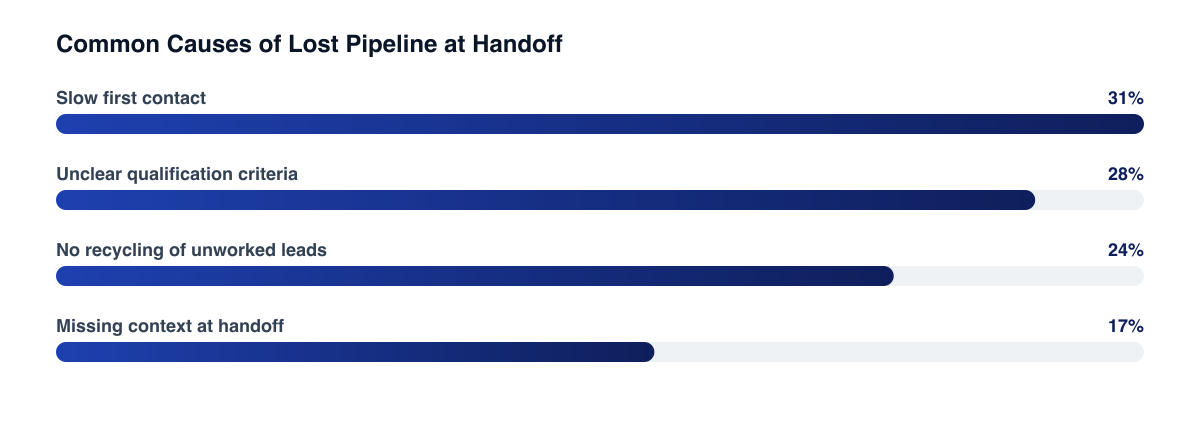
The most expensive gap in B2B pipeline isn't in the funnel — it's between two teams who never agreed on what they were passing to each other.
"Almost every 'our leads are bad' argument is really an argument about a definition nobody wrote down."
— Nitesh Kasma, Co-Founder — Brand Strategy & Client Growth
What is a marketing–sales SLA actually?
A short, written agreement covering three things: what qualifies as a handoff-ready lead, how quickly sales will work it, and what happens to leads that don't qualify or don't convert. That's it. It doesn't need to be a policy document — a single page that both teams sign off on removes most of the friction, because the friction was always ambiguity rather than disagreement.
Without it, marketing optimises for volume (the metric it's measured on) and sales optimises for close rate (the metric it's measured on), and those two incentives pull directly against each other at exactly the point where they meet.
What has to be in the definition?
Not a score. A score is the output; the definition is the input. Write down the observable facts that make a lead worth a salesperson's time:
- Fit criteria from your ICP — company size, industry, geography, tech stack. These are binary, not weighted, and a lead failing them isn't an MQL no matter how much content it consumed.
- Role criteria — is this person a buyer, an influencer, or a researcher? Each is legitimate, but they route differently.
- Intent criteria — the specific actions that indicate active evaluation, distinguished from ones that just indicate interest. A pricing page visit and a demo request are not the same signal as an ebook download.
- Disqualifiers — current customer, existing open opportunity, competitor, student, known non-buyer. These belong in the definition because they're the leads that generate the loudest complaints.
Only once those are written does a lead score become meaningful, because the score is now a summary of agreed criteria rather than a proxy for them.
Speed is the term most often broken and most worth enforcing Response time to inbound demo requests degrades fast — a lead worked within the hour is a materially different prospect from the same lead worked two days later, because in the interim they've spoken to two competitors. If the SLA contains one enforced number, make it this one.
What does sales owe marketing in return?
The agreement runs both directions, and this half usually gets skipped. Sales commits to:
- Working every handed-off lead within the agreed window, with a defined number of attempts across more than one channel.
- Logging a disposition — why a lead was rejected, in a fixed set of reasons rather than free text. Without this, marketing has no feedback loop and will keep sending the same lead type forever.
- Returning rather than discarding unqualified-but-in-ICP leads, so they go back into nurture instead of dying in a rep's inbox.
That last term is where most recoverable pipeline lives. A lead that isn't ready today is not the same as a bad lead, and treating the two identically quietly writes off a large share of what marketing generated.
How do you know the SLA is working?
Three numbers, reviewed together, monthly: MQL-to-SQL acceptance rate, median time to first contact, and the rejection-reason distribution. Acceptance rate rising while volume holds means the definition is doing its job. A rejection distribution dominated by one reason is a targeting brief, not a complaint. And if time to first contact drifts, nothing else in the agreement matters much — the fastest-decaying asset in B2B is a lead that just raised their hand.
Related guides
- B2B Lead Generation: The Complete Guide
- Defining Your ICP and Targeting It Properly
- B2B Marketing Automation and Lead Scoring
- B2B Lead Nurturing Strategy
None of this requires new tooling or new spend. It requires one page, agreed by both teams, and a monthly review that treats the handoff as a shared metric rather than a place to assign blame — which is usually the cheapest pipeline improvement available.
PART OF OUR SERVICE
B2B Lead Generation
PROOF FROM A CLIENT
$340K pipeline
quarterly qualified pipeline from near zero · SaaS / Technology
How a B2B SaaS Company Built a $340K Quarterly Pipeline→Want a free marketing audit?
We'll review your tracking, ad accounts, and funnel — and show you exactly where the gaps are.
Get Your Free Audit →