
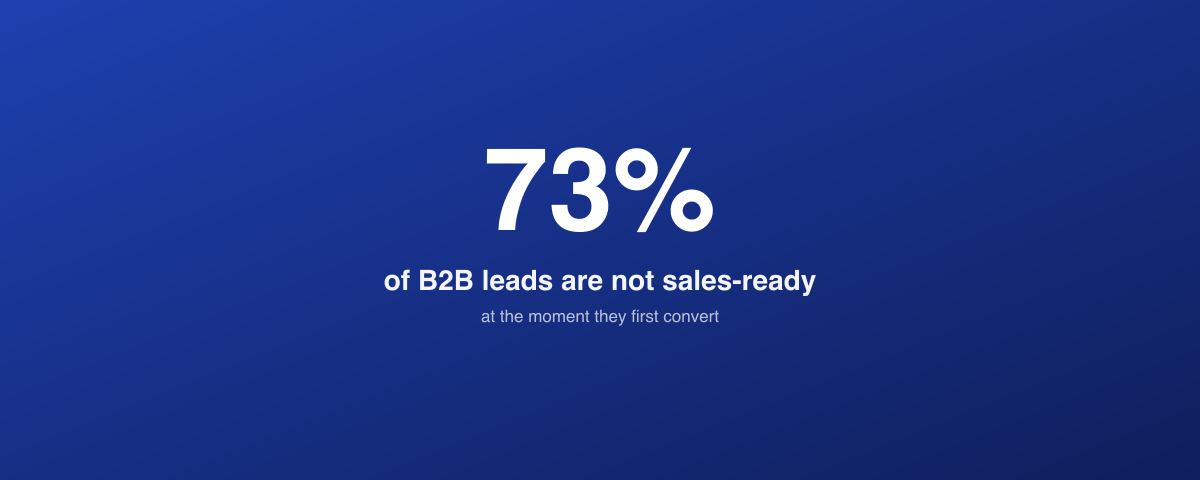
73% of B2B leads are not sales-ready at the time they first convert. You either nurture them to readiness or you hand them off to a competitor who will.
The problem isn't lead volume — most companies running B2B lead generation at any meaningful scale have more MQLs than they know what to do with. The problem is the gap between "downloaded a whitepaper" and "ready to talk to a rep." Closing that gap is nurturing. Most companies don't do it well, or don't do it at all.
Why do most B2B leads die in the funnel?
Three failure modes kill the majority of B2B leads before they ever reach a close:
No follow-up cadence. A prospect fills out a form, gets a welcome email, and then hears nothing for three weeks. By then they've evaluated two competitors and have a demo booked elsewhere.
Generic messaging. The same email sequence that goes to an enterprise IT director goes to a startup founder. Same pain points, same CTAs, same everything. Open rates crater, leads disengage, and the sequence gets blamed instead of the targeting.
Wrong timing. Blasting five emails in week one and then going silent is not nurturing — it's noise followed by abandonment. Buying cycles in B2B run 3 to 12 months. Your sequence needs to match that rhythm, not sprint and stop.
The fix is a structured nurture program that maps content to buying stage, respects cadence, and uses engagement signals to determine when a lead is ready to hand off.
What's the difference between marketing nurture and sales nurture?
These are two different jobs and conflating them creates friction in both directions.
Marketing nurture runs from first conversion to sales-ready. It's automated, educational, and designed to build trust and surface intent. The goal is not to sell — it's to educate and qualify. A lead who reads your pricing page twice and downloads your ROI calculator is telling you something.
Sales nurture starts after the MQL-to-SQL handoff. It's a rep-driven sequence of personalized outreach — calls, custom emails, LinkedIn touches — designed to move an engaged prospect through evaluation and into a commercial conversation.
Most companies treat the entire funnel as one thing and do both poorly as a result. Define the handoff criteria explicitly (more on this below) and build separate workflows for each phase.
What's the 30/60/90-day email sequence framework?
A well-structured nurture sequence does not need to be complicated. It needs to be relevant and timed to the prospect's decision-making pace.
Day 0–7 (Activation): Confirmation email + one value-deliver email (case study, quick win guide, or relevant blog post). Goal: reinforce the decision to engage, set expectations.
Days 8–30 (Education): 2–3 emails spaced 7–10 days apart. Map content to problem awareness. Use blog content, explainer guides, and third-party data the prospect cares about. No product pitches.
Days 31–60 (Consideration): 2 emails. Introduce social proof — client results, ROI data, comparison content. This is where you surface differentiation, not features. If they're engaging at this stage, lead score should be climbing.
Days 61–90 (Decision): 1–2 emails. Invite them toward a next step — audit offer, demo, consultation. Make it low-friction and value-forward. A "free audit" offer converts better than "book a demo" at this stage.
For reference, see how Klaviyo flow architecture handles similar stage-based logic in e-commerce — the underlying sequencing logic translates directly to B2B automation.
Subject line performance drops sharply after day 30 if earlier emails haven't been opened. Build in conditional branching: if a contact hasn't opened anything in 21 days, shift them to a re-engagement track rather than continuing the main sequence.
How does lead scoring turn engagement into pipeline signal?
Lead scoring is only useful if the inputs are meaningful and the thresholds are calibrated to actual conversion data.
Engagement signals and example point values:
- Email open: +2
- Email click: +5
- Blog post view: +3
- Pricing page view: +15
- Case study download: +10
- Free tool or ROI calculator use: +20
- Demo page visit: +25
- Form submission (non-gated content): +8
Start conservative with your MQL threshold — set it at a score that reflects genuine intent, not just passive consumption. If your CRM shows that SQL conversions cluster around contacts who hit 60+ points, don't set your MQL threshold at 25. You'll flood sales with leads they can't close, and they'll stop trusting the scoring model.
Revisit scoring weights every quarter against closed-won data. Customer Lifetime Value should inform which lead segments are worth investing heavier nurture resources on — a segment with 3x LTV deserves a longer, more personalized sequence even if conversion rates are lower.
When does marketing stop and sales start?
The MQL-to-SQL handoff is where most B2B revenue leaks. Sales teams ignore leads that aren't ready; marketing sends leads that aren't qualified. Both sides blame the other.
Fix this with a Service Level Agreement (SLA) that defines:
- MQL criteria — minimum score, specific behaviors (e.g., pricing page + demo page viewed within 7 days), and firmographic fit (company size, industry, job title)
- Response time commitment — sales responds to MQLs within 4 business hours. Every hour of delay reduces contact rate significantly; by 24 hours, conversion rates drop by more than 60%
- Sales follow-up sequence — defined touches (call, email, LinkedIn) within a set window before a lead is recycled back to marketing nurture
Without this structure, leads fall into a gray zone where no one owns them. That's where pipeline goes to die.
How do you reactivate cold leads?
Not every lead that goes dark is a lost cause. Buying timelines shift, budgets reopen, and internal priorities change. A cold-lead reactivation campaign running 60–90 days after a lead disengages can recover 8–15% of dormant contacts.
Reactivation emails should do three things: acknowledge the time gap without being weird about it, lead with something new (a case study, a product update, a relevant piece of data), and offer an easy re-entry point.
Avoid leading with a hard ask on a first reactivation touch. "We noticed you haven't heard from us in a while — here's what's changed" performs better than "Ready to book a call?"
Segment your cold leads before reactivating. Contacts who were highly engaged and then went dark are a different audience than leads that never engaged beyond the initial download. Tailor the angle accordingly — the former needs a reason to re-engage; the latter needs a better value hook than whatever failed the first time.
The bottom line
B2B leads don't die because of poor lead generation — they die because of poor follow-through.
"B2B leads don't die because of poor lead generation — they die because of poor follow-through."
— Nitesh Kasma, Co-Founder — Brand Strategy & Client Growth
A structured 30/60/90-day nurture sequence, intent-based lead scoring, and a clean MQL-to-SQL handoff protocol can meaningfully compress sales cycles and recover leads that would otherwise churn out of your funnel. Build the system once, calibrate it on real conversion data, and the pipeline follows.
Related guides
PART OF OUR SERVICE
B2B Lead Generation
PROOF FROM A CLIENT
$340K pipeline
quarterly qualified pipeline from near zero · SaaS / Technology
How a B2B SaaS Company Built a $340K Quarterly Pipeline→Want a free marketing audit?
We'll review your tracking, ad accounts, and funnel — and show you exactly where the gaps are.
Get Your Free Audit →