
Most B2B lead generation programs are expensive, slow, and largely guesswork dressed up in dashboards. The pipeline looks busy but conversion rates are weak, sales blames marketing for lead quality, and nobody can explain why the numbers moved last quarter. This guide is a systematic fix for that.
Building a predictable B2B lead pipeline requires five things working in sequence: a sharply defined ICP, the right channel mix for your deal size, content that earns trust before a sales conversation happens, a nurture system that keeps warm leads warm, and metrics that connect marketing activity to revenue. Most companies have fragments of all five. Very few have a functioning system.
Here is how to build one.
Why does most B2B lead gen fail?
The failure modes are consistent. Understanding them is the fastest way to diagnose what is broken in your own program.
No ICP clarity. When the target is "companies that could benefit from our product," every lead looks viable and none get prioritized. Sales spends time on prospects that were never a fit. Marketing optimises for form fills instead of pipeline.
Wrong channel for the buying motion. A $5K/month SaaS product and a $250K enterprise implementation require completely different channel strategies. Companies often inherit a channel mix from early days and never revisit whether it matches the current ACV and sales cycle.
No demand creation, only demand capture. Running Google Search ads captures the 3–5% of your market actively searching right now. The other 95% never see you. Without LinkedIn, content, or outbound, you are competing for a small, expensive slice of an already-aware market.
Lead nurture that's actually lead abandonment. Most nurture sequences are four emails over two weeks and then silence. For 90-day sales cycles, that's leaving the relationship unattended for 75 days.
Metrics that reward activity over outcomes. Volume of leads generated is not a business metric. MQL-to-opportunity rate, pipeline velocity, and CPL by channel are.
How do you build and operationalize your ICP?
Your ICP is the foundation. Get it wrong and every downstream decision — channel, messaging, offer, nurture — is slightly off. The compounding effect of a vague ICP is significant.
An ICP has two layers. The firmographic layer covers company size (headcount and revenue), industry vertical, business model, geography, and technology stack. The psychographic layer covers buying triggers, decision-making structure, pain threshold, and urgency signals. Most teams build the first layer and skip the second, which is why their targeting is technically correct but their messaging doesn't convert.
Effective ICP definition requires four inputs:
- Analysis of your 10–20 best closed-won deals (deal size, sales cycle, champion profile, trigger event)
- Analysis of your 5–10 worst fits (where did the deal drag, where did it churn)
- Direct interviews with 5–8 current customers about why they bought and what almost stopped them
- Competitor win/loss data if available
The output is not a slide deck — it is a scoring rubric that your CRM can apply to every inbound lead. Revenue range, headcount, industry, and 2–3 behavioral signals (visited pricing page, downloaded a specific content asset, attended a webinar) give you a working lead score without enterprise tooling.
For a detailed breakdown of how to define, score, and operationalize your ICP across paid channels, see How to Define Your B2B Ideal Customer Profile and Target Them at Scale.
What's the 2026 B2B channel mix?
The channel question is really a question about your buyers' behavior. Where are they when they are thinking about your category? What are they doing when they are actively evaluating solutions? The right channel mix covers both states.
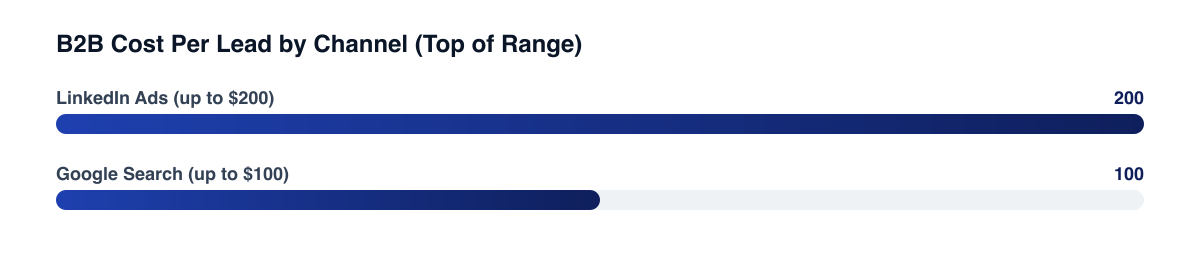
LinkedIn Ads is the primary demand creation channel for B2B companies with ACV above $15K. The targeting precision lets you reach the exact buyer persona with no spillover — LinkedIn's ad targeting documentation covers job title, function, seniority, and years of experience under Job Experience; company size, industry, revenue, and named-company lists under Company; plus Matched Audiences for uploaded contact and account lists. Worth noting before you plan a European campaign: LinkedIn restricts several of these attributes for members in the EEA and Switzerland. In our accounts, CPL on LinkedIn runs $80–$200 for most B2B categories, which sounds expensive until you compare it against the value of a qualified pipeline opportunity. For companies running Account-Based Marketing programs, LinkedIn Sponsored Content against a custom company list is close to essential.
The caveat: LinkedIn requires patience. You are reaching people who are not actively searching right now. Expect a 30–60 day lag between first impression and a lead entering your pipeline.
Google Search captures existing demand. If your ICP is actively typing queries like "enterprise HR software" or "B2B marketing agency pricing," Search gives you access to high-intent buyers at a predictable CPL. The problem is volume — in most B2B niches, search volume for bottom-of-funnel terms is limited, and CPCs for competitive terms are $15–$80. You can exhaust the addressable market on Search and still have a small pipeline.
The tactical answer for most B2B companies is: use Google Search to capture demand that already exists, use LinkedIn to create demand among accounts that match your ICP. Neither channel alone is sufficient. For a direct comparison of both channels across deal size, ACV, and targeting mechanics, see B2B Lead Generation: LinkedIn Ads vs. Google Search — Which Wins?.
Content marketing is a compounding asset. A well-structured content program generates leads from organic search, builds topical authority that accelerates sales conversations, and gives your LinkedIn and email campaigns material to distribute. The payoff is slower — typically 6–12 months before meaningful organic traffic — but the unit economics improve over time as CPL falls while lead volume grows.
The strategic framing: content is not a blog. It is a system for capturing demand from buyers at every stage of their research process, from "what is this category" to "which vendor should I shortlist." Each piece should serve a specific funnel stage and map to a conversion action. For a full framework, see B2B Content Marketing: How to Build a Lead Generation Engine Through Content.
Outbound and cold email still work when executed with precision. The key variables are list quality (ICP match), personalization depth, and offer relevance. Mass-blast sequences at 10,000 contacts per month are largely dead — inbox rates have collapsed and reply rates have followed. Highly targeted sequences of 50–100 accounts per month with meaningful personalization and a relevant trigger event (funding, hiring, technology change) produce materially better results. Think of outbound as a way to accelerate pipeline from your highest-priority target accounts, not a volume play.
How does account-based marketing work for mid-market deals?
When deal sizes climb above $50K and buying committees involve 4–6 stakeholders, the playbook shifts from lead generation to account-level engagement. ABM is that shift operationalized.
The core ABM logic:
- Define a target account list (TAL) of 100–500 accounts that match your ICP
- Prioritize by intent signals — accounts showing category-level research activity rank higher
- Run coordinated campaigns across LinkedIn, display, email, and direct outreach targeting all decision-makers within each account
- Measure engagement at the account level, not the individual lead level
The practical advantage of ABM for mid-market is that it prevents the situation where marketing generates a lead from a low-level influencer at a target account while the actual economic buyer has never heard of you. By running multi-threaded campaigns to every relevant contact at a target account, you create organizational awareness before the sales conversation starts.
Intent data from platforms like Bombora or 6sense adds meaningful signal to TAL prioritization. An account in your ICP that is actively researching your category is worth 3–5x the outreach investment of one that is not. For the complete ABM playbook — including TAL building, intent data integration, and campaign orchestration — see Account-Based Marketing (ABM): The Playbook for Mid-Market B2B Brands.
How does lead nurturing actually shorten sales cycles?
The average B2B sales cycle is 84 days for mid-market deals. Most nurture programs cover the first two weeks and then go quiet. That's not nurture — it's a hello and a ghosting.
Effective lead nurturing requires a different mental model. Instead of thinking "how many emails should I send," think "what does this buyer need to believe before they can say yes, and how do I build each of those beliefs over time?"
For a 90-day sales cycle, a working nurture sequence looks roughly like this:
Weeks 1–2: Problem validation. Case studies, diagnostic content, industry benchmarks that confirm the problem is real and costly. Goal: make them feel understood.
Weeks 3–5: Solution education. How your category solves the problem, what good looks like, what to watch out for in evaluation. Goal: shape their buying criteria in your favor.
Weeks 6–10: Proof and differentiation. Customer ROI data, comparison content, technical depth for the people doing diligence. Goal: survive the shortlist.
Weeks 11–14: Urgency and conversion. ROI calculators, limited-time offers, executive briefing invitations, direct outreach from sales. Goal: drive a decision.
Channel mix matters as much as content. Email is the backbone, but LinkedIn retargeting keeps your brand visible to leads who are not opening emails. High-value accounts should get direct outreach from an SDR layered on top of automated email. Treating nurture as email-only misses buyers who are consuming your content but not converting through that channel.
Lead scoring should gate the handoff to sales. An MQL is a lead that has accumulated enough behavioral signals — content downloads, page visits, email engagement, webinar attendance — to indicate genuine evaluation intent. An SQL is an MQL that sales has contacted, confirmed as qualified, and accepted. The MQL-to-SQL conversion rate is one of the most diagnostic metrics in B2B marketing. Published "industry benchmarks" for it are worth treating with suspicion — the widely repeated figures trace back to vendor blog posts rather than primary research, and the number is only meaningful relative to how tightly you define the MQL threshold. In the programs we run, 13–27% is the usual band, with the low end typical of enterprise motions and the high end of product-led ones. Establish your own baseline over a quarter and manage against that instead of a borrowed number. For a full sequence framework with timing, content mapping, and sales handoff criteria, see B2B Lead Nurturing: The Sequence From MQL to Closed Deal.
How do you define and score MQLs vs SQLs?
The MQL/SQL boundary is where most B2B marketing and sales relationships break down. Marketing sets a low bar, passes volume, and sales spends time on unqualified leads. Or marketing sets a high bar, passes fewer leads, and sales complains about pipeline gaps. Neither is right.
A working MQL definition combines fit and intent:
- Fit score: firmographic match to ICP (company size, industry, role) — binary yes/no
- Intent score: behavioral signals weighted by funnel stage (visited pricing page = 20 points, downloaded a case study = 10 points, attended a webinar = 15 points, etc.)
- MQL threshold: fit = yes AND intent score ≥ X
The threshold requires calibration. Start conservative, measure MQL-to-opportunity conversion rate over 90 days, and adjust. If your MQL-to-opportunity rate is below 15%, your MQL bar is probably too low. If it is above 40%, you may be passing leads to sales too late and losing deals to competitors who engaged earlier.
The SQL definition is simpler: a lead that sales has worked and confirmed meets BANT criteria (Budget, Authority, Need, Timeline) or your equivalent qualification framework. The discipline here is on the sales side — SQLs should only be created when qualification has actually happened, not as an administrative step to move a lead through the CRM.
Which metrics connect lead gen to revenue?
Vanity metrics exist at every stage of B2B lead gen. Here are the ones that matter and the benchmarks to hold them against:
CPL by channel: What you are paying per lead, segmented by source. LinkedIn CPL will be higher ($80–$200) than Google Search ($30–$100) but quality and deal size often compensate. Blend CPL without channel segmentation is meaningless.
MQL-to-opportunity rate: Of leads that cross your MQL threshold, how many convert to a sales-accepted opportunity? Benchmark: 20–35% for a well-calibrated MQL definition.
Opportunity-to-close rate: Of opportunities created, how many close? B2B benchmarks vary widely — 20–30% is a reasonable baseline for mid-market. Below 15% usually signals ICP drift or a competitive positioning problem.
Pipeline velocity: (Number of opportunities × average deal size × win rate) / average sales cycle in days. This single number captures the health of your entire revenue engine and how changes to any input affect output.
Cost per acquired customer (CAC) by channel: The number that closes the loop between marketing spend and revenue. Paid channels should show improving CAC over time as creative and targeting mature. Content should show declining CAC as organic volume grows.
Revenue attribution is the hard part. In a multi-touch world where a buyer has seen LinkedIn ads, consumed three blog posts, attended a webinar, and then converted through Google Search, last-click attribution assigns 100% of credit to the Search click and starves LinkedIn and content of their justified investment. Google's own About attribution models documentation spells out the trade-offs between last-click, data-driven, and position-based models, and GA4's attribution documentation covers how to configure the model and lookback window for your reports. Both are worth reading before you argue about channel credit internally — most of those arguments are really disagreements about the attribution model nobody has explicitly chosen. Linear or position-based models give a more accurate picture of how each channel contributes to the conversion path.
For a framework on building attribution models and the dashboard your leadership team will actually use to make decisions, see How to Build a Marketing Dashboard Your CFO Will Actually Love.
How do you build a compounding lead generation system?
The difference between a lead generation program and a lead generation system is compounding.
"The difference between a lead generation program and a lead generation system is compounding."
— Nitesh Kasma, Co-Founder — Brand Strategy & Client Growth
A program produces leads proportional to what you spend this month. A system builds assets — content, audience, brand authority — that generate leads next year from work you did this year.
The practical structure of a compounding B2B lead gen system:
Paid channels fund short-term pipeline. LinkedIn and Google Search deliver predictable volume at predictable cost. They scale up with budget and down when you cut spend. Use them to hit quarterly pipeline targets while the longer-term assets build.
Content builds durable organic demand. Each high-quality piece of content is a permanent asset that earns traffic and leads indefinitely. A library of 50 well-optimized articles targeting the full research journey of your ICP generates a meaningful share of pipeline with near-zero marginal cost after creation.
Brand authority reduces sales friction. When prospects have seen your name in five relevant contexts before the sales conversation, discovery calls are shorter, objections are lighter, and win rates are higher. LinkedIn organic content, industry publications, podcast appearances, and webinars all build this recognition.
Systems and automation protect capacity. Lead scoring, MQL routing, nurture sequences, and SDR workflows should be automated where possible. The goal is for every qualified lead to receive a consistent, high-quality experience without requiring manual intervention for each one.
Iteration on data improves unit economics over time. Run channel-level attribution. Review MQL quality by source quarterly. Kill channels that produce high volume and low pipeline contribution. Double down on channels where CPL and MQL-to-opportunity rate both look strong. The program that exists in 12 months should be materially more efficient than the one you are running today.
The companies that build durable B2B pipeline are the ones that treat lead generation as an engineered system — with inputs, outputs, feedback loops, and continuous optimization — not a collection of campaigns.
The bottom line
B2B lead generation in 2026 requires a functioning system, not a channel tactic: start with an operationalized ICP, match your channel mix to your deal size and buying motion, build nurture that covers the full sales cycle, and measure the metrics that connect activity to revenue. The compounding effect of content and brand authority is what separates programs that plateau at a volume ceiling from systems that grow pipeline year over year without proportional spend increases.
Related cluster guides
- B2B Lead Generation: LinkedIn Ads vs. Google Search — Which Wins?
- B2B Content Marketing: How to Build a Lead Generation Engine Through Content
- How to Define Your B2B Ideal Customer Profile and Target Them at Scale
- B2B Lead Nurturing: The Sequence From MQL to Closed Deal
- Account-Based Marketing (ABM): The Playbook for Mid-Market B2B Brands
- How to Build a Marketing Dashboard Your CFO Will Actually Love
Work with us on this
We run full-funnel B2B lead generation — ICP definition, paid media, content strategy, ABM, and nurture infrastructure — for D2C and B2B brands globally. Start with a free audit →
PART OF OUR SERVICE
B2B Lead Generation
PROOF FROM A CLIENT
$340K pipeline
quarterly qualified pipeline from near zero · SaaS / Technology
How a B2B SaaS Company Built a $340K Quarterly Pipeline→Want a free marketing audit?
We'll review your tracking, ad accounts, and funnel — and show you exactly where the gaps are.
Get Your Free Audit →