How a B2B SaaS Company Built a $340K Quarterly Pipeline
KEY RESULT
$340K pipeline
quarterly qualified pipeline from near zero
Quarterly Pipeline
$340K
from $40K
Monthly MQLs
110
from 8
Cost Per Lead
$62
from $280
Sales Cycle
41 days
from 74 days
The Challenge
This B2B SaaS company had built a product that customers genuinely loved — NPS of 62, strong retention, and a steady stream of referrals. But after two years, they hit a ceiling. Monthly new business was inconsistent: some months $120K in new ARR, others $15K. The variance was entirely dependent on whether a happy customer had mentioned them to someone that month.
The team had tried LinkedIn outreach (high effort, low response rate), a content blog (three posts then abandoned), and Google Ads (high CPCs with unqualified traffic). Nothing had built a real, scalable pipeline. They came to us needing to get from "founder-dependent" to "system-dependent" within 12 months.
What We Did
1. ICP Definition and Tier Mapping
The first four weeks were spent defining the ICP properly — not the marketing-team version ("mid-market SaaS"), but a version grounded in actual customer data. We pulled their 20 best customers by ARR, retention, and NPS and mapped what they had in common: company size (50–300 employees), vertical (professional services and finance), trigger event (recent Series A or new CRO hire), and tech stack (HubSpot + Salesforce overlap).
This gave us a Tier 1 ICP that was narrow enough to target precisely and large enough (~8,000 companies in the US) to build real pipeline.
2. LinkedIn Demand Generation
Rather than cold outreach (which their team had already proved didn't work at scale), we built a LinkedIn content program for three internal thought leaders — the CEO, Head of Product, and Head of Customer Success. Each published 3x/week on topics their ICP cared about: operational efficiency, team scaling, and retention metrics.
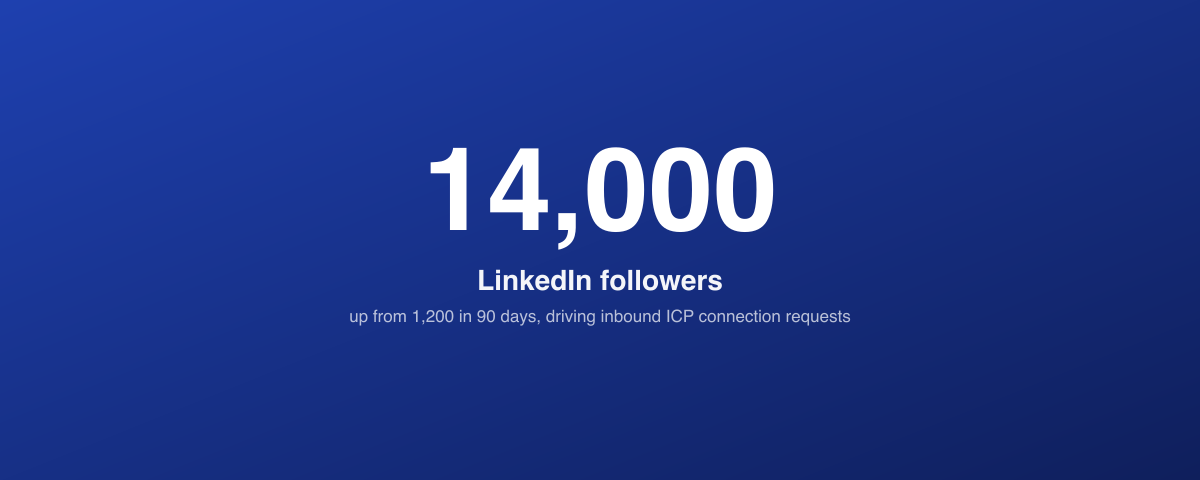
Within 90 days, the combined following grew from 1,200 to 14,000. More importantly, the content was driving inbound connection requests from their exact ICP — warm leads who already knew the product before any sales conversation.
We paired the organic program with LinkedIn Lead Gen Form campaigns targeting Tier 1 ICP by job title, company size, and industry. The combination of warm organic + targeted paid drove MQLs from 8/month to 110/month by month four.
3. Content-Led SEO Pipeline
We identified 12 high-intent search queries their ICP was making — not "what is [category]" searches but "how to [problem]" searches that map directly to the product's use cases. We built 12 long-form guides optimized for these terms.
Within three months, four of the 12 guides were ranking on page one. These pages now drive 40% of inbound demo requests.
4. Sales Cycle Compression
The 74-day sales cycle was a symptom of a missing middle of funnel. Prospects would request a demo, get one, go quiet for six weeks, then either convert or disappear. We built a 21-day nurture sequence — case studies, ROI calculator, comparison guides — triggered immediately after demo attendance. Deals that went through the nurture sequence closed in an average of 41 days versus 74 for those that didn't.
The Results
By month five, the company had 110 MQLs/month feeding a qualified pipeline, with CPL down from $280 to $62 — an 78% reduction. Quarterly pipeline grew from $40K to $340K.
The sales cycle compression from 74 to 41 days was arguably the most operationally significant outcome: it meant the same sales headcount could process nearly twice as many deals, improving the company's revenue-per-rep metric without a hiring event. The founder's referral channel still contributes, but now it's one input among several — not the whole system.
“For two years we grew on referrals and thought that was fine. Now we have a pipeline that doesn't depend on who I know. That's a completely different business.”
— CEO, B2B SaaS Startup
+ DEEPER READING
The tactics behind these results
B2B Lead Generation: The Complete 2026 Playbook
The complete guide to building a predictable B2B lead pipeline in 2026 — ICP definition, LinkedIn and Google strategy, content-led lead gen, ABM, lead nurturing, and the metrics that actually matter.
Read guide →
B2B MARKETINGHow to Define Your B2B Ideal Customer Profile and Target Them at Scale
Most B2B companies have a vague ICP that sales ignores and marketing can't target. Here's how to build one grounded in real data — and use it to focus every acquisition dollar.
Read guide →
B2B MARKETINGAccount-Based Marketing (ABM): The Playbook for Mid-Market B2B Brands
ABM flips traditional lead gen on its head — you pick the accounts, then build the pipeline. For mid-market B2B, it's the most efficient path to larger deals.
Read guide →
B2B MARKETINGB2B Content Marketing: How to Build a Lead Generation Engine Through Content
B2B content that generates leads is fundamentally different from content that gets shares. Here's how to build a content system that fills pipeline — not just drives traffic.
Read guide →