
Brand Registry gets treated as a legal checkbox you tick when a hijacker shows up. That undersells it: it is the gate to most of the brand-level tools on Amazon, and enrolling late means running blind for months.
"Brand Registry isn't the strategy. It's the key that opens the rooms where strategy happens: the data, the storefront, and the ad formats."
— Dhruvit Shah, Co-Founder — Performance Marketing & Growth Strategy
What do you need before you can enroll?
Amazon's Brand Registry requirements centre on a trademark. You need an active registered mark or a pending application, either a word mark or a design mark with words, letters, or numbers, issued by an office Amazon supports. The application must come from the trademark owner, and Amazon also asks for evidence that the brand name is permanently affixed to your products or packaging.
The practical consequence for a young D2C brand: trademark work is the long pole, not the Amazon form. If you plan to sell on the marketplace, start the filing early, because everything below waits on it.
What does Brand Registry unlock beyond protection?
Amazon's Brand Registry page groups the benefits into three buckets, and it helps to see them that way:
- Protection: the Report a Violation tool, Transparency for serialised authentication, and Project Zero for removing counterfeits.
- Customer experience: A+ Content, plus programs such as Vine for early reviews.
- Performance and growth: Brand Analytics, Stores, Sponsored Brands, Sponsored Display, Posts, Brand Metrics, and Manage Your Experiments.
Availability of individual programs can depend on category, marketplace, and account, so check eligibility in Seller Central rather than assuming.
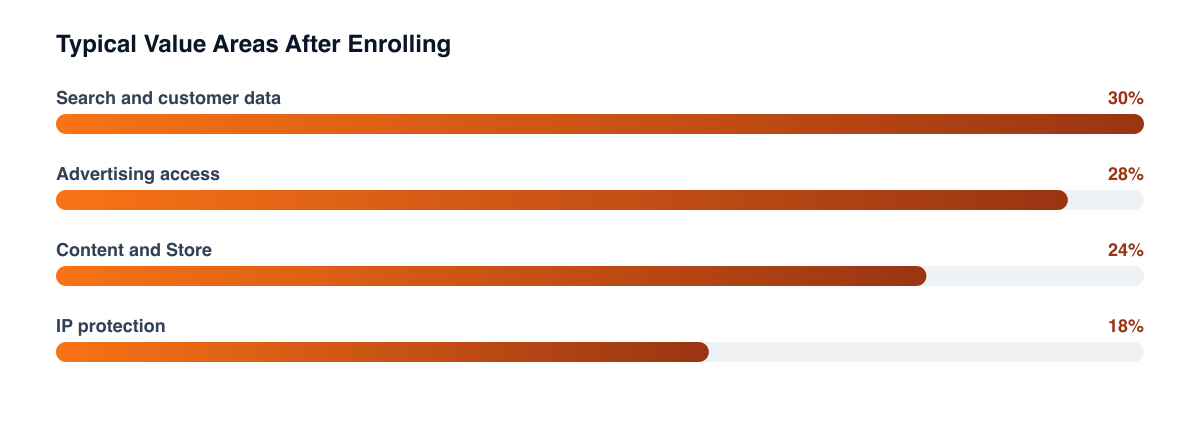
The chart is illustrative; the balance shifts with category and how exposed your products are to copycats.
Why is Brand Analytics the quiet winner?
Because it shows you demand you otherwise have to guess at. Amazon's Brand Analytics page describes dashboards covering search (including Search Query Performance and Top Search Terms), consumer behaviour (market basket analysis and demographics), customer loyalty (repeat purchase behaviour), and the customer journey. Access requires a Professional selling account and a Brand Representative role on an enrolled brand.
What this gives a D2C team is concrete: the queries shoppers use before landing on you, which products are bought alongside yours, and how often customers come back. The first feeds listing optimisation and keyword targeting; the second informs bundles; the third tells you whether Amazon is acquiring customers or only fulfilling one-off orders. Caveat: it is Amazon's view of Amazon customers, so don't mix it with your own site's data as if the two measured the same thing.
What do Stores and A+ Content really change?
A Brand Store gives you a branded destination you can send ad traffic to, which matters because, per Amazon Ads, Sponsored Brands shoppers can be sent to a product page, your Brand Store, or a new landing page rather than a single listing. A+ Content upgrades the product detail page with modules for comparison, imagery, and brand story. We cover the mechanics in our A+ Content guide, so the point here is just the dependency: both exist only because Brand Registry came first.
Be realistic about their ceiling. Neither fixes a weak offer, thin reviews, or a poor price position, and neither guarantees conversion lift for your specific listings. Test them: Manage Your Experiments exists precisely for that, subject to its own traffic requirements.
Enrol before you need it Register the brand before you launch ads or hit your first counterfeit complaint. Search data and ad formats start accruing value from the day you can use them, and a dispute is a bad time to start the paperwork.
What does it not do?
Brand Registry does not win the Buy Box, stop every unauthorised reseller, replace an advertising strategy or carry over to a new brand name. It gives you tools to report and enforce, and it unlocks Sponsored Brands, but pricing, fulfilment and campaign structure still decide results.
- It does not win the Buy Box for you; pricing, fulfilment, and seller metrics still decide that.
- It does not stop all unauthorised resellers; it gives you tools to report and enforce.
- It does not replace an advertising strategy. It unlocks Sponsored Brands, but the campaign structure behind it determines whether the spend pays back.
- It does not transfer to a new brand name; Amazon's requirements are framed per brand ("your brand must have an active registered trademark or a pending trademark registration"), so expect a new brand name to need its own mark and enrolment.
Related guides
- Amazon Marketplace for D2C Brands: The Complete 2026 Guide
- Amazon A+ Content: The Complete Guide to Enhanced Brand Pages
- Amazon Product Listing Optimization: How to Rank and Convert
- Amazon PPC Advertising: Campaign Structure That Reduces ACoS While Growing Revenue
Treat Brand Registry as infrastructure: set it up once, assign roles correctly, and build a habit of reading the data it opens up. If you would rather have a team own that loop alongside listings and ads, that is what marketplace management is for.
Want a free marketing audit?
We'll review your tracking, ad accounts, and funnel — and show you exactly where the gaps are.
Get Your Free Audit →