

The Buy Box is the "Add to Cart" button, and the overwhelming majority of Amazon orders go through it. Lose it and your listing still exists — it just stops selling.
"Sellers respond to a lost Buy Box by cutting price, because price is the lever they control fastest. It's often the one input that wasn't the problem."
— Dhruvit Shah, Co-Founder — Performance Marketing & Growth Strategy
What actually decides who wins it?
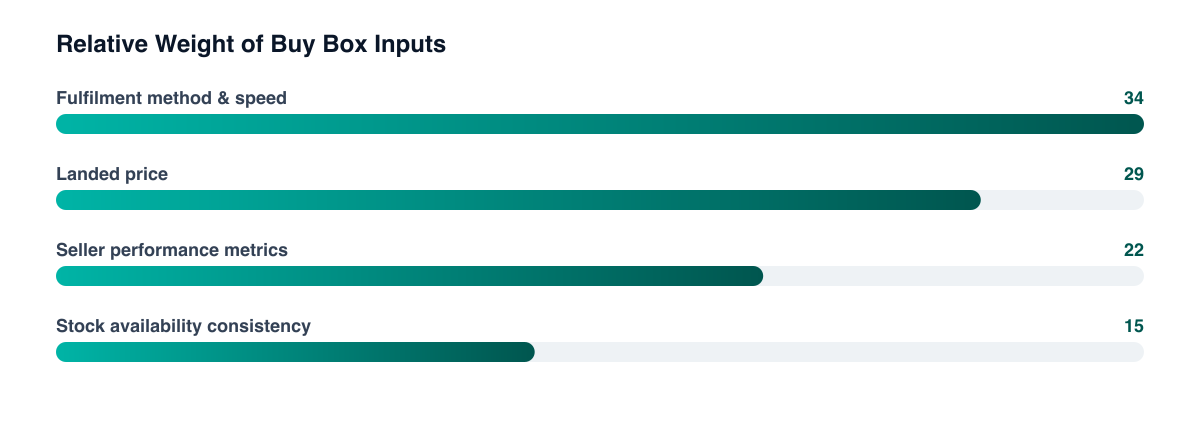
Amazon doesn't publish the formula, but the inputs are well established from seller-facing documentation and consistent observed behaviour: landed price (item plus shipping), fulfilment method and speed, seller performance metrics, and stock availability. These are evaluated together and re-evaluated continuously, which is why the Buy Box can rotate between sellers through the day rather than sitting with one.
The important consequence: a seller with a slightly higher price and materially better fulfilment and metrics frequently beats a cheaper competitor. Price matters at the margin, not absolutely.
Why is fulfilment usually the highest-leverage fix?
Because it changes two inputs at once. Moving a SKU to FBA improves delivery speed and shifts the customer-experience metrics — late shipment rate, order defect rate, valid tracking — onto Amazon's own infrastructure, where they stop being a source of seller-side risk. For merchant-fulfilled sellers competing against FBA offers on the same ASIN, matching on price alone rarely closes the gap, because the gap isn't price.
If FBA isn't viable for the SKU's margin or size, Seller Fulfilled Prime is the closest substitute, and it carries genuinely demanding performance requirements — worth entering deliberately rather than opportunistically.
Check eligibility before optimising anything Historically, a seller account could be ineligible for the Buy Box (now called the Featured Offer) entirely — new account, poor account health, or a product-condition mismatch. Amazon announced that it is removing that separate seller-eligibility step, rolling out gradually from July 2026 through the end of 2026, while still selecting the Featured Offer on pricing, delivery speed and performance. Check how your own account and marketplace are behaving now before assuming either way — if a listing loses the box and never regains it, rule out eligibility and account health first, because repricing won't fix those.
What about repricing tools?
Useful, and easy to misuse. A repricer set to simply undercut the current lowest offer starts a race that ends with everyone's margin gone and the box still rotating. A better configuration sets a floor tied to your actual contribution margin, competes only against offers with comparable fulfilment, and holds price when the competing offer is from a seller you'd beat on other inputs anyway.
The other trap is the automated response to a stockout by a competitor: prices rise, then snap back when they restock, and the volatility itself can hurt conversion on the listing.
How does this connect to everything else on the listing?
Buy Box win rate multiplies whatever else the listing is doing. Sponsored ads pointed at an ASIN where you don't hold the box are frequently sending paid traffic to a competitor's offer — one of the more painful ways to spend a marketing budget. Similarly, listing content and A+ modules improve conversion for whoever holds the box, not necessarily for you.
The sequence that works is: confirm eligibility, fix fulfilment and account health, hold stock consistently, set a disciplined price floor — and only then scale ad spend into the ASIN.
Related guides
- Amazon Listing Optimization: The Fundamentals That Still Move Rank
- Amazon PPC Campaign Structure That Scales
- Amazon A+ Content: What's Worth Building
- Amazon Marketplace for D2C Brands: The Complete Guide
Buy Box share is the metric worth putting at the top of the marketplace dashboard, above revenue — because it explains most of the revenue movement underneath it, and it's the number marketplace work can most reliably improve.
PART OF OUR SERVICE
Marketplace Management
Want a free marketing audit?
We'll review your tracking, ad accounts, and funnel — and show you exactly where the gaps are.
Get Your Free Audit →