
Most Amazon PPC accounts are a graveyard of auto campaigns left running on default bids, broad match keywords cannibalizing each other, and zero negative keyword hygiene. The result: ACoS climbs, organic rank flatlines, and the brand concludes "Amazon PPC doesn't work." The structure does the work — or it doesn't. The ACoS and bid figures throughout come from Amazon accounts we've audited and restructured ourselves.
Here's the campaign architecture that actually scales.
What are the three Amazon PPC ad types, and when do you use each?
Amazon gives you three core sponsored ad formats, and each has a distinct role.
Sponsored Products are the workhorses. They appear in search results and on product detail pages, drive direct conversion, and have the most granular bid controls. For most brands, 70–80% of PPC budget belongs here.
Sponsored Brands run across the top of search results with a custom headline and logo. They drive branded awareness and are particularly effective for new product launches and competitive conquesting. Expect higher CPCs but strong halo effects on branded search volume.
Sponsored Display targets shoppers on and off Amazon — on product pages, in remarketing audiences, and across Amazon's display network. Use it for retargeting cart abandoners and conquesting competitor PDPs. ACoS benchmarks run higher here (40–60%+), so factor that into TACoS, not standalone ACoS.
If your marketplace management strategy treats all three as interchangeable, you're leaving both efficiency and scale on the table.
The three-campaign structure: discovery → harvesting → scaling
The single most impactful structural change you can make is separating your campaigns by intent stage. The architecture works like a funnel:
Campaign 1 — Auto/Broad (Discovery): Low bids. Purpose is to surface new search terms, not to win. Set bids 20–30% below your target CPC and let it run for 2–4 weeks. Mine the Search Term Report weekly.
Campaign 2 — Phrase/Exact (Harvesting): Pull converting search terms from Campaign 1 and add them here with phrase and exact match. Increase bids to competitive CPC. Negative-match those terms out of Campaign 1 to prevent budget cannibalization.
Campaign 3 — Exact (Scaling): Your proven winners. High-converting, high-volume exact match keywords with aggressive bids and uncapped budgets. This is where you spend to rank.
This separation gives you complete visibility into what each match type costs, prevents keywords from competing against themselves across campaigns, and makes bid decisions obvious rather than inferential.
How do you handle match type strategy and negative keyword management?
Running broad, phrase, and exact in the same campaign is one of the most common and costly mistakes on Amazon. Amazon's algorithm will route impressions unpredictably, you lose bid control by intent, and the Search Term Report becomes impossible to act on.
Separate by match type. And be aggressive with negatives.
Negative keyword rules that should be non-negotiable:
- Add irrelevant search terms from auto campaigns as negatives within 7 days of their first appearance
- Cross-negative between campaigns so the same term doesn't trigger at multiple match types simultaneously
- Build a master negative list (brand names of products you don't sell, irrelevant modifiers like "used," "wholesale," "DIY") and apply it account-wide at campaign level
- Review the Search Term Report weekly for the first 90 days, bi-weekly after
A well-maintained negative keyword list can reduce wasted spend by 15–25% without touching a single bid.
What are the raise/lower triggers for bid optimization?
Bid management without rules is guesswork. Build decision logic into your process:
Raise bids when: ACoS is below your target ACoS by 20%+ AND impression share is low. This means you're profitable but not visible enough. You're leaving conversions on the table.
Lower bids when: ACoS exceeds your target by 20%+ over a 14-day window. Don't react to single-day spikes — Amazon conversion rates fluctuate with traffic quality. Use 14-day rolling windows.
Pause keywords when: Zero conversions after 20+ clicks AND ACoS is infinite. Don't wait for 50 clicks. 20 clicks with no conversion on a product converting at 15%+ category average is a signal.
Add to scaling campaign when: A keyword hits 5+ conversions with ACoS at or below target over 30 days. Graduate it, raise bids, and remove budget constraints.
For most categories, target ACoS ranges from 15–25% for established products and 30–45% for new launches where you're buying rank.
What's the relationship between PPC and organic rank that most brands ignore?
Amazon's A10 algorithm considers sales velocity — including PPC-driven sales — when calculating organic rank. This is why chasing the lowest possible ACoS in isolation is strategically wrong.
A campaign running at 35% ACoS that's generating enough sales velocity to move a keyword from position 8 to position 3 is worth far more than its direct ad spend math suggests. Position 3 on a high-volume keyword might deliver 5–10x the organic revenue of position 8.
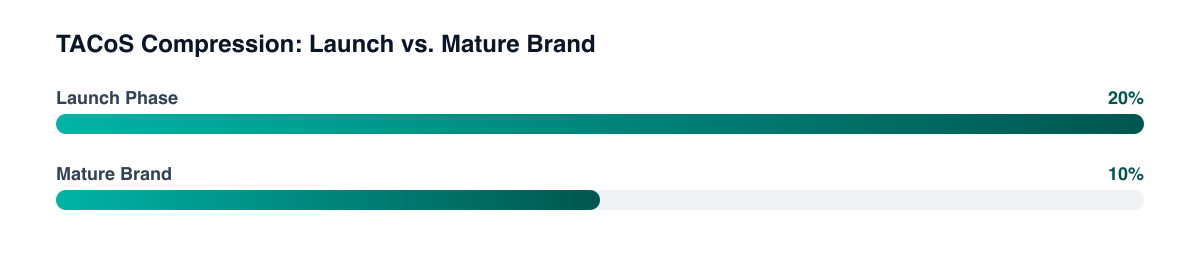
This is why TACoS (Total Advertising Cost of Sale) is the real metric, not ACoS. TACoS = Total Ad Spend / Total Revenue (organic + paid). A healthy, scaling brand typically sees TACoS compress from 15–20% in launch phase to 8–12% at maturity as organic rank improves and organic revenue grows faster than ad spend.
For a deeper look at how listing quality amplifies PPC efficiency, see Amazon Product Listing Optimization — because even the best campaign structure leaks conversions to a weak PDP.
What campaign naming conventions give you reporting clarity?
This sounds administrative. It isn't. Naming conventions determine whether your account is reportable at scale.
A consistent naming framework:
[Brand/ASIN] | [Campaign Type] | [Match Type] | [Funnel Stage] | [Launch Date]
Example: NovaSupplement-B09XZ | SP | Exact | Scale | 2026-01
When you have 50+ campaigns, this naming structure means you can filter, sort, and report in Seller Central or any third-party tool without opening each campaign individually. It also makes handoffs between team members frictionless.
Avoid generic names like "Campaign 1" or "Auto - Broad." They're useless in dashboards and make optimization decisions slower.
How does this compare to other paid channels?
The three-campaign funnel logic — discovery, harvesting, scaling — maps conceptually to how we structure Google Shopping Campaign Structure, where you similarly segment by query intent to control CPCs and push budget toward proven converters. The mechanics differ, but the underlying principle is the same: don't let unknowns compete with knowns for budget.
The key difference on Amazon is that ad performance has a direct feedback loop into organic visibility. On Google, a click doesn't improve your SEO. On Amazon, it often does.
The bottom line
Amazon PPC performance is mostly a structural problem, not a bidding problem.
"Amazon PPC performance is mostly a structural problem, not a bidding problem."
— Dhruvit Shah, Co-Founder — Performance Marketing & Growth Strategy
The three-campaign discovery-harvest-scale architecture, disciplined negative keyword management, and TACoS as your north star metric will drive ACoS down while growing total revenue — because you're building organic rank simultaneously. Get the structure right first, then optimize bids.
Related guides
PART OF OUR SERVICE
Marketplace Management
Want a free marketing audit?
We'll review your tracking, ad accounts, and funnel — and show you exactly where the gaps are.
Get Your Free Audit →