Most D2C video ads die in the first three seconds.
"Most D2C video ads die in the first three seconds."
— Nitesh Kasma, Co-Founder — Brand Strategy & Client Growth
Not because the product is bad, not because the offer is weak — because the hook didn't stop the scroll. Everything after that is irrelevant.
If you're investing in creative & branding for paid social, the script and production decisions you make before you ever hit record determine 80% of your ad's ceiling. This guide covers the full production chain — from hook structure to multi-variant shoot strategy — so you stop guessing and start building a repeatable system.
Why is the hook the whole game?
There are three hook archetypes that consistently outperform everything else in D2C:
Problem hook — Lead with the pain. "You've tried six moisturizers this year and your skin still looks like sandpaper." Curiosity hook — Create an open loop. "The reason your Meta ads stopped working has nothing to do with your targeting." Bold claim hook — Make a provocative, specific statement. "This sold 12,000 units in 11 days with a $4,000 ad budget."
Problem hooks tend to win for products solving a clear, felt pain. Curiosity hooks work well for content-style ads or when educating a cold audience. Bold claim hooks work when your proof is genuinely strong — weak proof with a big claim kills trust instantly.
Test all three. Don't fall in love with one hook style. Your audience will tell you which one resonates through your 3-second video view rate. A healthy benchmark for feed placements is 40%+ 3-second view rate; if you're below 30%, the hook is the problem.
What's the 4-part script anatomy?
Once you hook them, the structure is straightforward:
Hook (0–3 sec): Stops the scroll. Sets up tension or intrigue.
Context (3–8 sec): Agitate or expand the problem. Establish why this matters and for whom. This is where you earn the right to present a solution.
Solution (8–20 sec): Introduce the product, show it working, demonstrate the outcome. Specifics matter here — "skin felt smoother in 48 hours" beats "amazing results."
CTA (final 3–5 sec): One clear action. "Shop now." "Use code SCALE for 20% off." "Tap the link." Don't stack multiple CTAs — it dilutes intent.
For most Meta feed placements, keep total runtime between 20–35 seconds. Reels and TikTok reward shorter (15–25 sec). YouTube pre-roll needs to deliver the hook and enough value before the 5-second skip option, which means the first 4 seconds are even more critical there.
What filming specs work by placement?
Shooting once for every placement is a budget trap. Spec for your primary placements up front:
Meta feed (1:1 square): 1080 x 1080px minimum. Safe zone keeps text and faces away from edges. Works for both static and video. Majority of spend for most D2C brands lives here.
Reels / TikTok (9:16 vertical): 1080 x 1920px. Full bleed — use the entire frame. Faces fill the screen. Text overlays stay in the center 80% of the frame to avoid UI overlap.
YouTube pre-roll (16:9 horizontal): 1920 x 1080px. Hook must land before second 5. Product/logo visible early. More time to tell a story if running skippable in-stream.
If you're shooting on a budget, prioritize 9:16. You can center-crop vertical footage to 1:1 without much quality loss. Going the other direction — cropping 16:9 to 9:16 — almost always looks wrong.
Studio vs. UGC: when does each win?
This is one of the most debated questions in D2C creative. The full breakdown is in our UGC vs. Studio Creative guide, but here's the fast version:
Studio production wins when you need to establish brand credibility, you're in a category where visual quality signals trust (beauty, wellness, luxury apparel), or you're running YouTube pre-roll where polish reads better.
UGC-style wins on Reels and TikTok because native-looking content outperforms polished ads in those feeds — full stop. It also wins when social proof and relatability are the primary buying triggers for your product. See what's working specifically on TikTok in our TikTok Ads for D2C: What's Actually Working in 2026 breakdown.
The most effective D2C creative programs run both in parallel and let performance data dictate budget allocation. Don't make it a religious debate.
How do you edit for retention?
Your hook got them. Now your editing has to keep them.
Pacing: Cut faster than feels comfortable. Dead air — a pause, a slow zoom, an empty second — is where viewers drop. On mobile, attention spans are measured in quarter-seconds. If a frame doesn't advance the narrative or emotion, cut it.
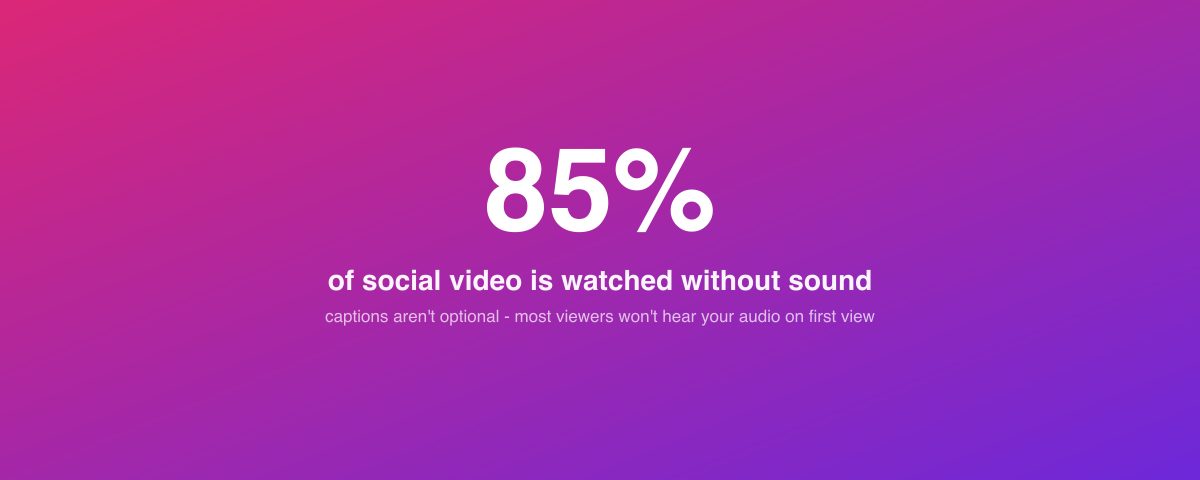
Captions: Add them. Always. Roughly 85% of social video is watched without sound on first view. If your audio carries the argument and there are no captions, you've written off most of your audience before the hook even lands.
Text overlays: Use them to reinforce, not repeat. If the voiceover says "works in 48 hours," a text overlay that says "Results in 48 hours" amplifies the message. If it just transcribes the audio verbatim, it adds clutter. Bold the key stat or claim. Keep font sizes readable on mobile — 40pt+ as a baseline.
Pattern interrupts: A cut, a zoom, a sound effect, a graphic — every 3–5 seconds. This isn't stylistic preference; it's retention mechanics. Each interrupt resets attention.
How do you get 8 variants from one shoot?
A single half-day shoot can yield a full creative testing matrix if you plan for it. Here's the framework:
- 3 hook variations — shoot the problem hook, curiosity hook, and bold claim opening as separate slates
- 2 CTA endings — one offer-led (discount/urgency), one benefit-led (outcome statement)
- 2 aspect ratios — frame both 9:16 and 1:1 during filming so you're not cropping later
That's 12 theoretical combinations. In practice, you'll cut 6–8 meaningful variants, each with a distinct hook or CTA pairing. Launch them in a single ad set with creative-level reporting on. Let the data pick the winner. This is a faster and cheaper path to a proven creative than shooting six separate concepts.
How do you use performance data to brief better scripts?
Every script you write should be informed by what the previous scripts told you. The feedback loop matters more than the individual ad.
Pull these four metrics per creative after 500+ impressions:
- 3-second video view rate — diagnoses hook effectiveness
- Video completion rate (25%, 50%, 75%, 100%) — shows where you're losing people
- Click-through rate — measures whether the offer/CTA landed
- Cost per purchase or ROAS — the only metric that ultimately matters
If completion drops sharply at the 8-second mark, your context section is losing them — tighten it or reorder it. If CTR is strong but purchase rate is weak, the ad is over-promising relative to the landing page. If the hook gets strong 3-second views but completion tanks, the hook and body aren't connected — you sold a promise the ad didn't deliver on.
Brief your next script with specific fixes, not vague notes. "The hook tested well; cut the product demo from 12 seconds to 6 and lead with the before/after outcome" is a useful brief. "Make it more engaging" is noise.
The bottom line
D2C video ads are won or lost in the script and the first three seconds of execution. Build a production system that generates multiple variants from every shoot, edit for mobile retention by default, and close the feedback loop between performance data and your next creative brief. Iteration speed beats production polish every time.
Related guides
PART OF OUR SERVICE
Creative & Branding
Want a free marketing audit?
We'll review your tracking, ad accounts, and funnel — and show you exactly where the gaps are.
Get Your Free Audit →