

Every conversation about tracking loss eventually arrives at server-side tagging, usually framed as a switch that restores what browsers took away. It restores some of it. Being precise about which part is the difference between a worthwhile project and an expensive one.
"Server-side tagging moves where the tag runs. It doesn't create consent you didn't get or identity you never had."
— Aashish Kasma, Co-Founder — Data & Analytics
What is it actually doing?
Instead of the browser sending events directly to a dozen vendors, it sends one request to a server container you control, and that container distributes events to the vendors from the server side. The page loads less third-party JavaScript, you decide what data leaves your infrastructure, and cookies can be set in a first-party context.
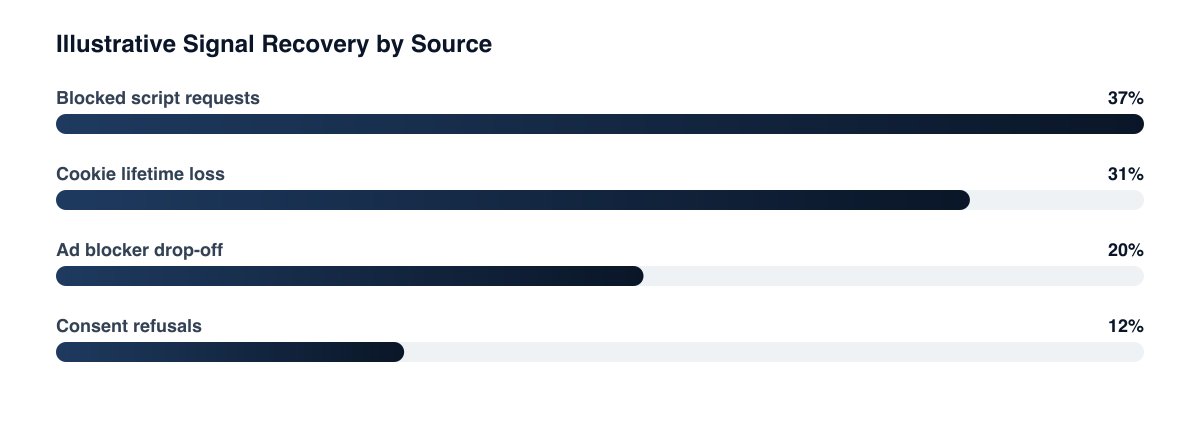
That's the mechanism, and three real benefits follow from it: fewer blocked requests, longer-lived first-party cookies where browsers restrict script-set ones, and control over the payload — which is the part that matters most for data privacy compliance and rarely gets mentioned in the sales pitch.
What does it not fix?
Consent. If a user declines tracking, server-side tagging doesn't ethically or legally give you the event, and building it to do so is the fastest way to turn a measurement project into a compliance problem. Any vendor pitching recovery of consent-refused traffic is describing something you should decline.
It also doesn't fix cross-device identity, doesn't repair a broken data layer, and doesn't reconcile platform reporting differences — the discrepancies between Meta, GA4, and Shopify are mostly definitional, and moving tags to a server doesn't change how each platform defines a conversion. Teams that expected numbers to converge afterwards are usually disappointed.
And it does not remove the need for platform-specific conversion APIs. Server-side tagging is the plumbing; the Conversions API is one of the endpoints that plumbing feeds.
What does it cost?
More than the hosting line, which is the number usually quoted. The real costs:
- Ongoing infrastructure. A container that has to stay up under traffic peaks, with monitoring, because a silent failure loses data you can't backfill.
- A named owner. Server-side setups fail differently from client-side ones — quietly, in a place marketers can't see. Without someone responsible for it, the first sign of a problem is a month of missing conversions.
- Migration risk. During the switch you'll run both paths, and duplicate events are worse than missing ones because they corrupt optimisation as well as reporting.
- Reduced transparency for the team. Debugging moves from the browser console to server logs, which puts it out of reach of most of the people who used to check it.
Deduplication is the whole migration Event IDs shared between browser and server events are what stop a conversion being counted twice. Get this right before sending live traffic through both paths — not after you notice ROAS looks suspiciously good.
When is it worth doing?
When your spend is large enough that a recoverable percentage of signal is worth real money, and when your data layer is already trustworthy. Those two conditions do most of the qualifying work.
If your event tracking is inconsistent, your product IDs don't match between platforms, or nobody's confident what a "purchase" event includes, server-side tagging will faithfully deliver those problems to more places, faster. Fix the tracking foundation first — it's cheaper, and it's the prerequisite either way.
The pragmatic middle path for most brands: run platform conversion APIs directly through your commerce platform's native integrations, which gets a large share of the benefit with none of the infrastructure, and revisit full server-side containers when spend or compliance requirements justify the ownership cost.
Related guides
- D2C Analytics and Attribution: The Complete Guide
- Meta Conversions API: A Practical Implementation Guide
- Why Meta, GA4, and Shopify Never Agree
- First-Party Data Strategy for D2C Brands
Server-side tagging is infrastructure, not a fix. Scope it against what it genuinely recovers, budget for the ownership rather than the hosting, and make sure the data model underneath it is sound before any data and analytics migration starts.
PART OF OUR SERVICE
Data & Analytics
Want a free marketing audit?
We'll review your tracking, ad accounts, and funnel — and show you exactly where the gaps are.
Get Your Free Audit →