

Every D2C team eventually holds the same meeting: Meta says 340 purchases, GA4 says 291, Shopify says 268, and someone is asked to find out which platform is wrong.
"The platforms aren't disagreeing about reality — they're each answering a different question, and only one of them is the question your P&L asks."
— Aashish Kasma, Co-Founder — Data & Analytics
Why do the numbers differ in the first place?
Each platform has a different definition, a different attribution rule, and a different vantage point:
- Meta counts conversions it believes it influenced, credited back to the day of the ad click or view, within its attribution window — including view-through. It also models a portion of conversions it can't directly observe.
- GA4 counts sessions and events it observed in the browser, credited to the last non-direct channel, on the day the event fired. Consent banners, ad blockers, and cross-device journeys all remove events it never sees.
- Shopify counts orders that actually exist, on the day they were placed, with no attribution opinion at all — but it also includes orders from every channel, including ones no ad platform touched.
None of those are errors. They're three different measurement systems being read as if they were the same one.
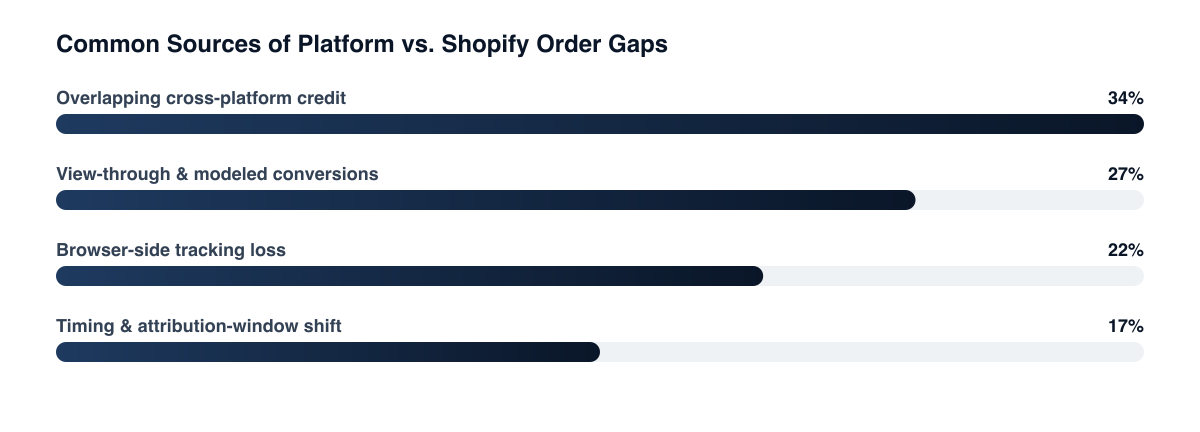
Which number should actually run the business?
Shopify. Or whatever your order system of record is — it's the only source that reflects money that actually arrived. Platform numbers are optimisation signals, not financial ones. The practical rule most teams land on:
- Shopify (or your ERP) is truth for revenue, order count, AOV, and anything that reaches the P&L.
- Platform-reported conversions are for in-platform decisions only — which creative to scale, which ad set to cut. Comparing Meta's ROAS to Google's ROAS is comparing two different measurement systems and is a common source of bad budget calls.
- Blended metrics — total revenue over total spend, straight from Shopify and your invoices — are the honest top-line number, and the one worth reviewing weekly.
- GA4 is best used for on-site behaviour: funnel drop-off, landing page performance, site search. It's a weak arbiter of channel credit and a good one for what happened after the click.
Stop trying to make them match Reconciliation is about explaining the gap, not eliminating it. A stable, explainable gap between Meta and Shopify is a healthy system. A gap that suddenly changes size is the actual alert worth building.
How do you narrow the gap that shouldn't be there?
Some of the difference is definitional and permanent. Some is genuine data loss that's worth fixing. Server-side event tracking through the Conversions API recovers a meaningful share of events that browser-side pixels miss to ad blockers and consent handling, which usually tightens the platform-to-Shopify gap and improves the platform's optimisation at the same time. Consistent UTM discipline does the same job for GA4 — most "direct traffic" inflation is untagged links, not genuinely direct visitors.
What that won't fix is double-counting. If Meta and Google both claim the same order, no amount of tracking hygiene resolves it, because both claims are defensible under their own attribution rules. That gap only closes with incrementality testing or marketing mix modelling, which measure contribution instead of credit.
What should the weekly reporting actually look like?
One table, sourced from Shopify, showing total revenue, total spend, blended ROAS, and new-customer share. Platform figures sit beside it as a secondary column, clearly labelled as platform-reported — not averaged, not summed, and never reconciled into a single "true" number. The moment the two are merged into one figure, everyone stops knowing which question they're answering, and the argument comes back the following week.
Related guides
- D2C Analytics and Attribution: The Complete Guide
- Meta Conversions API: A Practical Implementation Guide
- Marketing Mix Modeling for D2C Brands
- ROAS and Attribution: The Truth About Blended vs. True Return
The discrepancy meeting stops recurring the moment each number has an assigned job. Truth comes from the order system, optimisation signal comes from the platforms, and the analytics layer exists to keep the two from being confused for each other.
PART OF OUR SERVICE
Data & Analytics
Want a free marketing audit?
We'll review your tracking, ad accounts, and funnel — and show you exactly where the gaps are.
Get Your Free Audit →