
The usual new-SKU launch on a quick commerce app is a listing, a sponsored bid, and a hope. The listing goes live in a handful of dark stores, the ad spend points at all of them, and two weeks later the brand concludes the product doesn't sell, when what it actually showed was that nobody could find it in stock.
"A new SKU doesn't fail on quick commerce because the demand isn't there. It fails because the first fortnight of data was collected from a shelf that was mostly empty."
— Dhruvit Shah, Co-Founder — Performance Marketing & Growth Strategy
Why is a new SKU harder than an existing one?
Because, in our experience, ranking leans on recent sales velocity within each dark store (the platforms don't publish their ranking logic), and a new listing has none. As the quick commerce playbook covers, an out-of-stock listing typically starts a decay loop: no stock, no sales, lower rank, worse conversion even after replenishment. A new SKU starts at the bottom of that loop with no history to cushion it.
Shelf space is also limited. A dark store holds a limited range, so every addition typically competes with something already selling. That's why assortment decisions belong before the launch, not after it: a new SKU that cannibalises your own best seller isn't growth.
What does seeding availability actually mean?
It means concentrating stock where the launch can be read cleanly, rather than spreading it thin everywhere. In practice:
- Pick a small set of cities or dark-store clusters where your brand already has velocity and the buyer profile matches the new product.
- Agree the replenishment plan with the platform before launch, so the SKU doesn't stock out in week two when the first orders land.
- Hold the same pack and price across the seeded stores so the early signal isn't muddied by variation.
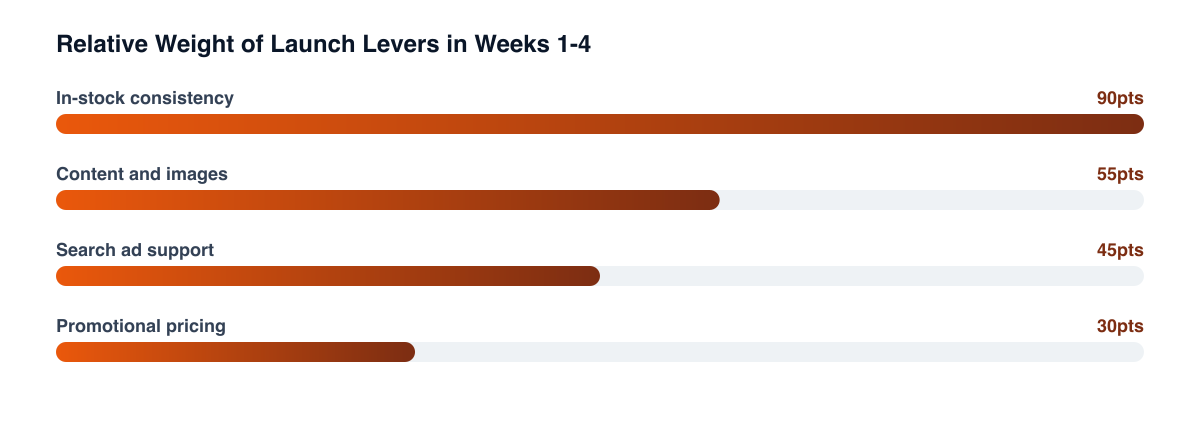
You are trying to produce a clean velocity signal, not maximum reach. A launch seeded in fewer stores that stay in stock tells you more, and ranks better, than one scattered across stores that keep running dry. The platforms publish little on stocking rules, which in our experience are set per account and change, so confirm minimum order and replenishment terms with your account manager.
How does the ranking ramp work?
Think of it in three phases rather than a fixed calendar, because the pace differs by category and city:
- Seeding — stock lands, the listing is complete, and organic orders start from existing brand searchers and browsers in the category.
- Velocity build — repeat orders and category browsing push the SKU up its own search results as sales accumulate in each store.
- Rank holding — once the SKU ranks on its target terms, spend shifts from discovery to defence.
The platforms' weighting isn't public and the phases below reflect our experience, so treat any promised timeline with suspicion. What you can observe is in-stock rate, rank position on your three or four primary terms, and units per store per day. Track those, not just total sales.
When should ad support start?
After availability is stable, not before. For new launches, sponsored spend is typically the main route to first-purchase volume because there's no sales history to rank on, as the ad formats guide explains. But in our experience sponsored placements work only where the SKU is in stock, so spend aimed at a store where it is out of stock buys impressions you can't convert. Confirm how each platform handles this with your account manager.
A sensible sequence is to start with narrow category-discovery bids in the seeded stores once availability holds, add brand-adjacent terms as the SKU gains sales history, and move toward defending the rank once it appears on its own. Pause any city where in-stock falls below a threshold you set in advance.
Launch in fewer stores, keep them full, then add ads A clean read from a small, consistently stocked footprint beats a wide launch with patchy shelves. Expand store coverage only after velocity and rank hold in the seeded set.
How do you know the launch worked?
Judge it at the SKU-per-store level, against a threshold you wrote down before launch. Ask whether the SKU is holding a rank without ad support, whether repeat orders are appearing, and whether the contribution margin survives the launch spend, using the same budget discipline you'd apply to any channel. A launch that needs permanent ad support to hold its position isn't a ranked product; it's a rented one.
If it doesn't clear the bar, the answer may be a different pack size or price rather than more spend. That's a better outcome than finding out after a quarter of unread data.
Related guides
- Quick Commerce for D2C: What Changes When Your Shelf Is 10 Minutes Away
- Quick Commerce Ads: What Each Format Actually Buys You
- Assortment and Pack Size on Quick Commerce: What to List and What to Hold Back
- Marketing Budget Allocation for D2C Brands
A new SKU earns its place through a stocked shelf and a rising rank, with ad support added once there's something worth supporting. If you're planning a launch across Blinkit, Zepto, and Instamart, our quick commerce team can map the seeding footprint and the spend sequence before the first order is placed.
Want a free marketing audit?
We'll review your tracking, ad accounts, and funnel — and show you exactly where the gaps are.
Get Your Free Audit →