

Brands arriving on quick commerce platforms usually port their Amazon playbook straight across: bid on category terms, bid on brand terms, watch ACoS. The formats rhyme, but the shelf underneath them doesn't.
"On Amazon, an ad buys you a place in a list. On quick commerce, it buys you a place in a list that only exists if the product is in that store's inventory right now."
— Dhruvit Shah, Co-Founder — Performance Marketing & Growth Strategy
What are you actually buying?
Three broad placement types, whatever each platform calls them:
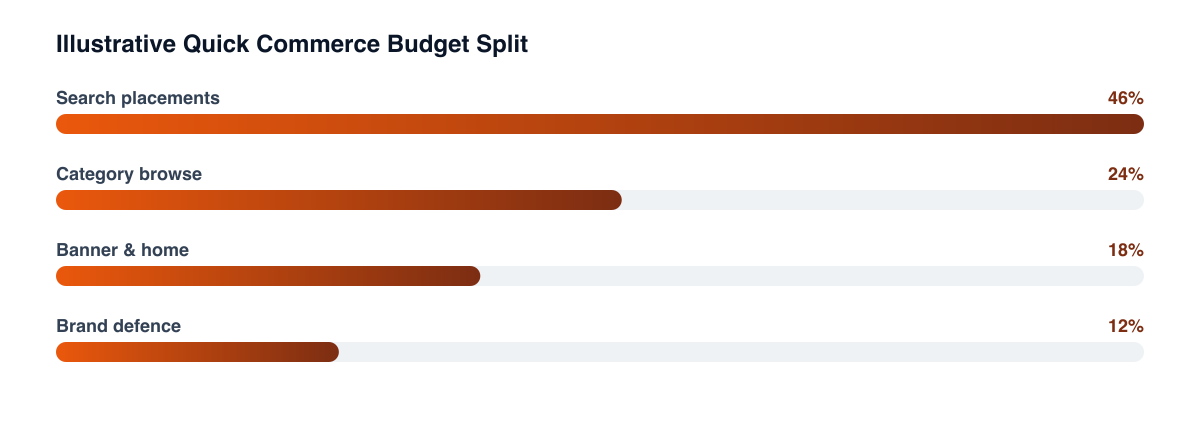
Search placements put you at the top of results for a query. This is the closest analogue to Sponsored Products, and the same discipline applies — the term has to describe the product, not the category you wish you owned.
Category and browse placements put you in front of someone scrolling a section without a specific product in mind. Intent is weaker and conversion is lower, but so is the competition on genuinely broad terms.
Banner and home placements are brand media sold on a performance channel. They're priced like awareness, they report like performance, and the mismatch is where a lot of quick commerce budget disappears.
Why does availability change the maths?
Because impressions are served from a store's live catalogue. If your SKU is out of stock in a dark store, the ad simply doesn't serve there — which sounds protective until you realise what it does to your reporting. Your spend concentrates in the stores that happen to be well-stocked, your reported performance reflects those stores only, and you draw conclusions about creative or bidding from a sample selected by your supply chain.
The practical consequence: read performance by store cluster and in-stock rate before you read it by keyword. A term that looks unprofitable nationally is often profitable in the stores that reliably carry the product, and the fix is inventory, not a bid change. This is the same reason assortment and pack size come before budget on these platforms.
Should you bid on your own brand terms?
Usually yes, and for a different reason than on search engines. On a quick commerce app, a customer searching your brand name sees a results page where competitors can occupy the top slot — and the substitution decision happens in seconds, against a customer who wants something delivered now. The switching cost for them is near zero.
That makes brand defence cheaper than the alternative and easier to justify than the equivalent debate in paid search brand defence, where organic listings at least hold the position for free. Cap it, don't uncap it: brand terms should have a fixed share of budget, because it's the easiest line to over-spend into cannibalisation.
Separate defensive spend from acquisition spend in reporting Brand-term ROAS will always look excellent and will always flatter the account. Report it as its own line so the acquisition budget is judged on its own numbers.
How should the account be structured?
Keep it flat and readable. These platforms give you far less structural control and far less data than Google or Amazon, and elaborate structures produce cells too small to interpret:
- One campaign per objective — search, browse, brand defence — not one per SKU.
- Group SKUs by margin band, so the bid you're willing to pay reflects the contribution, not the category.
- Exclude the SKUs that aren't reliably in stock. Advertising them subsidises a discovery you can't fulfil.
- Reconcile spend against platform sales weekly, not daily. The reporting lag on these platforms is real, and daily reads produce panic decisions.
Then hold the whole channel against your own site's numbers rather than in isolation — quick commerce demand and D2C demand interact, and the marketplace versus DTC trade-off is a portfolio question, not a channel one.
Related guides
- Quick Commerce for D2C: What Changes When Your Shelf Is 10 Minutes Away
- Assortment and Pack Size on Quick Commerce
- Amazon PPC: Campaign Structure That Reduces ACoS
- Marketplace vs. DTC: Building a Strategy That Doesn't Cannibalise
The formats are learnable in a week; the discipline of reading them against availability takes longer and matters more. Get the inventory picture into the same report as the spend before scaling any quick commerce budget.
PART OF OUR SERVICE
Quick Commerce
Want a free marketing audit?
We'll review your tracking, ad accounts, and funnel — and show you exactly where the gaps are.
Get Your Free Audit →