
The "spend 10–15% of revenue on marketing" rule is useless advice. A brand doing $2M/year with 60% gross margins and strong organic retention needs a completely different budget logic than one doing $2M/year with 35% margins and a one-time purchase product. Stage, category, and margin structure all override generic percentage benchmarks. The allocation ranges here come from budgets we've built and audited across D2C accounts, not from a published benchmark — they're starting points shaped by real P&Ls, not rules.
"Stage, category, and margin structure all override generic percentage benchmarks."
— Dhruvit Shah, Co-Founder — Performance Marketing & Growth Strategy
Here's how to actually build a budget framework — one that starts with your economics, not a spreadsheet template.
Why do fixed percentage rules fail D2C brands?
The percentage-of-revenue model assumes your cost structure scales linearly with revenue. It doesn't. At early stages, you're paying a premium for learnings, not just customers. At scale, you're facing diminishing returns in your core channels. At maturity, you're fighting to hold share while margin pressure from rising CPMs compounds.
A $50K/month spend brand and a $500K/month spend brand both running Meta and Google can have wildly different efficiency profiles. The inputs that matter are CAC, LTV, and gross margin — not revenue as a percentage.
The right framing: Your marketing budget is a function of how many customers you can profitably acquire, not a fixed slice of what you've already earned.
What are the three growth stages and what does each one demand?
Stage 1: $0–$50K/month — finding signal
At this stage, you don't have enough data to optimize. Your job is to find what works, not scale what's working. That means a higher percentage of budget goes to testing — and you should expect to "waste" some of it.
Channel mix at this stage typically looks like:
- Paid social (Meta/TikTok): 50–60% — broadest reach, fastest feedback loop on creative
- Paid search (brand + non-brand): 20–30% — captures demand you've already created
- Testing budget (email, affiliates, influencer): 10–20% — small bets on channels with asymmetric upside
CAC targets here are loose by necessity. If your LTV is $180 and your 12-month payback window allows a $90 CAC, you may accept $110–$120 during this phase in exchange for faster learning velocity. Don't try to be efficient before you've found repeatable acquisition.
Stage 2: $50K–$300K/month — efficiency and volume
You've found your core channel. Now the challenge is scaling it without destroying your CAC. This is where performance marketing discipline becomes the difference between brands that compound and brands that plateau.
The budget logic shifts to defending efficiency while expanding reach:
- Primary acquisition channel (usually Meta or Google): 45–55%
- Secondary acquisition channel: 20–25%
- Retention and lifecycle (email/SMS): 15–20%
- Emerging channel tests: 5–10%
At $150K/month, a 10% misallocation is $15K. That starts to matter. This is also when Attribution Modeling becomes critical — your Meta ROAS number and your actual blended CAC are probably telling different stories, and you need to reconcile them before you make scaling decisions.
A useful benchmark: brands at this stage that maintain a blended CAC within 15% of their target while growing spend 15–20% month-over-month are executing well. Most brands see CAC drift 25–40% above target as they push volume. That's a signal to diversify, not just spend more.
Stage 3: $300K+/month — defend and diversify
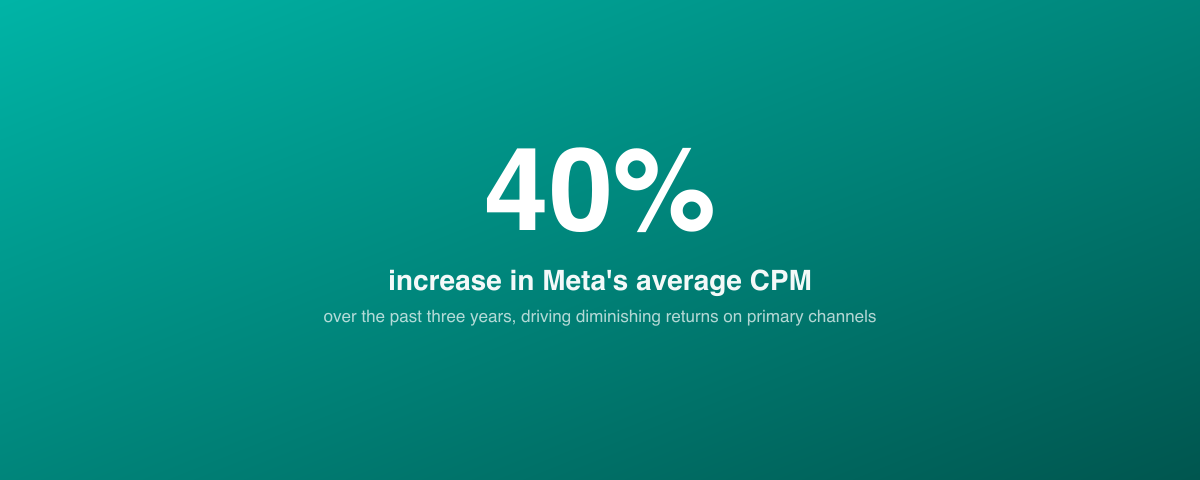
At this level, your primary channel is likely hitting diminishing returns. You've worked through your best audiences. CPMs are rising (Meta's average CPM has increased over 40% in the past three years). Your next dollar on the primary channel is less efficient than your last dollar.
Channel mix here is less about percentages and more about portfolio construction:
- Core acquisition channels: 40–50% — still your biggest lever, but not your only one
- Brand and upper funnel (CTV, YouTube, OOH): 10–20% — builds the demand your performance channels convert
- Retention and loyalty: 20–25% — your owned channels have the best margin profile
- New channel diversification: 10–15% — actively testing to find the next core channel
The brands that stall at this stage are the ones that treat their media mix as fixed. Treat it as a portfolio with regular rebalancing.
How do you build from CAC targets and LTV data?
Start with your LTV-to-CAC ratio, not a channel split. If your 12-month LTV is $200 and your target payback window is 9 months, your max CAC is roughly $130 (assuming 65% gross margin on a $200 LTV means ~$130 contribution). Work backwards from there.
LTV-based CAC ceiling = (LTV × Gross Margin %) ÷ Payback Period Multiplier
Once you know the CAC you can afford, you set efficiency targets per channel — and budget accordingly. A channel that reliably hits your CAC target at volume gets more budget. One that needs a 30% CAC premium to scale gets a hard cap until you've improved the creative or targeting.
This is also why understanding how to scale ad budgets without killing performance is a prerequisite before aggressive allocation changes — the mechanics of how budget increases affect delivery and efficiency are non-obvious.
What's the 70/30 starting point for acquisition vs. retention?
A common starting allocation is 70% acquisition, 30% retention. This holds reasonably well for brands in Stage 1 and early Stage 2.
It breaks down when:
- Your repeat purchase rate exceeds 40% (shift toward 60/40 or even 55/45)
- Your category has high organic churn (shift toward 80/20 and invest in acquisition before worrying about retention)
- Your email/SMS list is under 10,000 — retention investment has poor leverage at small list sizes
Retention spend generates the best margin-adjusted return at scale. A well-run lifecycle program can reduce net CAC by 15–25% by improving LTV on already-acquired customers. But it requires list size and purchase history to work. Don't over-invest in it early.
How do you evaluate new channel investment?
Before committing budget to a new channel, set three things in advance:
- Minimum test budget: Enough to exit the learning phase. For paid social, that's typically $5K–$10K and 50+ conversions. For affiliates or influencer, it's at least 5 partner activations.
- Success criteria at 60 days: Define what "working" looks like before you start — usually CAC within 20% of target and week-over-week efficiency improvement.
- Kill threshold: If you hit two consecutive weeks of CAC 40%+ above target in week 3 or later, cut it. Don't let sunk cost keep a poor channel alive.
Most channel tests fail not because the channel is wrong but because the creative or offer wasn't adapted for the channel's native format. Factor that into your evaluation — one round of optimized creative before you declare failure.
What's the marginal ROAS framework for the next-dollar decision?
Once you're at Stage 2 or Stage 3, marginal ROAS is a better budget allocation tool than blended ROAS.
Marginal ROAS = Change in Revenue ÷ Change in Spend (measured at the channel or campaign level, incremental spend only)
If Meta's blended ROAS is 3.2 but your marginal ROAS on the next $20K is 1.8, that budget is better deployed elsewhere — in a higher-margin retention channel, a new acquisition test, or simply held back.
The practical way to measure this: run a budget hold-out test. Pull 10–15% of spend from a channel for two weeks and measure the revenue gap. If revenue drops less than proportionally, your marginal ROAS on that channel is below your blended ROAS — and you're over-indexed there.
Most brands discover they're over-invested in their primary acquisition channel by 15–25% once they run this analysis. That reallocation alone often delivers a 10–15% improvement in total blended efficiency.
The bottom line
Budget allocation isn't a one-time decision — it's a quarterly rebalancing exercise driven by your CAC targets, LTV data, and marginal efficiency signals. The brands that grow profitably are the ones treating their media mix like a portfolio, not a formula. Start from your unit economics, set hard efficiency thresholds per channel, and let the marginal ROAS data tell you where the next dollar goes.
Related guides
PART OF OUR SERVICE
D2C Growth Bundle
Want a free marketing audit?
We'll review your tracking, ad accounts, and funnel — and show you exactly where the gaps are.
Get Your Free Audit →