
Brands that treat quick commerce as "Amazon, but faster" usually stall in the first quarter. The catalog transfers fine; the assumptions don't.
"On quick commerce your listing isn't competing for a click, it's competing for a slot on a shelf that only holds a few thousand SKUs and gets restocked by van."
— Dhruvit Shah, Co-Founder — Performance Marketing & Growth Strategy
The difference is physical. A marketplace listing is available to everyone the moment it's live. A quick commerce listing is only available to shoppers within range of a dark store that currently has the item in stock — which means the same SKU can be a bestseller in one pin code and invisible three kilometres away.
Why does availability matter more than ads here?
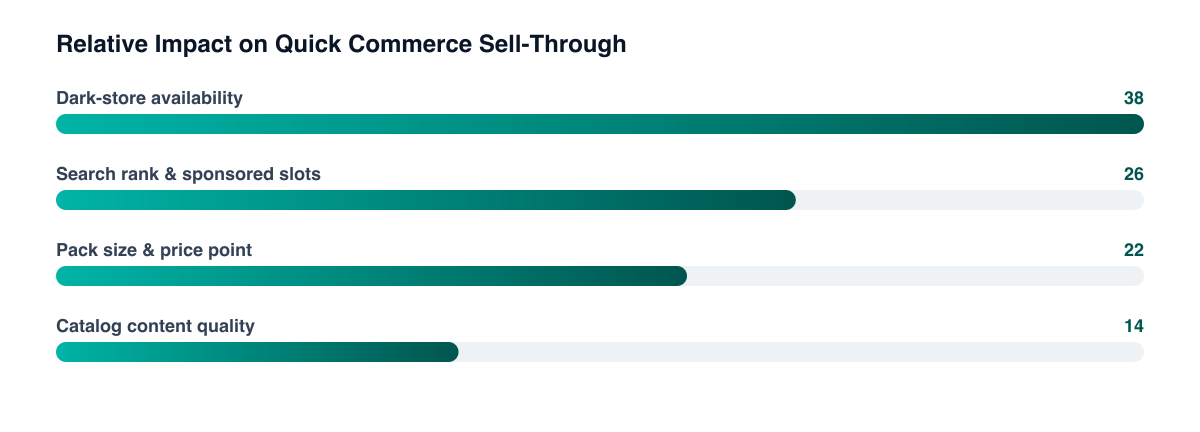
Because an out-of-stock listing doesn't just lose that sale — it loses search position. Platform ranking leans heavily on recent sales velocity within each dark store, so a stockout starts a decay loop: no stock means no sales, no sales means lower rank, and lower rank means the listing converts worse even after replenishment lands. Ad spend pointed at a SKU with patchy availability is paying for impressions that can't convert in half the catchment area.
How is pack size a growth lever, not a packaging decision?
Quick commerce demand skews toward impulse and top-up purchases, not stock-up runs. A pack size built for a monthly grocery shop carries a price point that stalls at a 10-minute decision, while a smaller trial pack lands inside the impulse band and converts at a much higher rate. The brands scaling fastest on these platforms usually run a quick-commerce-specific SKU ladder: a small trial pack to win first purchase, and a mid-size pack positioned as the repeat option — not the same lineup they sell on their own site or on marketplaces.
Availability is a reporting metric, not just an ops metric Track in-stock percentage per dark store, not as a single national average. A 90% national figure can hide a handful of high-demand cities sitting near 60% — which is where the lost revenue actually is.
What should sponsored ad spend actually be doing?
- Defend the SKUs that already rank. Organic top-of-search positions are volatile on these platforms; a modest sponsored bid holds the slot on days when velocity dips.
- Buy category discovery for new launches, where there's no sales history to rank on and ads are the only route to first-purchase volume.
- Daypart against real ordering behaviour — evening and late-night peaks are pronounced, and flat bidding across the day quietly overspends on low-intent morning hours.
- Pause spend on any SKU below a reasonable availability threshold in that city, instead of buying impressions the fulfilment side can't service.
Does quick commerce cannibalise your own D2C revenue?
Partly, and it's worth measuring rather than assuming. Quick commerce tends to capture genuinely different demand — urgent, small-basket, and often a first-time trial of a brand the shopper has seen in ads but never bought. The real risk isn't cannibalisation, it's margin: platform commissions, deal funding, and the smaller basket sizes mean contribution per order sits well below your site's. Treat it as a paid acquisition channel with a physical shelf attached, hold it to a contribution-margin target rather than a revenue target, and the channel mix decision gets a lot clearer.
Related guides
- Marketplace vs. D2C: Building a Strategy That Uses Both
- Amazon Listing Optimization: The Fundamentals That Still Move Rank
- Marketing Budget Allocation for D2C Brands
- First-Party Data Strategy for D2C Brands
Quick commerce rewards operational discipline more than clever media buying. Get availability and pack strategy right across the dark stores that matter, and the ad spend starts compounding instead of subsidising a shelf that's half empty.
PART OF OUR SERVICE
Quick Commerce
Want a free marketing audit?
We'll review your tracking, ad accounts, and funnel — and show you exactly where the gaps are.
Get Your Free Audit →