

The instinct when a brand gets onto a quick commerce platform is to upload everything. Every variant, every size, every flavour — more listings, more chances to be found. On a platform where the shelf is a dark store with a few hundred square feet of space, that instinct is expensive.
"Every SKU you list on a quick commerce platform competes with your own SKUs for the same inch of dark store shelf. Breadth on the site is depth removed from the store."
— Dhruvit Shah, Co-Founder — Performance Marketing & Growth Strategy
Why does a narrow assortment usually outsell a wide one?
Because the platform decides which of your SKUs to stock in which dark store, and it decides on velocity. A SKU that sells slowly gets stocked in fewer stores, which reduces the population that can see it in-stock, which reduces its velocity further. That loop runs in both directions, and a wide catalogue starts most of its SKUs at the wrong end of it.
Splitting demand across eight variants also splits the sales signal the platform's own ranking uses. Three variants each doing meaningful volume will out-rank eight variants doing a third of that each, and they'll hold availability across more stores while doing it — which, as the quick commerce playbook covers, is the single largest driver of sell-through on these platforms.
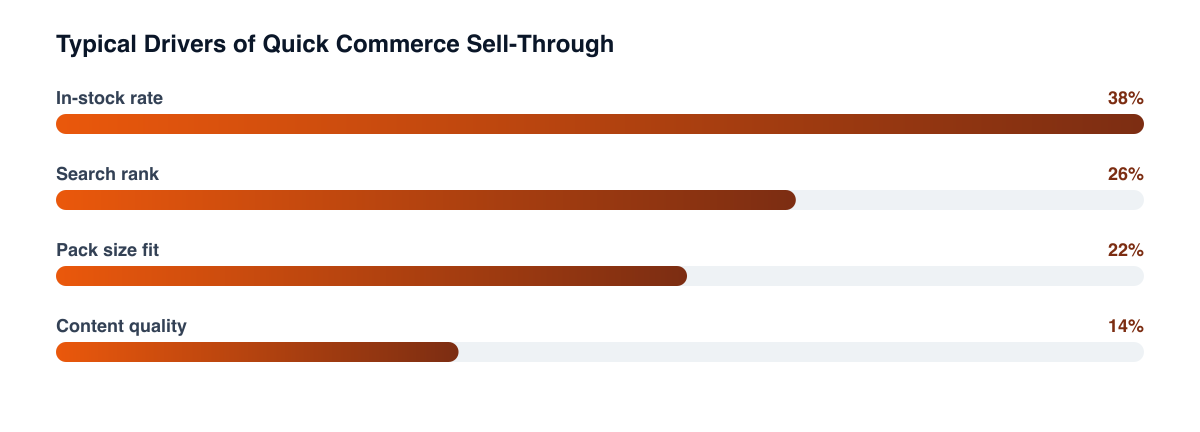
How should pack size differ from your own site?
It should differ deliberately, and usually downward. The purchase occasion is different: quick commerce is replenishment and impulse, not stock-up. A customer buying at 9pm because they ran out is buying the size that solves tonight, not the size that solves the month.
That gives you three practical rules:
- Lead with the single-unit or small pack. It carries the lowest price point on a screen where price is the most visible attribute, and it wins the impulse occasion outright.
- Keep the bulk pack on your own site. It's the higher-AOV, higher-margin format, and it's the reason to send a repeat buyer to your D2C store rather than back to the app — the same logic behind the marketplace vs. DTC split.
- Don't list the same pack size at a lower price than your own site. You'll train your best customers onto the channel that costs you the most to serve.
What does the platform's economics do to your margin?
Commission, fulfilment, and the near-mandatory ad spend stack on top of a price the platform expects to be competitive. That combination makes low-value SKUs structurally unprofitable — not marginally, but by a distance that no volume increase fixes.
Run the unit economics per SKU before listing, not per brand after the first month. A useful floor is the price point at which platform commission plus the ad cost required to hold search rank still leaves a contribution margin you'd accept on your own site. SKUs below that floor belong on the site, in a bundle, or nowhere.
Rationalise the assortment before you increase the ad budget Ad spend against a SKU that isn't stocked in most dark stores buys impressions you cannot convert. Fix availability and assortment depth first; the same budget performs differently afterwards.
How do you decide what to add next?
Add on evidence, one cohort at a time. Once your core SKUs hold a high in-stock rate across the store network and rank on their primary search terms, you have earned the shelf space for a fourth and fifth SKU — and the platform's own data will tell you which. Look at what customers search on your brand term and don't find, and at which adjacent category your buyers are also purchasing.
The temptation is to treat a new listing as free because uploading it costs nothing. It isn't free: it dilutes velocity, it adds another SKU to keep in stock, and it adds another content set to maintain. Treat every addition as a decision with a hurdle rate, the same way you'd treat budget allocation across channels.
Related guides
- Quick Commerce for D2C: What Changes When Your Shelf Is 10 Minutes Away
- Marketplace vs. DTC: Building a Strategy That Doesn't Cannibalise
- Amazon Product Listing Optimization: How to Rank and Convert
- Marketing Budget Allocation for D2C Brands
Quick commerce rewards the brand that shows up in stock, in the right pack, on the terms customers actually search — and it punishes catalogue sprawl faster than any other channel. Getting the assortment right is the cheapest lever available before any quick commerce spend goes in.
PART OF OUR SERVICE
Quick Commerce
Want a free marketing audit?
We'll review your tracking, ad accounts, and funnel — and show you exactly where the gaps are.
Get Your Free Audit →