
A discount on a quick commerce app feels like the cheapest growth lever available: the price drops, the orders come in, the rank improves. The part that gets skipped is the invoice, because the question of who funds the markdown is easy to leave unanswered until the invoice arrives.
"A discount on a 10-minute platform isn't a price. It's a loan against your margin that you hope velocity repays before the promotion ends."
— Dhruvit Shah, Co-Founder — Performance Marketing & Growth Strategy
Who actually funds a quick commerce discount?
It depends on the deal, and you should never assume. In our experience a markdown can be funded by the platform out of its own customer-acquisition budget, by the brand through a negotiated promotional contribution, or split between the two. The shelf price the customer sees tells you nothing about which structure you're in.
Platform terms differ by account, category, and negotiation, and they change. Blinkit, Zepto, and Instamart publish little official documentation on promotional funding, so we can't give you a universal split and what circulates is mostly secondhand. Confirm terms with your account manager and get the funding mechanism in writing from your account manager for each promotion: the discount percentage, who bears it, on which base price, and for how long. A discount you funded without realising it is the most common surprise in a first-quarter margin review.
How does discount depth interact with ranking?
The platforms don't publish their ranking weights. In our experience, listings that sell quickly within a dark store tend to rank better, so a markdown that moves units can lift a listing. Treat that as practitioner observation, not documented platform behaviour. It is the argument for discounting, and it's real in our accounts.
The trap is what happens when it ends. Velocity earned at a promotional price is velocity the listing may not hold at full price. If the discount was the reason people bought, rank typically decays when the price returns, and you've effectively paid to climb a ladder you then fall down. Depth matters less than whether the lift survives the price going back up, which is also why availability, not promotion, anchors the rank loop.
What does a deep discount do to margin and repeat?
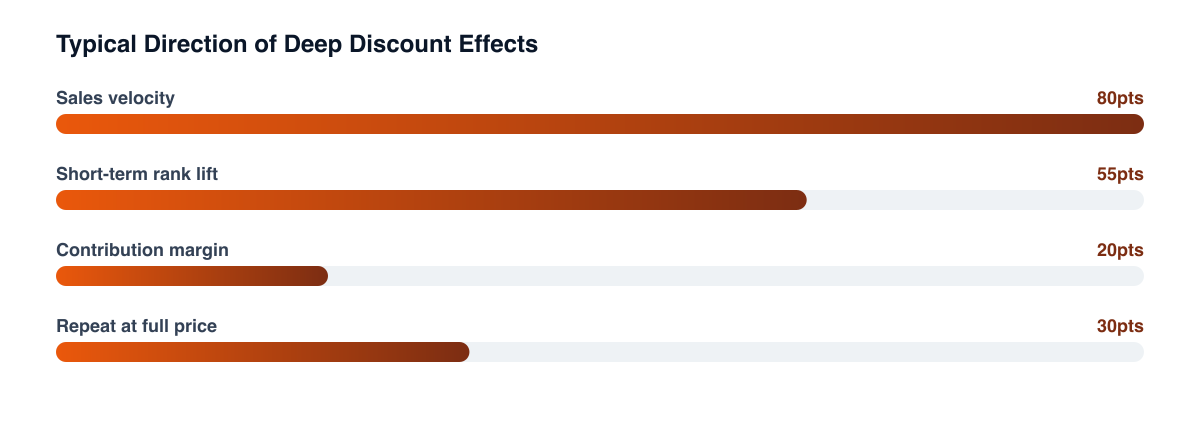
Margin first. Commission, fulfilment cost, and the ad spend needed to hold search position are already stacked on the price, as covered in the assortment and pack size guide. A discount comes off the top of that stack, which is why a promotion that looks like a modest percentage can erase most of a SKU's contribution.
Repeat is the subtler cost. Customers acquired on a deep discount have been taught a reference price. When they reorder at full price, some won't, and a cheaper alternative is usually one tap away in the app. The honest framing is that a discount buys a first purchase, not a customer, and whether it buys a second depends on the product and pack, not the deal.
When is a deep discount worth running?
Run it as a deliberate, bounded experiment, not a standing price. These conditions make it more defensible:
- Availability is already strong in the dark stores the promotion covers. Discounting a patchy shelf buys orders you can't fulfil.
- The SKU is a trial pack designed to win a first purchase, with a clear step-up to a repeat pack at full price.
- The funding split is agreed in writing and the post-discount contribution is still positive.
- There is an end date and a plan for the ranking comparison afterwards.
Pair a promotion with sponsored placement for new launches only if you can read both against the same inventory report. Otherwise you can't tell which lever moved sales.
Set a margin floor before you set a discount Work out the lowest net price at which a SKU still clears a contribution margin you'd accept on your own site, after commission, fulfilment, and ad cost. Any promotion that breaches it needs a named reason and an end date.
How do you measure whether it worked?
Compare against the same SKUs in the same stores, not against last month. Look at four things after the promotion ends: velocity at the restored price, rank on your primary search terms, the share of buyers who reorder without a deal, and contribution per unit across the whole period. If velocity falls back to where it started and the reorder share is thin, you rented volume.
The better lever is often not depth but structure: a lower-priced small pack, a bundle the platform can list as a distinct SKU, or a short event-linked offer. These protect the reference price on your core pack, in line with the logic of keeping your own site and the app positioned differently.
Related guides
- Quick Commerce for D2C: What Changes When Your Shelf Is 10 Minutes Away
- Quick Commerce Ads: What Each Format Actually Buys You
- Assortment and Pack Size on Quick Commerce: What to List and What to Hold Back
- Marketplace vs. DTC: Building a Strategy That Doesn't Cannibalise
Discounts on quick commerce work when they are priced as a cost with a defined payback, not as a default state. If you're deciding how deep to go and who should carry it, our quick commerce team can build the per-SKU floor with you before the next promotion goes live.
Want a free marketing audit?
We'll review your tracking, ad accounts, and funnel — and show you exactly where the gaps are.
Get Your Free Audit →