
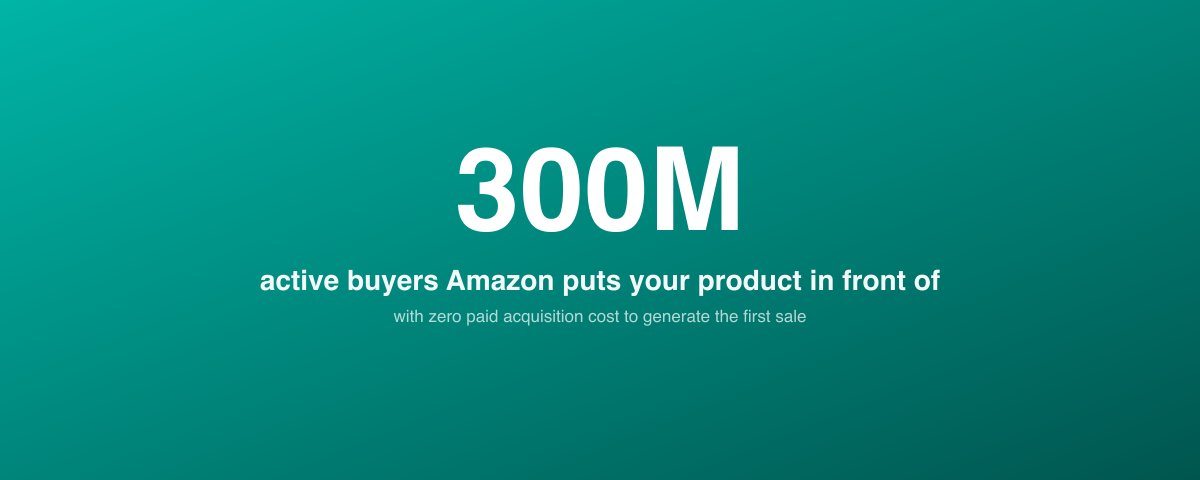
Amazon will sell your product to 300 million active buyers with zero paid acquisition cost. Your own website won't. That single fact explains why marketplace-first brands can scale to eight figures before they ever run a Meta ad — and also why so many of them find themselves with a $10M revenue business and a customer list they don't own.
The channel mix question isn't "marketplace or D2C?" It's "what does each channel do for you, and in what order?" Getting that wrong costs years.
What are the core tradeoffs, laid out plainly?
Marketplace (Amazon, Walmart, Target+):
- Built-in search intent — shoppers arrive ready to buy
- No paid acquisition cost to generate the first sale
- Fulfillment infrastructure (FBA) at scale from day one
- Referral fees ranging from 8% to 45% depending on category
- Zero customer data — you cannot retarget, email, or build LTV sequences
- Algorithm dependency: ranking volatility can crater revenue overnight
- Price parity enforcement punishes channel differentiation
D2C (your own site):
- Full customer data: email, SMS, behavioral, purchase history
- Gross margin 15–25 points higher than equivalent marketplace units
- Creative freedom — PDPs, quizzes, bundles, subscriptions
- Cold traffic requires paid acquisition, typically $25–80 CAC in competitive categories
- Conversion rates are lower (1.5–3% vs. Amazon's 10–15% for established listings)
- You own the relationship. Full stop.
Rough benchmark: D2C contribution margin after paid media is typically 20–35% for healthy brands. Amazon net margin after fees, COGS, and ads runs 8–18%. The margin gap is real — but so is the traffic cost to close it.
Neither channel wins on all dimensions. The right mix depends on where you are in the growth curve.
How do you prioritize channels stage by stage?
0 to $1M: Prove the product, not the funnel. Marketplace wins here. You need purchase volume, reviews, and unit economics data before you invest in cold traffic. Amazon's conversion rate advantage means you'll iterate on product-market fit faster. Use this stage to understand which SKUs move, which price points convert, and which search terms buyers use. That data is gold for D2C later.
$1M to $5M: Start D2C while marketplace is funding it. Your Amazon cash flow should be buying paid media learnings on Meta and Google. You're not trying to replace marketplace volume — you're building the D2C engine in parallel. Expect D2C to be unprofitable or breakeven at this stage. That's acceptable if you're acquiring customer data and LTV is tracking.
$5M to $20M: Channel specialization. Marketplace handles acquisition at scale; D2C handles retention and LTV. Your email and SMS lists are now assets. Subscription economics start making D2C CAC math work. You should be running marketplace management as a distinct P&L from D2C — different teams, different KPIs, different investment logic.
$20M+: Channel conflict becomes the main problem. Pricing, exclusives, and bundle strategy become the levers. See below.
What hybrid playbook do most scaling brands use?
The cleanest structure we see working in 2026: use marketplace for discovery and volume, use D2C for high-LTV customers.
Tactically, that means:
Marketplace as your top-of-funnel. Buyers discover the brand on Amazon, buy once, and become aware of you. You can't capture that customer, but the category discovery is essentially free.
D2C for repeat buyers and subscribers. Every insert card, unboxing moment, and post-purchase email from a marketplace order should push toward a DTC offer — a subscription discount, an exclusive bundle, a free gift with direct purchase. You're converting marketplace buyers into owned customers over time.
Different SKU architecture. Many brands run a "marketplace core" (clean, standard SKUs optimized for ranking) and a "D2C exclusive" tier (bundles, subscriptions, premium kits that aren't available on Amazon). This separates the channels functionally rather than relying on price to do it.
For a deeper dive on how the channel decision plays out across different business models, see Amazon vs. DTC: Where Should Your Brand Sell in 2026?
How do you use Amazon data to sharpen your D2C paid media?
This is underused and worth slowing down on.
Amazon Search Term Reports tell you exactly which phrases buyers use before converting. Not impressions — conversions. That's intent data most brands ignore when building D2C campaigns.
Tactic: Export your top 50 converting Amazon search terms. These are your highest-intent keyword groups. Run them as phrase match in Google Search. Build Meta audiences around the product categories and pain points embedded in those terms. You're reverse-engineering proven buyer language.
Beyond keywords, Amazon's Brand Analytics provides demographic data, repeat purchase rates by ASIN, and market basket analysis (what buyers purchase alongside your product). Use basket data to build D2C bundles. Use repeat purchase rates to calibrate subscription cadences.
If you're running DSP, your Amazon audience segments can be mirrored into programmatic buys off-platform — another way to extend the data flywheel without needing a massive first-party database. For the longer-term play on building that database, First-Party Data Strategy for D2C covers the infrastructure you'll need.
How do you manage cannibalization and pricing across channels?
The concern: a customer finds your product on Amazon, then buys D2C instead, or vice versa. You've "cannibalized" a higher-margin D2C sale.
The reality: most customers don't cross-shop channels. They're Amazon buyers or DTC buyers — rarely both by default. The cannibalization risk is lower than brands fear, except in one scenario: if your D2C price undercuts Amazon significantly.
Amazon's price parity rules (and algorithmic suppression) punish sellers who list cheaper elsewhere. Practically, this means:
- Match prices exactly on commodity SKUs that appear on both channels
- Protect D2C margin through exclusive products, not lower prices
- Offer D2C value through free shipping thresholds, loyalty points, or subscription discounts — not list price differences
- Use gift-with-purchase or bundle mechanics to make D2C "cheaper" in effective CPU without triggering parity violations
If you're in a category with aggressive third-party sellers or gray market activity, price parity gets harder to enforce. That's a separate problem — but be aware it compounds channel conflict.
What operational complexity actually breaks?
Running both channels sounds clean in strategy decks. In practice, these are the friction points that kill execution:
Inventory allocation. FBA needs predictable replenishment on its own cycle. D2C 3PL needs its own buffer stock. Running out of one allocation to fund the other is a constant tension, especially during sales events or demand spikes. Most brands underinvest in inventory planning tooling until they've been burned twice.
Content versioning. Amazon PDP content (A+ content, backend keywords, image stacks) and D2C PDP content serve different purposes. Amazon content is search-optimized. D2C content is conversion-optimized for cold traffic. They need separate creative workflows, not a copy-paste approach.
Attribution gaps. Multi-touch attribution breaks across channels. A buyer who discovers you on Amazon, sees a retargeting ad on Instagram, and converts on your site via email looks like an email conversion. The marketplace assisted and you can't see it. Budget decisions based on last-click will chronically under-invest in marketplace and over-credit owned channels.
Returns and customer service. Amazon handles its own returns, but creates customer service expectations your D2C operation has to match. If Amazon returns in 2 clicks, your D2C return process needs to be close.
None of these are blockers — but they're real operational costs that belong in your channel margin models.
The bottom line
Marketplace and D2C aren't competitors — they're different stages of the customer relationship.
"Marketplace and D2C aren't competitors — they're different stages of the customer relationship."
— Dhruvit Shah, Co-Founder — Performance Marketing & Growth Strategy
Marketplace buys discovery at the cost of ownership; D2C buys ownership at the cost of acquisition. The brands scaling efficiently in 2026 are running both with clear role definitions: marketplace feeds volume, D2C builds asset value. Start with marketplace to fund the learning, then use what you learn to make D2C work.
Related guides
PART OF OUR SERVICE
Marketplace Management
Want a free marketing audit?
We'll review your tracking, ad accounts, and funnel — and show you exactly where the gaps are.
Get Your Free Audit →