

There's a long-running argument in Meta accounts about whether to target interests or go broad. It's mostly the wrong argument: on a modern delivery system, both settings end up asking the algorithm to find the same people, and the thing that differs is how much room it has to look.
"Interest targeting doesn't tell Meta who to show the ad to any more. It tells Meta where to start looking, and the creative decides where it ends up."
— Dhruvit Shah, Co-Founder — Performance Marketing & Growth Strategy
What changed, mechanically?
Delivery optimisation got substantially better at finding converters inside a large pool, and the pools available to it got larger. When the system can identify likely buyers from behavioural signal, a hand-built interest audience mostly serves to shrink the pool it's allowed to search — sometimes usefully, often not.
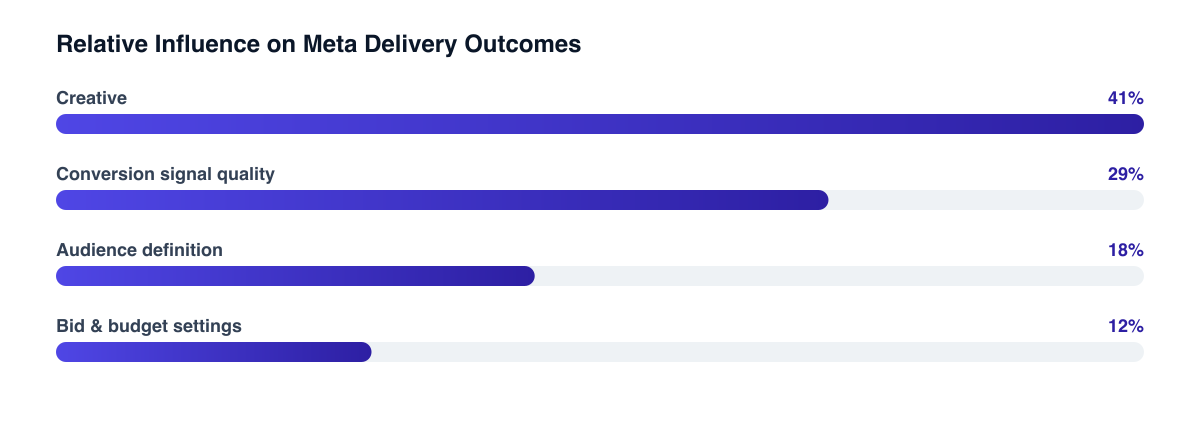
The second change matters more: with signal loss on the browser side, the quality of the conversion event you send back became the main input into who gets targeted. An account with a weak or duplicated event feed will underperform on every targeting setting, and no amount of interest layering compensates. If the Conversions API setup is shaky, fix that before touching audiences.
When does broad genuinely win?
When you have enough conversion volume for the system to learn from, and a product with a wide addressable market. Under those conditions, broad consistently finds pockets of demand that no planner would have listed as an interest — that's the entire value of it.
It loses in three situations worth naming:
- Low conversion volume. Below a meaningful number of weekly conversions the system never exits the learning phase, and broad becomes an expensive random search.
- Genuinely narrow products. A product for a specific profession or a specific medical need has a real audience boundary, and telling the system about it saves money.
- Brand safety or regulatory constraints, where you need to control exposure rather than optimise it.
Then what is interest targeting still for?
Two honest uses. The first is as a creative container: running an interest set as its own ad set lets you serve a message written for that audience, which is a legitimate reason to segment even if the delivery system didn't need the constraint. The second is exploration — deliberately isolating a hypothesis about a new audience so you can read whether it works, at a budget you're willing to lose.
What it isn't good for any more is precision. Stacked interests overlap heavily, the overlap isn't visible to you, and the resulting audiences compete with each other in the same auction. That's the mechanism behind most of the fragmented account problems that show up as rising CPMs with flat performance.
Consolidate before you conclude broad doesn't work Six ad sets splitting one budget each get a sixth of the learning data. Most "broad failed for us" results are really "we ran broad in a structure that starved it".
How should the account be structured now?
Fewer ad sets, more creative. Consolidate budget so each ad set clears its learning threshold, then use the ad level to carry the variation you'd previously have expressed as audiences. This is the structural implication of creative being the dominant variable — your testing cadence should live in a creative testing framework, not in an audience matrix.
Keep one exploration ad set running at a small, fixed share of budget for hypotheses you actually want tested. And treat Advantage+ campaigns as the same conversation in a different wrapper: they make the consolidation decision for you, which is helpful when your structure was the problem and unhelpful when your signal was.
Related guides
- Meta Ads for D2C Brands: The Complete Guide
- Meta Advantage+ Shopping Campaigns: What You Actually Control
- The Meta Ads Mistakes That Quietly Cost D2C Brands Money
- Retargeting Windows: How Long Should You Keep Chasing a Visitor?
The targeting debate is a proxy for a structure debate. Fix the signal, consolidate the budget, and move your variation into the creative — that ordering decides more about paid social performance than the audience setting ever will now.
PART OF OUR SERVICE
Performance Marketing
PROOF FROM A CLIENT
21% sales growth
measured against the pre-engagement baseline · Fashion & Apparel
How Sockscarving Grew Sales 21% and Lifted Conversion Rate 18%→Want a free marketing audit?
We'll review your tracking, ad accounts, and funnel — and show you exactly where the gaps are.
Get Your Free Audit →