

The 30-day retargeting window is the most-copied setting in paid social, and almost nobody chose it deliberately.
"A retargeting window that's too long doesn't just waste money — it manufactures a great-looking ROAS by re-buying customers who were already coming back."
— Dhruvit Shah, Co-Founder — Performance Marketing & Growth Strategy
What's actually wrong with a long window?
Two things, and they pull in opposite directions. Too short, and you drop people who are genuinely still deciding — common for considered purchases where the gap between first visit and purchase runs into weeks. Too long, and you spend heavily on people who were always going to return through direct or organic, and the platform happily claims the conversion.
That second failure is the expensive one because it's invisible in the reporting. Retargeting ROAS looks spectacular precisely when the audience is full of people who didn't need the ad. The number gets better as the targeting gets lazier.
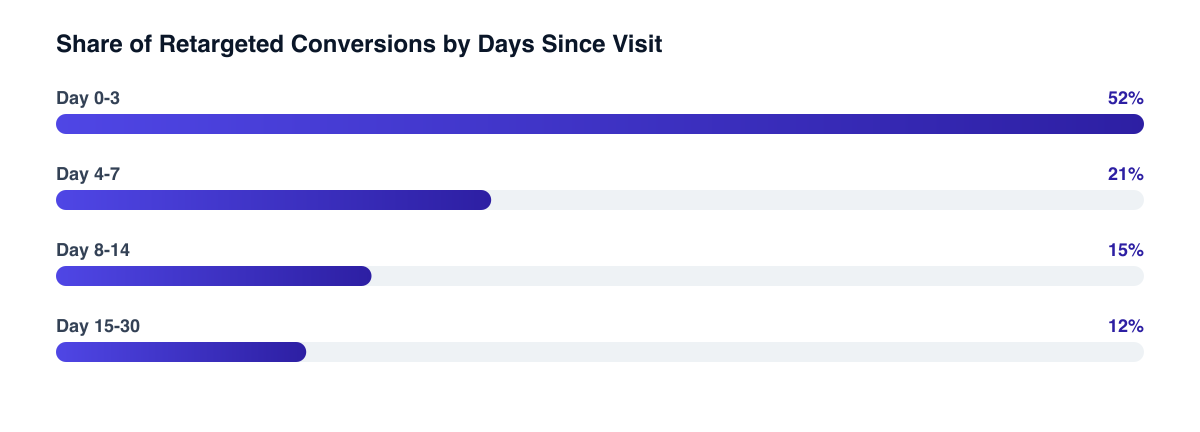
How do you find your actual window?
Pull the lag between first session and purchase from your own analytics, not from a benchmark. Look at the distribution rather than the average — averages get dragged out by a long tail of slow converters and will talk you into a longer window than the volume justifies. In most D2C categories the bulk of retargeted conversions land within the first week, with a thin tail after that. Higher-consideration categories, subscription products, and anything above a few hundred dollars run meaningfully longer.
Set the window where the marginal conversions stop justifying the marginal spend, then segment inside it instead of treating everyone the same.
Segment by intent, not just recency Cart abandoners, product-page viewers, and homepage bouncers deserve different windows and different budgets. A single "all site visitors, 30 days" audience blends the three and lets the cheapest, lowest-intent segment absorb most of the impressions.
What should each segment get?
- Cart and checkout abandoners (0–7 days): highest budget per user, direct offer or objection-handling creative — this is the only segment where an aggressive frequency is defensible.
- Product page viewers (0–14 days): product-specific proof, reviews, and comparison creative rather than a discount.
- General site visitors (0–7 days): brand and category creative at low frequency; this segment mostly exists to stay present, not to close.
- Past purchasers: exclude from acquisition retargeting entirely and handle through email and SMS flows, which cost a fraction of paid impressions to reach the same person.
How do you tell whether retargeting is actually incremental?
Hold it out. Suppress retargeting for a randomised share of your audience — or in a set of geographies — for long enough to cover a full purchase cycle, then compare total conversions between the groups rather than platform-attributed ones. Most brands running this test the first time find retargeting is real but smaller than reported, which is useful: it doesn't mean turning it off, it means resizing the budget to the incremental contribution instead of the attributed one.
Related guides
- ROAS and Attribution: The Truth About Blended vs. True Return
- Paid Social Funnel Playbook
- How to Reduce Cart Abandonment on Shopify
- Dynamic Product Ads: A Practical Guide
Retargeting is one of the few places where a five-minute settings change moves real money. Getting the window and segmentation right usually frees budget for prospecting without losing a single incremental sale.
PART OF OUR SERVICE
Performance Marketing
PROOF FROM A CLIENT
4x revenue growth
from $18K to $72K monthly revenue · Food & Beverage
How a Food D2C Brand Grew Revenue 4x in 6 Months→Want a free marketing audit?
We'll review your tracking, ad accounts, and funnel — and show you exactly where the gaps are.
Get Your Free Audit →