How Sockscarving Grew Sales 21% and Lifted Conversion Rate 18%
KEY RESULT
21% sales growth
measured against the pre-engagement baseline
Sales
+21%
from Baseline
Conversion Rate
+18%
from Baseline
Orders
+13%
from Baseline
Creative Tests Run
~400
from Ad-hoc
The Challenge
Sockscarving is an Indian D2C sock brand on Shopify, and the catalog is deep. The same inventory is merchandised five different ways — by height, by collection, by who it's for, by season, and by offer. A customer can arrive looking for no-show socks to wear under formals, or cushioned sports socks, or a winter gift box. Those are three different buyers with three different reasons to purchase.
The ad account didn't reflect any of that. Campaigns were organised around products and launches rather than the reason someone buys, which left the platform learning against a blended signal. A ₹299 single pair and a ₹999 five-pack sat inside the same ad sets, optimising toward the same conversion event.
That single detail was doing most of the damage. The single pair wins more conversions; the pack is the only version of the order that can carry acquisition cost. Optimising for conversion volume quietly pushed budget toward the cheapest possible order — and at a single-pair price point, in a market where a purchase often arrives via cash on delivery, there is very little room left to pay for the click. The brand had already built the right answer into the site: Buy 5 at ₹999, Buy 2 Get 1 Free, Buy 4 Get 3 Free, Build Your Own Box. The ad account simply wasn't structured to sell it.
Creative had the same problem from the other direction. Assets were briefed as one-off requests rather than against a defined hypothesis, so when something performed, there was no way to tell what had performed — the offer, the use-case framing, the format, or the audience. Tests weren't comparable, so nothing compounded.
What We Did
1. Restructured the Account Around Buying Intent
We rebuilt the account so campaign structure matched the way the catalog is actually shopped, then let each segment carry its own target rather than one blended goal.
The organising principle was the use-case and occasion axis — sports, professional, everyday, streetwear, cozy/winter, and gifting — because that is the layer where purchase intent is clearest and where the creative message genuinely differs. Someone buying sports socks is solving a performance problem. Someone buying a gift box in December is solving a completely different one. Collapsing those into one campaign means writing an ad that speaks to neither.
Three structural rules came out of it:
Packs and single pairs were separated. Pack-led campaigns took the budget authority and the higher targets, because that's where the order value supports paid acquisition. Single-pair ads were kept as an entry point, not a scaling target — and stopped competing with the packs for the same impressions.
The offer became a campaign-level decision, not a landing-page surprise. If the economics only work on a multi-pair order, the ad has to sell the multi-pair order. Pack pricing and the multi-buy offers moved into the ad itself rather than being discovered after the click, so the visitor arrived already evaluating the bundle.
Each intent segment got its own performance target. Instead of one blended number hiding which segments earned their spend, every segment had a threshold it had to clear before it got more budget. Segments that couldn't clear it stopped absorbing spend.
2. Built a Repeatable Creative Briefing Strategy
The second half of the work was making creative testing legible.
We replaced ad-hoc requests with a standing brief format built on the same intent axis as the account. Every brief now names one variable it is testing — the offer (single vs. pack), the use-case framing (sports vs. professional vs. gifting), the format, or the hook — and holds everything else steady.
That does two things. Read one way, it produces comparable results: when a pack ad outperforms, we know whether it was the offer or the framing, because only one of them moved. Read the other way, it removes the bottleneck — briefs stopped being written from scratch each time, so production ran to a cadence instead of a scramble, and winners could be iterated on while they were still winning.
3. The Creative Directions We Recommended
Three directions came out of the briefing system. Each one was built to prove a different thing, and each holds everything else steady so the answer is readable.
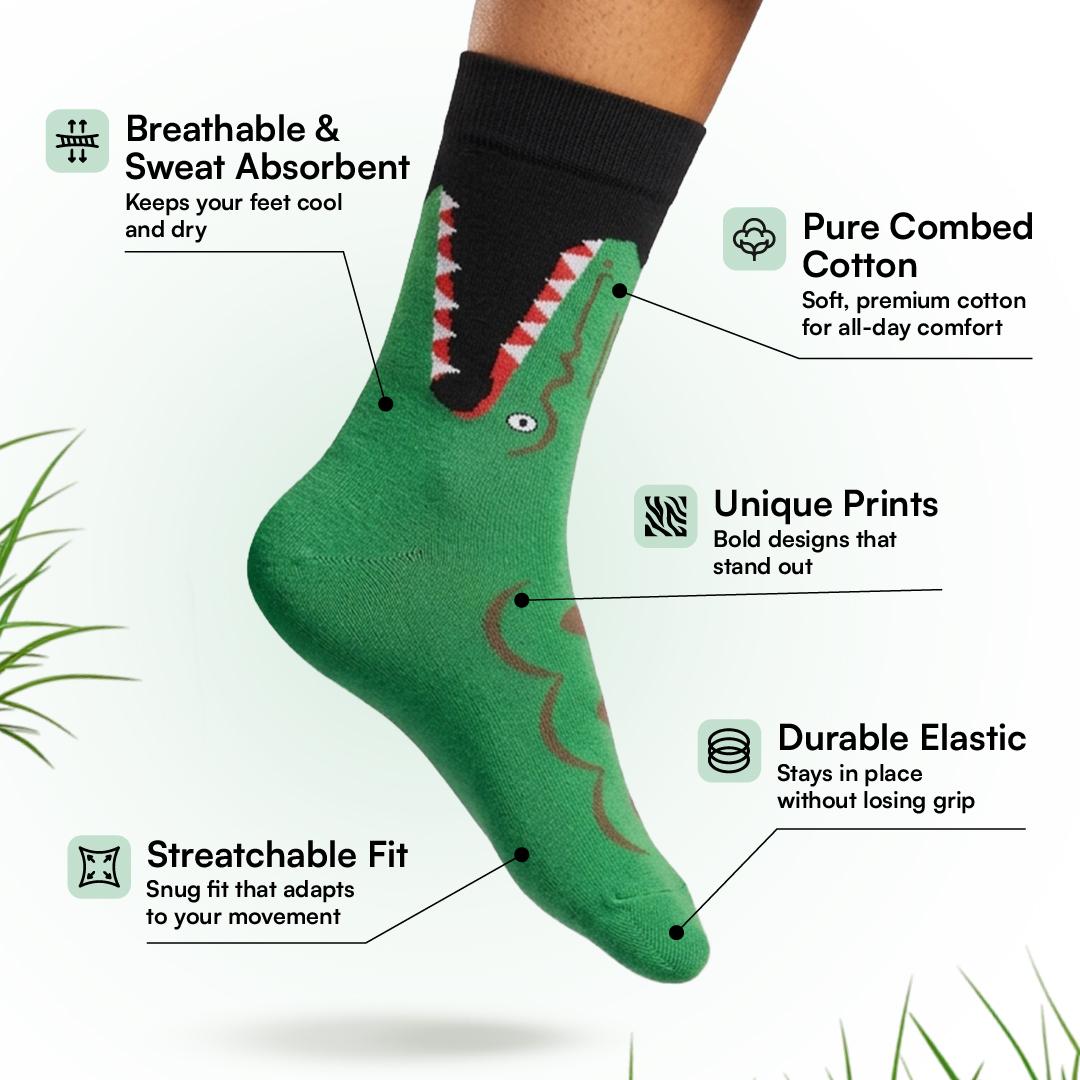
Direction 1 — Lead with construction, not the offer.
The insight: at a five-pack price point the objection isn't cost, it's whether a novelty print is actually a decent sock. The print earns the click; the construction has to earn the purchase. Nothing in the account was making the product's quality legible.
The execution: a single product on-foot, annotated with what the sock is made of and how it behaves — combed cotton, breathability, elastic that holds, stretch fit. No price, no offer, no urgency anywhere on the frame.
Testing: whether quality-led creative can carry cold traffic on its own, which isolates product credibility from discount motivation.
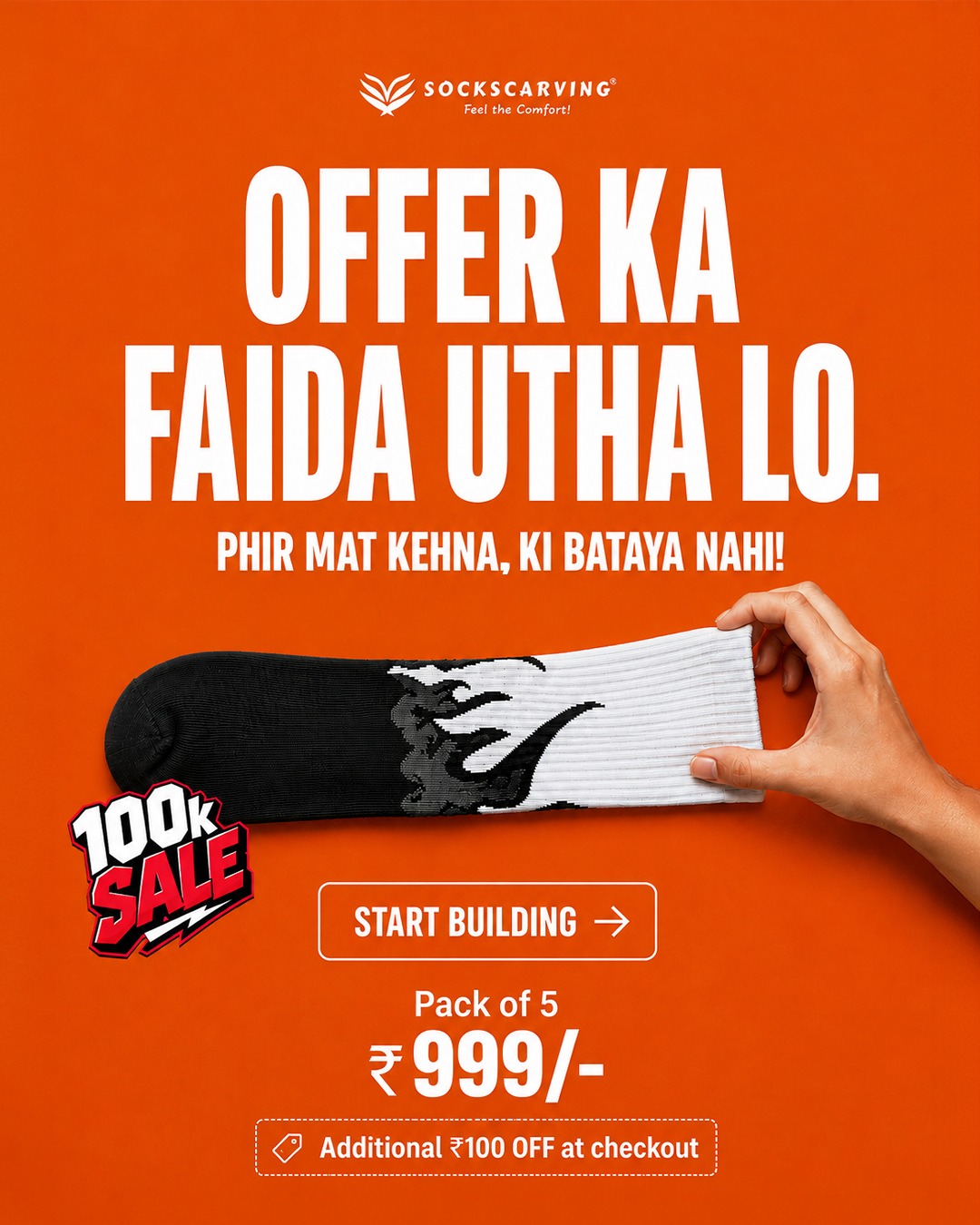
Direction 2 — Put the pack maths on the creative.
The insight: if the economics only work on a multi-pair order, the ad has to sell the multi-pair order. Leaving the pack price to be discovered after the click meant paying for visitors who arrived evaluating a single pair.
The execution: a Hinglish urgency hook for an India-first audience, the pack of 5 at ₹999 stated plainly on the creative, the additional ₹100 off at checkout stacked underneath it, and a CTA pointing at Build Your Own Box rather than a generic shop link.
Testing: offer-in-the-creative against offer-after-the-click, holding audience, format and product steady.
Direction 3 — Frame the pack as variety, not volume.
The insight: "pack of 5" can read as bulk, and bulk is a reason to hesitate. Framed as a rotation, the identical price reads as five different designs instead of five of the same thing — and the catalog's range becomes the selling point rather than a browsing problem.
The execution: five distinct prints on five feet in one frame, the pack reframed as a rotation to build, and the 30-day returns promise carried at the base of the creative to take the risk out of a cash-on-delivery decision.
Testing: same offer, same price, same product — only the framing moved. That isolates framing from discount, which is the one comparison the old ad-hoc briefs could never produce.

The Results
Across a two-month engagement, orders grew 13%, sales grew 21%, and site-wide conversion rate improved 18% — all measured against the equivalent prior period rather than a hand-picked baseline. The engagement is ongoing; these are the results as of 7 September 2026.
The gap between those first two numbers is the most useful thing in this case study. Orders moved 13% while sales moved 21%, which means the average order itself got bigger — customers were buying packs where they used to buy single pairs. That was the entire hypothesis behind separating pack campaigns from single-pair campaigns, and it is the one result that could not have come from simply spending more.
The conversion rate lift explains the rest. Nothing changed on the site — the traffic changed. When an ad for sports socks sends someone to sports socks, and the creative has already framed the pack offer rather than leaving it to be discovered at checkout, the visitor arrives further along in the decision. Better intent-matching upstream shows up as a conversion rate lift downstream.
Underneath all of it sat volume: close to 400 creative tests in two months. That number is only possible because of the briefing system — when every brief follows the same format and isolates one variable, production stops being bespoke and starts being a queue. And because each test isolated a single variable, 400 tests produced roughly 400 usable answers rather than 400 assets and no conclusions.
The restructure is what makes this durable rather than a good quarter. Separating packs from single pairs meant budget stopped drifting toward the orders that looked cheapest to win and were hardest to profit from. Giving each intent segment its own target meant the account could finally be read — it was obvious which parts of the catalog earned more spend and which were being carried. The creative library now compounds on top of that structure instead of resetting every cycle.
“The structure work changed how we think about the account. Splitting the packs out from single pairs was the thing we had not seen ourselves, and once the briefs became repeatable we stopped guessing about which creative to make next.”
— Yaxit & Hiren, Founders, Sockscarving
+ DEEPER READING
The tactics behind these results
Meta Ads for D2C Brands: The Complete 2026 Playbook
Everything you need to run profitable Meta ads for your D2C brand in 2026 — campaign structure, creative strategy, tracking setup, audience architecture, and the exact frameworks we use to scale accounts from $10k to $500k/month.
Read guide →
PAID SEARCHGoogle Ads for D2C Brands: The Complete 2026 Playbook
The complete guide to running Google Ads for D2C brands in 2026 — Shopping campaign structure, Performance Max vs Standard Shopping, search ads strategy, feed optimization, and how to scale budgets without tanking efficiency.
Read guide →
PERFORMANCE MARKETINGWhy Your ROAS Is Lying to You (And How to Fix It)
Most D2C brands trust their reported ROAS blindly — but platform-reported ROAS is almost always inflated. Here's why, and how to calculate your true blended ROAS.
Read guide →
PERFORMANCE MARKETINGHow to Scale Ad Budgets Without Killing Performance
Doubling your ad budget doesn't double your results — it often tanks them. Here's the framework for scaling spend gradually while protecting ROAS and efficiency metrics.
Read guide →