

Most account reviews start with "the algorithm did X" — spent unevenly, favoured one audience, stalled on a creative. It's rarely the algorithm making a choice; it's the algorithm finding the cheapest path through the constraints it was handed, and nobody built those constraints on purpose.
"Meta's algorithm is extraordinarily powerful, but it operates within the constraints you set. The way you build your campaigns, set your cost controls, define your audiences, and manage your creative supply directly determines the likelihood of achieving that outcome."
— Dhruvit Shah, Co-Founder — Performance Marketing & Growth Strategy
What is the algorithm actually optimising for?
Delivery is a search problem: find the cheapest conversions inside whatever boundaries the account gives it — a budget, a bid or cost target, an audience definition, and a pool of creative to serve. It doesn't have a point of view on your margin, your inventory, or which product line matters this quarter. Those judgments have to be encoded into the structure before spend starts, or the system optimises for the only thing it can measure: cost per result, which is not the same as the result you actually wanted.
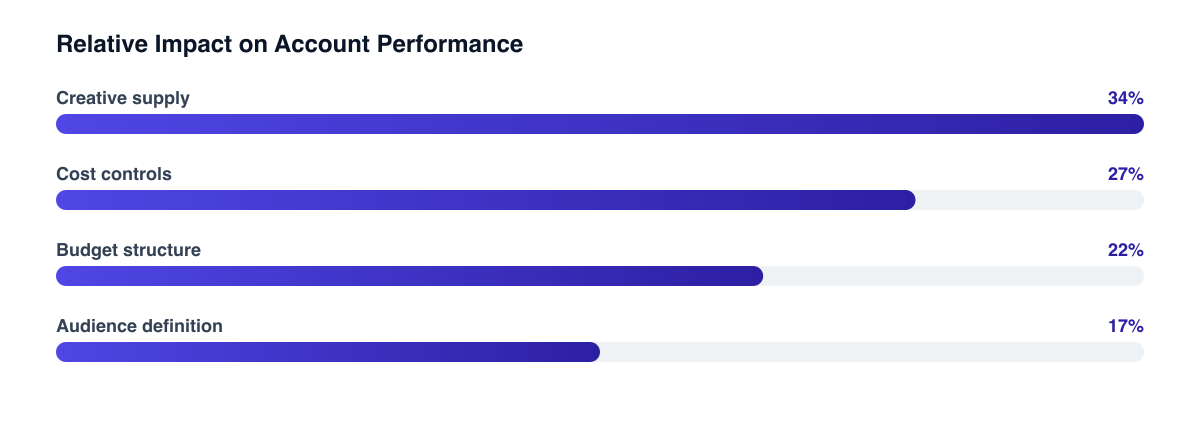
This is why two accounts running the "same" campaign type can produce opposite outcomes. The campaign objective is a shared setting; the cost controls, budget allocation, and creative volume behind it are account-specific decisions, and those decisions are doing most of the work.
Where do cost controls quietly set the ceiling?
A bid cap or cost cap doesn't just limit price — it limits reach, because the system won't enter auctions above the ceiling you set, even if that auction had your best prospect in it. Set it too tight off a cold launch and delivery gets throttled before the account has enough conversion volume to learn from (Meta's guidance is roughly 50 optimization events per ad set before leaving the learning phase); set it loose with no floor and you buy volume at a cost basis that never comes back down once the algorithm anchors to it.
The practical fix isn't picking the "right" number once. It's tiering controls to what the account actually knows:
- Cost cap during learning — set generously enough that the system clears the conversion threshold within days, not weeks.
- Bid cap once volume is stable — tightened gradually as you gather enough data to know the real efficient price, not a guessed one.
- No cap at all for a small, fixed share of budget, used deliberately to let the system test price ceilings you haven't found yet.
Skipping straight to a tight cap because a case study recommended it is the single most common way accounts self-inflict a spend problem, and it reads to the operator as "the algorithm won't spend" rather than "I built a wall it can't get past."
Does audience definition still matter under automated delivery?
Less than it used to, but not zero — and conflating "less" with "not at all" causes the opposite mistake. On broad targeting the system finds converters from behavioural signal rather than your interest list, but it still needs enough conversion volume and a clean enough event feed to know what a converter looks like. A shaky Conversions API setup breaks this at the root: the algorithm is optimising toward a signal you're sending badly, and no audience setting fixes a bad signal.
Where audience definition still earns its keep is exclusion, not inclusion — keeping existing customers out of acquisition budget, keeping a genuinely narrow B2B or clinical audience out of a broad pool that has no reason to find them. That's a boundary you're better positioned to know than the algorithm is.
Why does creative supply end up as the real bottleneck?
Structure and cost controls set the boundaries the algorithm searches within, but creative is what it searches with. An account running three ad variants gives the system three paths to test; one running fifteen gives it fifteen, and the winner among fifteen is almost always cheaper than the winner among three. This is the mechanism behind most creative fatigue problems that get misdiagnosed as targeting fatigue — the audience didn't run out, the creative pool did.
Creative supply isn't only volume, either. A pool of quick-turnaround UGC alongside studio-produced pieces gives the system format diversity to match against different placements and intents, which a single polished format can't do no matter how many versions of it you cut.
An algorithm can only optimise inside the room you build for it A tight cost cap, three creatives, and a fragmented audience structure isn't a delivery problem — it's a self-built ceiling the algorithm is faithfully bumping into.
How do you turn this into an operating discipline, not a one-time setup?
The accounts that scale predictably treat structure as something reviewed on a cadence, not set once at launch:
- Cost controls loosened or tightened against actual conversion volume, not a fixed schedule.
- Creative supply measured as a weekly production number, with a floor below which delivery is expected to degrade.
- Budget consolidated into fewer, better-fed ad sets rather than split thin across a matrix of audiences.
- Event feed quality checked before any audience or bid change gets blamed for a performance dip.
None of this requires outguessing Meta's model. It requires accepting that the model is only ever as good as the constraints it's given, and that building those constraints well is the job — the execution discipline the algorithm depends on and can't supply for itself.
Related guides
- Meta Ads for D2C Brands: The Complete 2026 Playbook
- Broad Targeting vs. Interest Stacking
- Meta Conversions API: The Complete Setup Guide
- Creative Fatigue: How to Spot It, Diagnose It, and Fix It
Getting delivery right isn't a matter of finding the setting Meta rewards this quarter — it's building the cost controls, audience boundaries, and creative pipeline that give paid social spend a fair search to run in.
Want a free marketing audit?
We'll review your tracking, ad accounts, and funnel — and show you exactly where the gaps are.
Get Your Free Audit →