
Your checkout page has the highest purchase intent of any page on your site — and it's still losing you a quarter of your buyers. Cart abandonment sits at 70%+ industry-wide, but checkout abandonment (people who started checkout and didn't finish) runs 25–35%. That gap is pure recoverable revenue, and most of it comes from friction you introduced, not reluctance the customer arrived with. The checkout benchmarks and lift figures in this post come from Shopify stores we've audited; where a figure comes from published research instead, it's linked.
This is where your Shopify & CRO work pays off most. Fix a form field here, add a payment method there, and you're not improving a vanity metric — you're directly moving revenue per session.
What's the benchmark reality?
Before you can fix checkout, you need to know what "bad" looks like. Average checkout completion rates by vertical:
Apparel & footwear: 65–72% checkout completion Health & beauty: 60–68% Electronics: 55–63% Subscriptions: 70–78% (pre-filled data advantage)
If your store falls 10+ points below these, you have structural friction. If you're hitting these benchmarks, there's still meaningful upside — the best-optimized Shopify stores run 80%+ checkout completion.
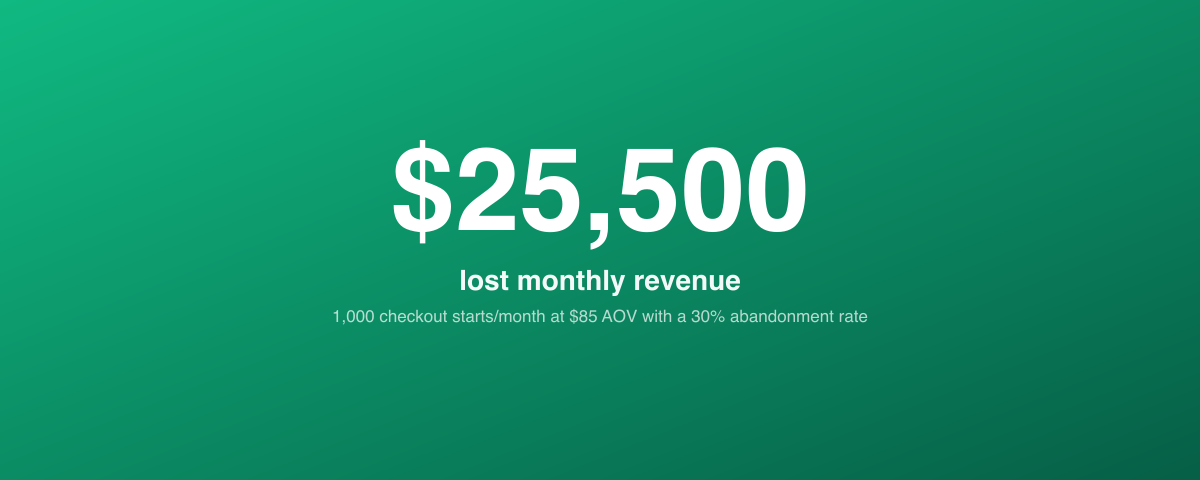
The abandonment cost is easy to calculate: take your average order value, multiply by monthly checkout starts, multiply by your drop-off rate. A store doing 1,000 checkout starts/month at $85 AOV with 30% abandonment is leaving $25,500 on the table monthly. That's before any ad spend.
What are the five friction points killing your checkout?
1. Unexpected shipping costs
This is the single largest driver of checkout abandonment. Customers who see $0 shipping in ads or on the product page, then hit a $12 shipping fee at checkout, feel deceived. The fix isn't always free shipping — it's making shipping cost visible earlier. Show it on the cart page, use a shipping threshold bar ("Add $14 more for free shipping"), and never reveal it for the first time at checkout.
2. Forced account creation
Requiring account creation before purchase is a conversion killer for first-time buyers. A guest checkout option is non-negotiable. The lift is largest on cold traffic, where the visitor has no relationship with the brand and no reason to accept a signup step before paying. You can still capture accounts post-purchase ("Save your details for next time") without gatekeeping the transaction.
3. Too many form fields
Standard Shopify checkout asks for first name, last name, address line 1, address line 2, city, state, zip, country, phone, and email. That's 10 fields minimum. Every unnecessary field costs you 1–3% conversion. Audit which fields you actually need for fulfillment. If you're not using address line 2 data, remove it. If your carrier doesn't need a phone number, make it optional.
4. Lack of trust signals
At checkout, anxiety peaks. The customer is about to hand over card details to a brand they may have discovered 20 minutes ago. SSL badges, security seals, and return policy reminders placed near the payment form reduce this anxiety measurably. Placement is what decides whether they do anything at all — near the CTA button, not buried in the footer.
5. Limited payment options
Offering only card payments in 2026 is leaving 15–25% of potential transactions on the table depending on your demographic. Buy now, pay later (BNPL) options like Afterpay, Klarna, and Shop Pay Installments lift AOV by 20–30% and improve conversion for purchases above $100. PayPal remains the most trusted payment option for first-time buyers on new brands — its absence is a trust gap.
How do you audit your checkout drop-off?
You cannot fix what you cannot see. Start here:
GA4 funnel exploration
In GA4, build a funnel report: begin_checkout → add_payment_info → add_shipping_info → purchase. The drop between each step tells you exactly where you're losing people. A large drop at add_payment_info points to payment friction. A drop at add_shipping_info is the shipping cost problem. GA4's segment comparison lets you cut this by device, traffic source, and new vs. returning — the drop-off pattern is almost always different on mobile.
Hotjar session recordings
Filter for sessions that hit the checkout page and did not convert. Watch 30–50 of these. Look for rage clicks on form fields, hesitation before the payment section, and users who scroll up to re-read the return policy before abandoning. Patterns emerge fast. Common findings: users tapping an autofill suggestion that doesn't populate correctly, confusion around shipping options, and payment form errors that aren't clearly communicated.
Exit intent surveys
A single-question exit intent survey on the checkout page ("What stopped you from completing your order today?") with 5 options generates actionable signal within a week. You'll get real language to use in trust copy and identify systemic issues that session recordings don't surface clearly.
What's the difference between Shopify Plus and standard checkout customization?
Standard Shopify checkout limits what you can modify. You can change colors, add a logo, and enable certain apps — but you can't restructure the form flow or inject custom components.
Shopify Plus unlocks checkout.liquid (being deprecated in favor of checkout extensibility) and the newer Checkout Extensions + UI Extensions framework. This is where significant CRO lives: custom upsell components, dynamic trust badges based on cart value, address validation integrations, and fully custom one-page layouts.
If you're on standard Shopify and hitting the ceiling of what's possible, the ROI calculation for upgrading to Plus often closes quickly for stores doing $1M+ annually where checkout optimization is the primary constraint.
For standard Shopify, focus on what you can control: payment methods, shipping settings, email/SMS flows for abandoned checkouts, and Shop Pay adoption (Shop Pay converts at 1.72x the rate of guest checkout according to Shopify's internal data).
What are the highest-ROI checkout fixes?
Ranked by typical lift-to-effort ratio:
- Enable guest checkout — 8–15% lift, 10 minutes to implement
- Add Shop Pay and PayPal Express — 5–12% lift for new customers
- Add a BNPL option — 15–25% AOV lift, 3–7% conversion lift above $80 AOV
- Progress indicator — 2–4% lift, reduces anxiety about "how long will this take"
- Address autocomplete — reduces form errors, 2–5% lift on mobile
- Trust badges near payment CTA — 3–7% lift, placement-dependent
- Shipping cost visibility before checkout — reduces abandonment at the cost reveal moment
The Shopify CRO: The Complete Conversion Rate Optimization Guide covers the broader optimization stack, but these seven items are pure checkout-layer wins.
One-page checkout vs. multi-step: which wins?
Shopify's native checkout is multi-step (contact → shipping → payment). One-page checkout collapses this into a single scrollable view.
The data here is more nuanced than the marketing suggests. One-page checkout wins on desktop for simple orders — fewer clicks, less perceived effort. Multi-step wins on mobile for complex orders with multiple shipping options, because users aren't overwhelmed by information density.
The real win isn't the layout — it's reducing the number of decisions per screen. Whether you're one-page or multi-step, the principle is the same: every unnecessary element on that screen that isn't moving the user toward payment is costing you conversion.
On cart abandonment strategy more broadly, How to Reduce Cart Abandonment by 30% (Without Discounting) covers the pre-checkout layer that feeds into these checkout conversion numbers.
Why is post-checkout revenue the most underused surface?
Most stores treat the post-purchase page as a receipt. It's actually your highest-intent, zero-cost real estate.
Order bump at checkout: Offering a relevant add-on (product protection, gift wrapping, a consumable complement to the main product) at the payment step converts at 8–15% without a separate session. The key is relevance — a generic "you might also like" doesn't work here. A product-specific complement does.
Post-purchase offer page: A one-click upsell or cross-sell immediately after the purchase confirmation — before the customer exits — converts at 15–25% when the offer is priced at 30–50% of the original order value. This requires Shopify Plus or a dedicated app like ReConvert. The economics are straightforward: no additional ad spend, no new session, and the customer's credit card is already out.
Confirmation email upsell: The order confirmation email has 60–70% open rates — 3–4x higher than standard promotional email. A secondary product offer in that email, triggered 1 hour post-purchase, adds 3–8% incremental revenue from the same cohort.
The bottom line
Checkout abandonment at 25–35% is not a customer problem — it's a friction problem you built.
"Checkout abandonment at 25–35% is not a customer problem — it's a friction problem you built."
— Dhruvit Shah, Co-Founder — Performance Marketing & Growth Strategy
The highest-leverage fixes (guest checkout, payment options, shipping transparency, trust signals) are low-effort with 5–15% lift each. Audit your GA4 funnel and session recordings first, then work the list systematically rather than guessing at what's broken.
Related guides
PART OF OUR SERVICE
Shopify & CRO
PROOF FROM A CLIENT
+68% revenue per visitor
without increasing ad spend · Health & Wellness
How a Health Brand Lifted Revenue Per Visitor by 68%→Want a free marketing audit?
We'll review your tracking, ad accounts, and funnel — and show you exactly where the gaps are.
Get Your Free Audit →