

Ask a brand how it chose its free shipping threshold and the answer is almost always the same: it's a round number a bit above average order value. That's a reasonable starting guess and a poor permanent answer.
"A free shipping threshold isn't a shipping policy. It's a price test that runs on every session, and most brands have never looked at the result."
— Dhruvit Shah, Co-Founder — Performance Marketing & Growth Strategy
What is the threshold actually doing?
Two things at once, pulling against each other. It lifts basket size for customers who were already close to it — the "add one more thing" effect that shows up clearly in cart data. And it suppresses conversion for customers who were never going to get close, who now see a shipping charge framed as a penalty for buying less.
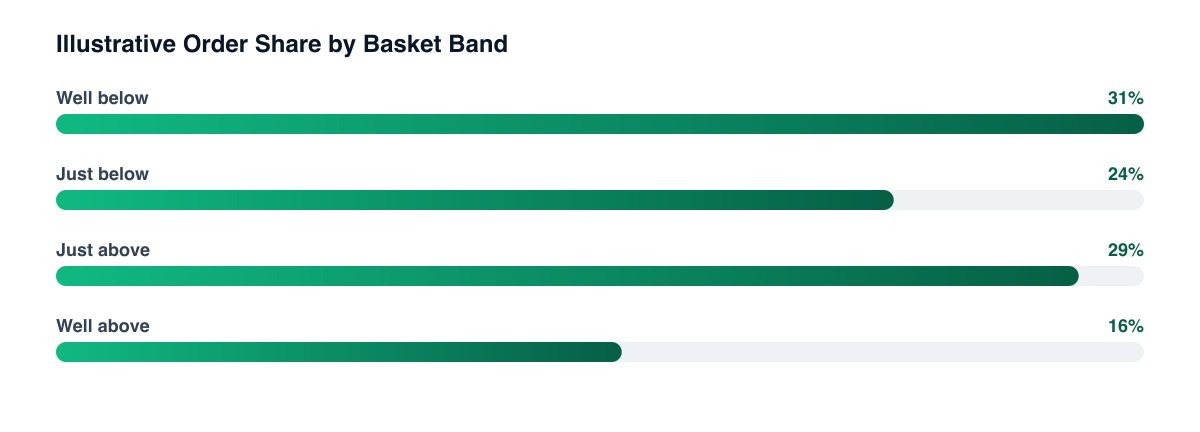
The net effect depends entirely on the shape of your order value distribution, not on the average. Two brands with identical AOV can need thresholds far apart, because one has a tight distribution around the average and the other has two clusters either side of it.
How do you find the right number?
Start with the histogram, not the mean. Pull order values into bands and look for where the mass actually sits:
- Find the cluster. If most orders land between two price points, the threshold belongs just above the top of that cluster — close enough that one more item clears it.
- Check the gap. The distance a customer has to travel matters more than the threshold itself. A shopper 15% short will usually add; a shopper 60% short will abandon or pay.
- Price the second item. The threshold is only reachable if you sell something at the right increment. If your cheapest add-on is a large fraction of the threshold, the maths doesn't work for the customer and won't work for you.
- Model the margin, not the AOV. A higher threshold that lifts AOV while cutting order count can be worse in absolute contribution. Judge the change on total margin, not the vanity metric.
The honest caveat: this is a test, not a calculation. The distribution tells you which two numbers are worth testing against each other — the test tells you which one wins. Structure it the way you'd structure any conversion test, with enough traffic to separate the effect from noise.
Does progress messaging change the answer?
Substantially. A cart that says how far the customer is from free shipping converts differently from one that only reveals the shortfall at checkout. The progress indicator turns a hidden condition into a goal, and goals get pursued.
That has a design consequence: if you run a threshold, it needs to be visible from the product page onward, not disclosed in the final step. Late disclosure of any cost is among the most reliable causes of cart abandonment there is, and a threshold the customer learns about at checkout is exactly that.
A threshold customers can't see is a shipping charge If the free shipping condition isn't communicated before the cart, you're getting the conversion cost of a shipping fee without the basket-size benefit of a threshold.
When is the answer no threshold at all?
More often than the advice usually admits. Brands with a narrow product range and few natural add-ons have nothing for the customer to add, so the threshold only ever functions as a penalty. Brands with a strong subscription or replenishment motion often do better making shipping free unconditionally and pricing it into the product — the subscription model absorbs it more cleanly than a one-off basket does.
And in categories where every competitor ships free with no minimum, a threshold is a visible disadvantage at the exact moment of comparison. That's a positioning decision more than a margin one.
Related guides
- How to Reduce Cart Abandonment on Shopify
- Checkout Optimization for Shopify: Recovering Revenue at the Last Step
- Post-Purchase Upsells on Shopify That Don't Annoy Customers
- Shopify CRO Tests Worth Running First
The threshold deserves the same scrutiny as a price change, because that's what it is. Revisit it when your product mix or shipping costs move, and treat it as one of the first things to test in any Shopify CRO programme rather than a setting you configured once at launch.
PART OF OUR SERVICE
Shopify & CRO
PROOF FROM A CLIENT
+68% revenue per visitor
without increasing ad spend · Health & Wellness
How a Health Brand Lifted Revenue Per Visitor by 68%→Want a free marketing audit?
We'll review your tracking, ad accounts, and funnel — and show you exactly where the gaps are.
Get Your Free Audit →