
Subscription revenue is the most valuable kind of D2C revenue. A customer paying $45/month is worth more than a customer who buys a $90 product once — not just because of the dollar amount, but because of the predictability, the data richness, and the marketing efficiency that comes with it. CAC is incurred once; LTV compounds every billing cycle. That's the theory. The problem is that most D2C subscription programs lose 30–50% of their subscriber base in the first three months, before the economics get anywhere near the math on the pitch deck. This is how to build one that doesn't. The retention and churn figures throughout come from subscription accounts we've audited, so read them as what we've observed rather than category-wide averages.
Why do D2C subscriptions fail early?
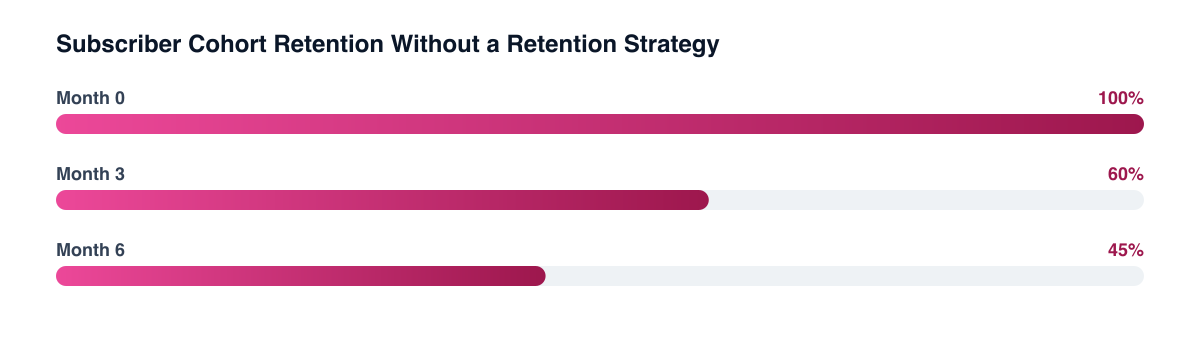
The failure pattern is consistent enough that you can predict it from the offer structure alone. A brand runs a "subscribe and save" mechanic — typically 10–15% off on auto-replenishment — and sees strong initial take rates. Sign-ups look great in month one. By month three, churn has eaten the cohort down to 60% of original subscribers. By month six, 45%. The brand has spent its performance marketing budget acquiring subscribers, not customers, and the unit economics collapse.
The root cause is almost always the same: the subscription was designed to capture revenue, not to deliver ongoing value. A discount on auto-replenishment is not a reason to stay subscribed — it's a reason to sign up. Those are different things. Customers who subscribe for a discount will cancel the moment the discount value no longer exceeds the perceived cost of staying (the mental overhead of another charge, the product sitting unused in a cabinet, the friction of the cancellation flow). Without a durable reason to keep the subscription active, churn is structural.
The second failure mode is mis-matched replenishment cadence. Selling a 90-day supply on a 30-day subscription cycle means customers are always accumulating product. When the cabinet fills up, they pause. Pauses become cancellations. The correct cadence depends on actual consumption rates, which most brands have never measured directly. Running a post-purchase survey asking "how long did your last order last?" is a low-investment fix for a high-cost problem.
What makes a subscription worth keeping?
A subscription worth keeping delivers something the customer can't replicate through single purchases at will. That value proposition takes a few forms:
Exclusive access. Subscribers get products, formulations, or drops before they're available to non-subscribers. This is particularly effective for brands with limited-run products or seasonal collections. The subscriber identity becomes about being first — which is a stronger retention driver than saving money.
Personalization that improves over time. Each delivery is better calibrated to the customer's preferences than the last because the brand has learned more about them. Beauty, nutrition, and pet brands execute this well: a subscription that asks three questions at sign-up and uses the answers to customize each box creates an experience that feels genuinely superior to buying off the shelf.
Curation. The subscription makes a decision on the customer's behalf that they find valuable — saves them from having to choose, research, or think. This works for commodity replenishment (razors, supplements, household supplies) where the value is the absence of friction, not a premium product experience.
Community and status. Subscribers are identified as a higher tier — they get access to a private Slack, early sale windows, direct lines to founders or product teams. The subscription becomes an identity marker rather than a convenience mechanic.
Most brands default to the savings mechanic because it's easy to model and easy to communicate. It's also the weakest retention driver. Discount-motivated subscribers are the first to cancel when a competitor runs a sale.
How do you structure the offer?
The subscription offer has three variables: the cadence, the discount, and the commitment structure. Getting these right is the difference between a subscriber cohort that pays back acquisition cost and one that doesn't.
Cadence should match consumption. For a product with a natural 30-day use cycle, a 30-day subscription is obvious. For anything less predictable, offer cadence choice at sign-up — every 30, 45, or 60 days — and let customers adjust after first delivery based on how fast they're consuming. Brands that give subscribers control over cadence see 20–30% lower pause and skip rates.
Discount structure. The discount needs to be meaningful enough to justify the commitment but not so deep that you acquire unprofitable subscribers. A 15% subscribe-and-save discount on a product with 60% gross margins is sustainable. A 25% discount on a product with 40% margins is not, especially accounting for subscription platform fees (typically 1–2% of subscription revenue), churn, and reactivation costs. The calculation most brands skip: what is the average subscriber's total payment before they churn, and does that cover CAC plus COGS plus platform costs? Run the cohort math before you set the discount rate.
Commitment structure. Prepaid subscriptions (customers pay for 3 or 6 months upfront, often at a deeper discount) dramatically reduce churn and improve cash flow at the cost of a harder conversion. A hybrid model — free first month, then auto-renewing — can work for high-confidence categories but increases payment failure risk. For most brands, month-to-month with easy management tools and strong onboarding is the right starting structure.
What's the onboarding sequence?
The 30-day window after first subscription is the highest-risk period for churn, and most brands do nothing meaningful during it. A subscriber who has no interaction with the brand between sign-up and first charge is far more likely to cancel than one who has been reminded why they subscribed.
A proper onboarding sequence looks like this:
Day 0 (Sign-up): Confirmation email that reinforces the value proposition — not just "your subscription is confirmed" but a reminder of what they're going to get and why it's good. Include the next delivery date prominently.
Day 2: Welcome email introducing the full subscriber experience — how to manage delivery cadence, how to access any exclusive benefits, how to contact support. Make the subscription feel like something they've joined, not a transaction they've initiated.
Day 7: Content email tied to their product category — a guide, a tip, a recipe, a routine. The goal is to use the product actively, not just receive it. A supplement brand sending a guide to building the habit of taking the supplement daily is reducing churn, not just sending content.
Day 14: Social proof — customer results, before/afters, reviews from subscribers who've been with the program 6+ months. This is the moment when second thoughts start emerging and the best defense is evidence that staying works.
Day 28 (Pre-billing): "Your next order ships in 3 days" notification with a link to manage the order — skip, swap a product, change the quantity, update the delivery date. Giving subscribers control over the upcoming order dramatically reduces cancellation-in-response-to-unwanted-charge. A subscriber who skips an order is not a lost subscriber. A subscriber who cancels because they felt trapped is.
How do you manage the subscriber relationship after onboarding?
The brands with the highest long-term retention treat their subscriber list as a distinct segment with a distinct content and engagement strategy — not as a subset of their email list that gets the same campaigns as everyone else.
Subscribers know more about the brand, have committed more to it, and have different questions than first-time customers. They're asking: am I still getting value from this? Is this product still right for me? What else is happening that I should know about? The content and communication that answers those questions — progress updates, new product previews, how-to content specific to long-term users — is retention content. It's different from acquisition content, which most brands produce almost exclusively.
Loyalty data matters here. Klaviyo's predictive analytics, or a custom model in your data warehouse, can score each subscriber on churn probability based on their engagement signals: email open rate, site visit frequency, order skip history, and time since last product review or engagement. A subscriber with declining engagement signals who hasn't visited the site in 45 days is a save target. Catching them with a proactive check-in or a "we noticed you haven't been as active" campaign before they cancel is significantly more efficient than a win-back campaign after they've churned.
Our CRM and retention work consistently shows that the gap between high-retention and low-retention subscription programs is almost entirely in the post-purchase communication strategy, not the initial offer structure.
Why do most brands leave retention money in the cancellation flow?
The cancellation flow is the most consistently underdeveloped part of a subscription program and one of the highest-ROI Shopify CRO opportunities available. Most brands have a cancellation confirmation page and nothing else. The brands that have invested in it recover 20–40% of would-be cancellations before they complete.
The structure that works:
Cancellation survey first. Before showing any retention offer, ask why they're cancelling. The options matter: too expensive, product sitting unused, didn't see results, found something better, not using it anymore, financial reasons. The reason they select determines the save offer you show them.
Reason-matched retention offers. A subscriber cancelling because they "have too much product" should be offered a skip or pause, not a discount. One cancelling because it's "too expensive" should be offered a downgrade option or a loyalty discount. One cancelling because they "didn't see results" should be shown a results guide and offered a check-in with customer success. The generic 10%-off-to-stay offer converts at 8–12%. Reason-matched offers convert at 18–30%.
Pause as an alternative to cancel. "Pause your subscription for 30/60/90 days" converts a meaningful percentage of cancellations that would otherwise be permanent. Subscribers who pause return at 35–50% rates. Subscribers who cancel outright return at 8–15% rates.
The final confirmation page. After a cancellation is confirmed, the only goal is to keep the relationship warm. A clean, non-resentful cancellation confirmation — "we're sorry to see you go, your discount code is still active, come back when you're ready" — is better brand building than guilt-tripping. Win-back campaigns for recently cancelled subscribers outperform those targeting subscribers who left more than 6 months ago.
What metric stack tells you if it's working?
Subscription health metrics to track Month-1 churn rate: % of new subscribers who cancel before their second billing cycle. Target: below 15% 90-day retention: % of subscribers still active 90 days after sign-up. Benchmark: 65–75% for a healthy program Average subscriber lifetime (months): should be well above the CAC payback period MRR (monthly recurring revenue): lagging indicator, but the one the business cares about Save rate: % of would-be cancellations recovered by the cancellation flow. Target: 20%+ Pause rate vs. cancel rate: high pause rate is a leading indicator of healthy retention; high cancel rate suggests structural problems with perceived value
Related guides
- D2C Retention Marketing: Email, SMS, and Owned Channels That Drive Repeat Revenue
- D2C Retention: How to Turn One-Time Buyers into Loyal Customers
- How to Build Klaviyo Email Flows That Actually Convert
- Customer Lifetime Value: The Metric That Should Drive Every Marketing Decision
The brands that get subscription economics right aren't smarter about discounts — they're more intentional about the post-purchase experience. The subscription itself is the beginning of the relationship, not the outcome.
"The subscription itself is the beginning of the relationship, not the outcome."
— Nitesh Kasma, Co-Founder — Brand Strategy & Client Growth
PART OF OUR SERVICE
CRM & Retention
PROOF FROM A CLIENT
+45% repeat purchase rate
from 22% to 32% of customers purchasing again within 90 days · Beauty & Personal Care
How a Beauty D2C Brand Lifted Repeat Purchase Rate by 45% with a Loyalty Program Rebuild→Want a free marketing audit?
We'll review your tracking, ad accounts, and funnel — and show you exactly where the gaps are.
Get Your Free Audit →