
Ask why the budget resets on the first of the month and the honest answer is that finance reports monthly. Nothing about how ad platforms learn, or how customers buy, has any relationship to that boundary.
"Learning phases don't reset on the first of the month, but most media plans behave as though they do."
— Dhruvit Shah, Co-Founder — Performance Marketing & Growth Strategy
What does bad pacing actually do?
Three specific things, all of which show up as performance problems attributed to something else.
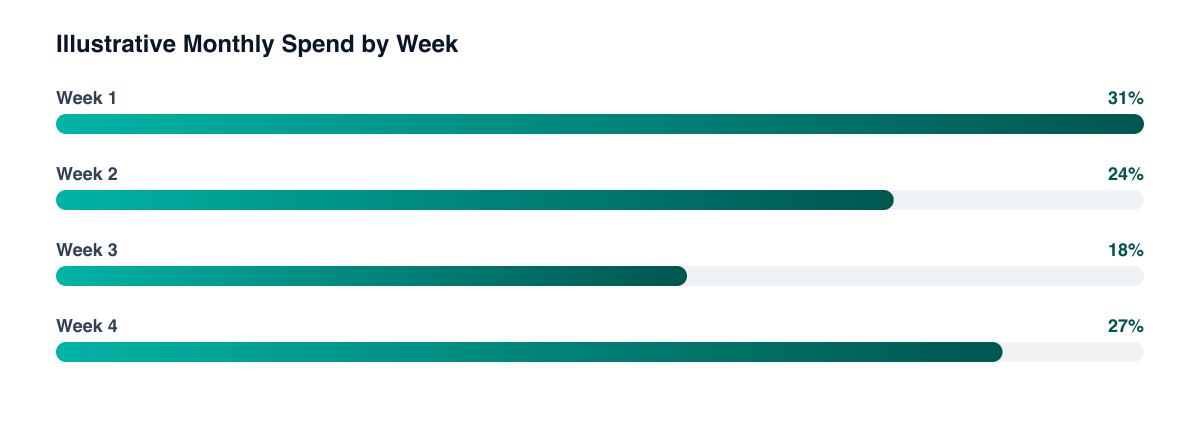
It resets learning. Sharp budget changes push campaigns back into a learning state, during which delivery is less efficient and results are less reliable. A monthly cycle that ends with a throttle and begins with a surge does this twelve times a year.
It buys the wrong inventory. Spending hard in the last three days of a month means buying whatever is available at whatever it costs, against every other advertiser doing the same thing for the same reason.
And it corrupts your reads. A test that spans a pacing cliff isn't a test — half the period ran under different delivery conditions, which is enough to produce a false winner and a wrong decision about creative or channel.
What should the cadence be instead?
Rolling, and tied to demand rather than to the calendar. In practice:
- Set a daily budget you can sustain, and treat the monthly figure as a reporting total rather than an allocation to be consumed.
- Change budgets gradually. Meaningful step changes destabilise delivery; incremental adjustments on a weekly rhythm rarely do.
- Reserve a flex pool — a fixed share held outside the daily plan for genuine demand signals, not for end-of-month catch-up.
- Pace against demand seasonality, which for most D2C brands is weekly and event-driven, not monthly.
The one legitimate exception is a hard-dated event — a sale, a launch, a festive peak — where concentrated spend is the point. Those should be planned as their own budget, not absorbed into the monthly line where they distort the baseline.
Never end a test on the last day of the month If the reporting period and the pacing cycle share a boundary, every test result carries a pacing artefact you can't separate out. Offset the test window deliberately.
Should you let the platform pace for you?
Partly. Campaign-level budget optimisation handles intra-campaign distribution better than manual splits do, and the CBO versus manual argument is largely settled in its favour for delivery efficiency. What it doesn't do is decide how much total budget the channel deserves, or protect a strategic allocation you want maintained regardless of short-term efficiency.
That distinction is the useful one: automate distribution within a channel, keep allocation between channels as a human decision informed by incrementality work rather than by platform-reported ROAS. Platforms optimise for their own reported outcome, which is not the same as your contribution margin.
How do you get finance to agree?
By separating the two calendars explicitly. Finance needs a monthly number for reporting and cash planning; media needs a stable daily rate. Those are compatible as long as the monthly figure is a forecast with a tolerance band rather than a cap enforced on the 28th.
Bring marketing mix modelling or a simple contribution model into that conversation if you have one — the argument for smooth pacing is much easier to make when the cost of the sawtooth is quantified rather than asserted.
Related guides
- Marketing Budget Allocation for D2C Brands
- How to Scale Ad Budgets Without Killing Performance
- Campaign Budget Optimization vs. Manual Budgets
- ROAS and Attribution: The Number That Lies Most Often
Pacing is invisible until you plot it, and then it explains a surprising share of month-to-month variance. Smooth the daily rate, offset your test windows, and keep the calendar for reporting — it's one of the least glamorous and most reliable improvements available in performance marketing.
PART OF OUR SERVICE
Performance Marketing
PROOF FROM A CLIENT
21% sales growth
measured against the pre-engagement baseline · Fashion & Apparel
How Sockscarving Grew Sales 21% and Lifted Conversion Rate 18%→Want a free marketing audit?
We'll review your tracking, ad accounts, and funnel — and show you exactly where the gaps are.
Get Your Free Audit →