

Every attribution model — last-click, multi-touch, even data-driven — shares one blind spot: it can only credit channels for touchpoints it can see. It has no way of knowing whether that sale would have happened anyway. Marketing mix modeling (MMM) answers a different question entirely: not "which touchpoint gets credit," but "how much revenue actually moves when spend on this channel moves."
Why does attribution keep overstating paid channels?
Attribution models — including the ones built into ad platforms — are structurally biased toward crediting whichever channel touches a customer closest to purchase. Retargeting and branded search almost always look like the highest-ROI channels in a platform dashboard because they intercept people who were already going to buy. That doesn't mean the spend was wasted, but it does mean the reported return is inflated by demand the channel didn't create.
This bias compounds as cookie and device-level tracking keeps degrading. Every platform is reporting on a shrinking, self-selected slice of the customer journey, and every platform tends to grade its own homework generously.
The tell If your platforms' reported ROAS added together implies more revenue than your total store revenue, you're not looking at incrementality — you're looking at overlapping credit claims. This is normal, and it's exactly the gap MMM is built to close.
What does MMM actually measure?
MMM is a regression-based approach: it takes weekly or monthly spend by channel, along with other revenue drivers (seasonality, price changes, promotions), and statistically estimates how much of total revenue each input actually explains — independent of who gets last-touch credit. Because it works on aggregate, channel-level data instead of individual user journeys, it isn't affected by tracking loss, ad blockers, or platform walled gardens.
The output that matters most is the incremental contribution of each channel — how much revenue actually disappears if that channel's spend goes to zero — compared against what platform attribution claims:
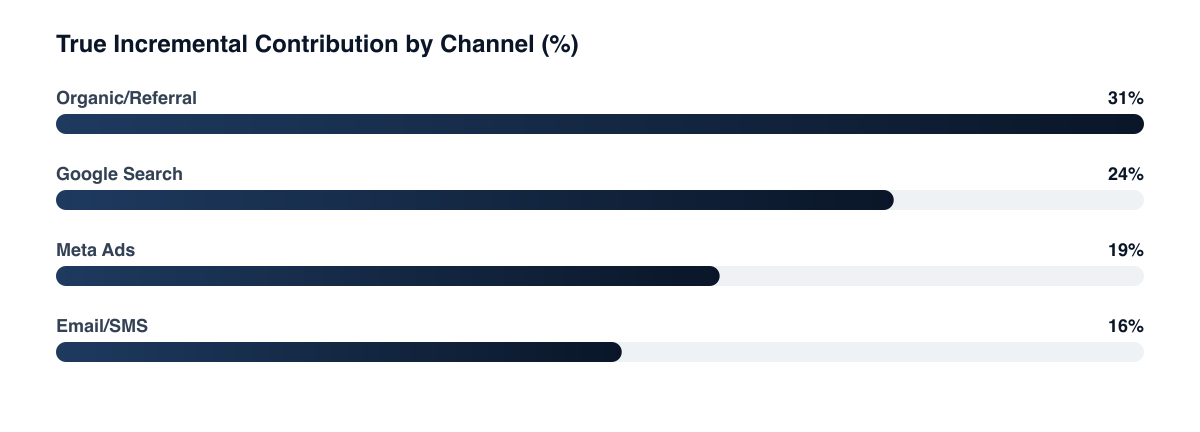
The pattern above is close to typical: organic and referral demand is usually undercredited by attribution (it shows up as "direct" or gets swept into whichever paid channel touched last), while paid social frequently gets more credit than its incremental contribution justifies.
How do you build a lightweight version without a data science team?
A full Bayesian MMM is overkill for most D2C brands under eight figures in revenue. A simplified version gets you most of the decision-making value:
- Pull 12+ months of weekly data — spend by channel, total revenue, and known confounders (promotions, price changes, seasonality, stockouts).
- Run a multiple regression of revenue against channel spend and the confounders. Even a spreadsheet regression gets you directionally useful coefficients.
- Validate with holdout or geo-lift tests — pause or cut spend in one channel or region for 2–4 weeks and compare actual revenue against the model's prediction. This is the step most brands skip, and it's the one that tells you whether the model is trustworthy.
- Re-run quarterly, not continuously. MMM coefficients shift slowly; monthly re-runs mostly add noise.
What this replaces, and what it doesn't MMM doesn't replace platform attribution for day-to-day budget pacing — it's too slow and too aggregate for that. It replaces attribution as the source of truth for quarterly budget allocation decisions, where being directionally right about incrementality matters more than being precisely wrong about last-touch credit.
Where should MMM and attribution agree, and what do you do when they don't?
The two methods measure different things, so they won't match exactly — but large, persistent gaps are informative. A channel that platform attribution loves but MMM shows near-zero incremental lift is a strong candidate for a controlled spend-down test before the next budget cycle. A channel MMM likes that attribution undercredits (organic content, referral, brand-building channels like YouTube or podcasts) is a case for protecting or growing budget even though the dashboard ROAS looks unremarkable.
The brands that get this wrong in both directions: cutting the channels attribution undercredits because the dashboard looks weak, and over-funding the channels attribution overcredits because the dashboard looks strong. MMM exists specifically to catch that mistake before a whole budget cycle is spent making it.
Related guides
- Attribution Modeling 101: Why Last Click Is Killing Your Growth
- Why Your ROAS Is Lying to You (And How to Fix It)
- D2C Analytics and Attribution: The Complete Guide to Measuring What Actually Works
- First-Party Data Strategy for D2C Brands
Attribution answers "who touched this customer last." MMM answers "what would happen to revenue if this spend disappeared."
"Attribution answers 'who touched this customer last.' MMM answers 'what would happen to revenue if this spend disappeared.'"
— Aashish Kasma, Co-Founder — Data & Analytics
Brands making eight-figure budget decisions off the first question alone are optimizing for a number that was never designed to guide that decision. Knowing which question a model can actually answer is the first piece of data and analytics work worth paying for — everything downstream inherits that choice.
PART OF OUR SERVICE
Data & Analytics
Want a free marketing audit?
We'll review your tracking, ad accounts, and funnel — and show you exactly where the gaps are.
Get Your Free Audit →